Can a Jump Starter Damage the Battery or the Car's Electrical System?
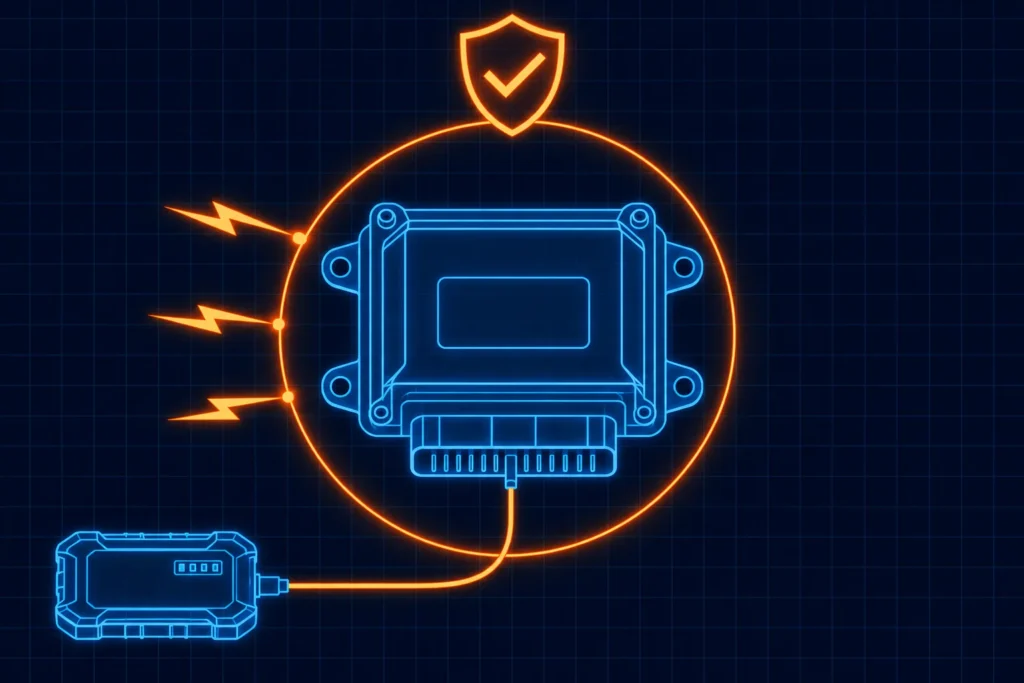
Short answer: Used correctly on a healthy 12 volt system, a jump starter with its protections is designed not to damage the battery or the car’s electrical system, and the makers we read say so. The risks that remain are a wrong connection, switching off the protections with an override button, trying to jump a frozen or damaged battery, using the wrong voltage and ignoring the vehicle manual. We found no independent lab test that confirms any maker’s protection, so treat the protections as a safeguard, not a guarantee.
This page is about damage. The steps are in How to Jump Start a Car, the brand-by-brand limits are in How to Use a Jump Starter Safely, and the comparison with cables is in Jump Starter or Jumper Cables.
What a Jump Starter Does to Your Battery
A jump starter sends a short, strong burst of current to the starter motor. It does not repair a weak battery and it is not a charger. After the engine runs, the alternator takes over.
The battery itself is more likely to be harmed by what happened before the jump than by the jump. Interstate Batteries says that leaving a battery drained, even for a few hours, can leave permanent damage because of sulfation, which is a build-up of lead sulfate on the plates. It also says heat above about 90 degrees Fahrenheit causes internal corrosion that permanently shortens a battery’s life. A battery in that state may start the car after a jump and fail again within days. That is not damage from the jump starter. It is a battery near the end of its life, and the lesson is to have it tested. See Why Does a Car Battery Die?.
Two conditions matter for the jump itself:
- A frozen battery. Interstate says that if a battery freezes solid, you should not jump-start it and should get help. The NOCO GBX155 guide also says not to jump-start a damaged or frozen battery.
- The wrong battery type. The GBX155 guide says the unit is for 12 volt lead-acid batteries only. NOCO’s GB40 data sheet lists wet, gel, MF, EFB and AGM. Use the unit only on a type its maker lists.
What a Jump Starter Does to the Wiring and the Electronics
A car’s electrical system is protected by fuses and, in many cars, fusible links. Jalopnik describes them as designed to blow first when a connection is wrong. The risk to the wiring and the electronics comes from a wrong connection, not from the jump itself.
Reversed clamps. If the red clamp is on the negative terminal and the black on the positive, the circuit is reversed. Jalopnik lists what it says can follow: fuses and fusible links blow, the alternator may be damaged, the engine control module could be damaged, the cables could catch fire, and a battery could explode. The article cites no manufacturer or expert, so these are warnings about what can happen, not figures. Jalopnik also notes that vehicle fuses are meant to protect other parts, and that a severe reversal can damage components before a fuse reacts.
A short circuit. If the clamps touch each other or a metal part while connected, current flows where it should not. The GBX155 guide says to keep the clamps apart.
A spark near the battery. AAA says that connecting the last black cable to the dead battery’s negative terminal, instead of bare metal on the engine block, can cause a spark and an explosion. This is a risk of the connection method, with cables.
Voltage and modern systems. Some articles say that jump starting can send a surge through sensitive electronics, in particular through start-stop systems and driver-assistance modules. Jalopnik mentions reports of damaged start/stop systems, traction control, power steering and airbag systems, without naming them. We found no controlled study, and the strongest wording in the sources comes from companies that sell jump starters or battery testers. We do not rely on a number. What the sources share is that the owner’s manual is the authority and that a correct jump is generally considered safe.
What the Protections Do, and What They Do Not
The units we cover list protection against reversed clamps and short circuits. Several list spark-proof clamps. Makers describe the idea simply: the unit checks the connection before it lets current flow. NOCO calls its version UltraSafe, and the GOOLOO A3 listing names ten protections. The A3 shows a solid green light when the connection is right.
These protections matter, and they have limits:
- They are claims. In the documents we read, no maker explains how its protections were tested, and we found no independent test or standards certification that confirms them. Some marketing says a unit guarantees zero damage. That is a sales statement, not a test result.
- They can be turned off. On NOCO units, the guides say manual override switches off the spark-proof and reverse polarity protection. The GBX155 guide says manual mode disables all safety measures and the 60 second timeout, and that misuse can cause injury or death. With the checks off, nothing stops a wrong connection.
- They do not read your manual. A unit cannot know that your vehicle restricts jump starting, or that the battery is in the trunk and the jump posts are under the hood.
- They do not fix a bad battery or a failed starter.
What Vehicle Makers Say
Some vehicle manuals are strict. Jalopnik quotes a Kia manual that says not to jump-start another vehicle with the hybrid, and a Tesla Model 3 manual that says the car cannot be used to jump-start another vehicle and that doing so can result in damage. Those quotations are about using the vehicle as the donor. They show that manuals carry vehicle-specific rules that no jump starter can know. Hybrids and electric vehicles also have a high-voltage battery, which a jump starter should never be connected to. Many have a 12 volt auxiliary battery, but this is not universal, and low-voltage designs and approved external-power procedures vary by vehicle, model year and battery configuration. The article advises staying away from high-voltage components.
Jalopnik also advises using remote terminal posts instead of the battery in cars that have them, and says this protects the car’s computers and avoids interfering with battery monitors on the negative terminal.
How to Keep the Risk Low
- Read your owner’s manual and your unit’s manual before you need them.
- Use a unit made for your battery’s voltage and type.
- Connect correctly. Red to positive. Black to the place your manual names.
- Wait for the connection signal if your unit has one, and do not press boost or override first.
- Do not jump a frozen or damaged battery.
- Respect the start limits and let the unit cool.
- Keep the unit charged and inside its temperature limits. The A3 manual warns that cells may be damaged above 60 degrees Celsius.
- Replace a battery that keeps dying instead of jumping it every morning.
What We Do Not Know
- How often damage happens. We found no statistics.
- Whether any maker’s protection works as described in every case. No independent test.
- What a given vehicle’s electronics tolerate. Your manual and a qualified mechanic know.
Frequently Asked Questions
Can a jump starter ruin my battery?
A jump starter can start an engine on a weak battery, but it does not repair one. A battery that was already drained for a long time or has aged may fail soon after. That is a battery problem. Do not jump a frozen battery.
Can a jump starter fry the ECU?
A reversed connection can damage fuses and, according to Jalopnik, may damage the alternator or the engine computer. The units we cover list reverse polarity protection, which is meant to prevent that, and we found no independent test of it.
Is it safe to use a jump starter on a new car?
Read the manual first. Some vehicles have jump posts or restrictions, and hybrids and electric vehicles have a high-voltage system that a jump starter should not touch.
Are the safety features enough?
They help, and they can be switched off by an override button. Connect correctly and use boost or override only as a last step.
What should I do if I connected it backwards?
Disconnect safely. Check the vehicle’s fuses and ask a mechanic if you see burnt wiring or smell burning, as Jalopnik advises.
The Bottom Line
A correctly used jump starter on a healthy 12 volt battery is designed not to harm it, and the real risks are a wrong connection, an override, a frozen or damaged battery and ignoring the manual. Treat the protections as a safeguard, connect carefully and check what your own vehicle manual says.
Sources
- Interstate Batteries, Why Your Car Battery Died (sulfation, heat, frozen battery): https://www.interstatebatteries.com/blog/why-did-my-car-battery-die
- Jalopnik, Connecting Car Batteries Backwards Can Have Shockingly Bad Results: https://www.jalopnik.com/2259971/connecting-car-batteries-backwards-consequences-shocking-bad-results-jump-starting/
- Jalopnik, Never Jump Start a Modern Car Without Checking For These Things First (Kia and Tesla manual quotations, remote posts, hybrids): https://www.jalopnik.com/2091386/never-jump-start-modern-car-without-checking-these-first/
- AAA Oregon/Idaho, Jump Starting Your Car Battery: A Safe and Easy Guide (spark warning): https://info.oregon.aaa.com/jump-starting-your-car-battery-a-safe-and-easy-guide/
- NOCO Boost X GBX155 User Guide, June 26, 2024 (override, timeout, battery type, frozen battery): https://no.co/media/wysiwyg/downloads/User_Guides/Boost_X/GBX155_User_Guide_06.26.2024.pdf
- NOCO GB40 data sheet, December 2024 (battery types): https://no.co/media/wysiwyg/downloads/brochures/Boost/GB40_Data_Sheet_12.05.2024.pdf
- Manual copies for the GOOLOO A3 (JS-506), WOLFBOX MegaVolt 24Air and WOLFBOX MegaVolt24 V1.0 on third-party hosts.