Jump Starter vs Battery Charger vs Battery Maintainer: Which One Solves Your Problem?
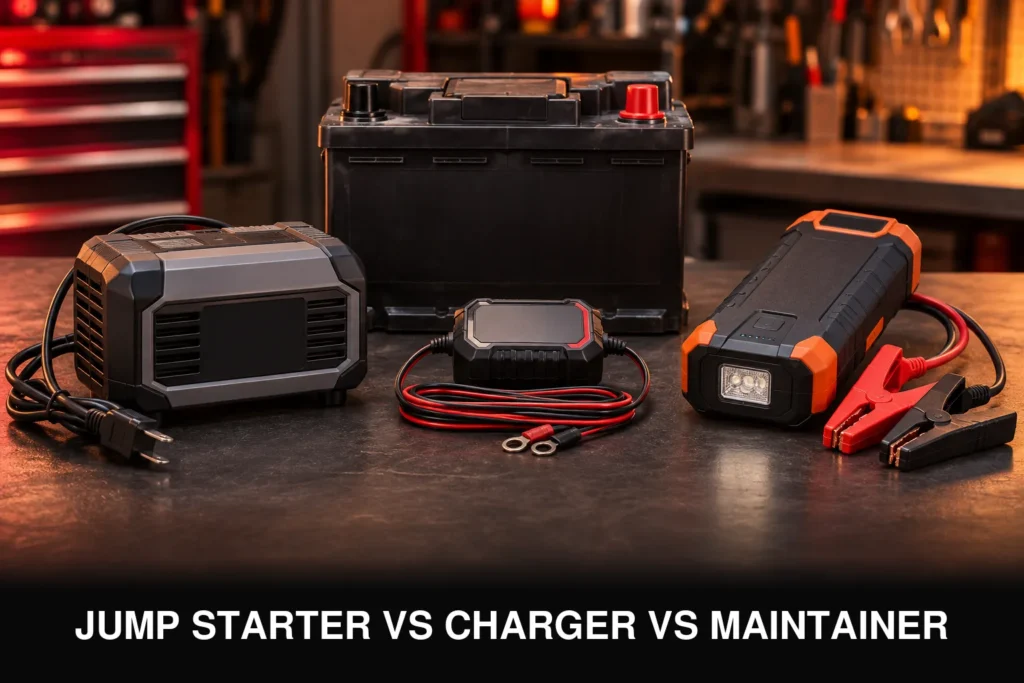
Quick answer: The three tools solve three different problems. A jump starter gives your engine a short, strong burst so a car with a weak battery can start now. A battery charger restores a battery slowly from a wall outlet, over hours. A battery maintainer keeps a healthy battery full while a vehicle sits, and can stay connected for long periods. A jump starter does not recharge the battery, a charger does not start a car in minutes, and a maintainer is not meant to revive a battery that is already flat. If you are stranded, you need the jump starter. If a car sits for weeks, you need the maintainer. If the battery is flat and you are at home, you need the charger.
Pick your situation
- My car will not start and I am not at home: read “The Stranded Driver”.
- My car sits for weeks or months: read “The Car That Sits”.
- My battery is flat but I have a garage and time: read “The Flat Battery at Home”.
- I do not know what a trickle charger is: read “Charger, Trickle Charger, Maintainer”.
- I want to know whether a jump starter can replace cables: that is a separate guide, Jump Starter or Jumper Cables.
Three Tools, Three Jobs
The jump starter. A portable lithium battery with cables, made to deliver a large current for a few seconds so the starter motor can turn the engine. Toolnerds, a tools review site, puts the difference this way: a jump starter provides the power to start the ignition, gets you moving again within minutes and does not recharge your battery. Once the engine runs, the car’s alternator takes over. The unit also has to be charged before you use it. How a jump starter works is in How a Lithium Jump Starter Works.
The battery charger. A device that plugs into a wall outlet and converts household power to the direct current a 12 volt battery needs. Toolnerds describes it as slow, with a steady flow of current, and says restoring a battery can take up to 24 hours. It is heavy compared with a jump starter and works only where there is mains power, such as a home or a garage. Many modern models are automatic and stop when the charge is complete.
The battery maintainer. A low-current, automatic charger that is meant to keep a good battery topped up while a vehicle or piece of equipment sits unused. The Drive describes the key behaviour: once the maintainer senses a full charge it goes into float mode and resumes charging only when the charge falls below the optimal level. That is why it can stay connected without the overcharging problem of older devices.
Side by Side
| Question | Jump starter | Battery charger | Battery maintainer |
|---|---|---|---|
| What problem does it solve? | A car that will not start right now | A battery that is discharged | A battery that should stay full during storage |
| How fast? | Minutes | Hours, up to about a day according to Toolnerds | Not a fast tool; it holds a charge rather than building one |
| Does it need a wall outlet to do its job? | No, but the unit needs charging beforehand | Yes | Yes |
| Does it recharge the car battery? | No | Yes | Keeps it topped up |
| Can it stay connected for long periods? | No, it is a short-use tool | Many are automatic and stop when full; read the manual | Yes, that is its purpose |
| Where is it used? | Anywhere | Home or garage | Home or garage |
| Does it need to be charged itself? | Yes, every few months in storage | No | No |
The recharge interval for jump starters comes from the maker documents we read for the units we cover, and it is explained in How to Store and Recharge a Jump Starter.
Charger, Trickle Charger, Maintainer
The words get mixed up in product listings, so the sources we read draw a line.
- A trickle charger sends a low, steady current, typically between one and three amps according to The Drive. The classic version keeps charging whether or not the battery is full, so leaving one connected indefinitely can damage a battery. Search summaries of several sources repeat the same warning about older trickle chargers.
- A maintainer, also called a float or smart charger, adds a control that switches to a float mode when the battery is full. This is the version meant for long storage.
- A standard charger is the tool for bringing a discharged battery back. One of the sources our search returned says that using a charger where you need a maintainer could damage the battery, while using a maintainer on a depleted battery will not do anything significant. That claim comes from a summary of a vendor-type page and we did not confirm it in a primary source, so treat it as general guidance and read the maker’s instructions for your device.
Many products combine functions, so the label on the box matters more than the word in the title. Look for what the device does when the battery is full.
The Stranded Driver
You are in a parking lot or on a road, the engine only clicks, and you have no outlet. A charger and a maintainer are no use here. A jump starter, or jumper cables and a second vehicle, are the options. The comparison of those two is in Jump Starter or Jumper Cables, and the step-by-step instructions are in How to Jump Start a Car.
A jump starter gets the engine going. It does not fix the cause. If the battery was left drained by a light, it may be fine after a drive. If the car needs a jump again within days, the problem is the battery or the charging system. See Why Does a Car Battery Die? and Signs Your Car Battery Is Failing.
The Car That Sits
A battery in a car that sits can lose charge over time. The causes are explained in Why Does a Car Battery Die?. A maintainer is made for this case: it holds a good battery at full while the car sits in a garage. A jump starter addresses the result, since a car that has sat too long may need a jump. The two do not replace each other.
- If you can reach an outlet where the car is parked, a maintainer prevents the problem, and a jump starter remains a backup.
- If the car is parked where there is no outlet, the jump starter is the realistic tool, and the unit itself must be kept charged.
- If you drive the car every week for a good distance, you may need neither. If it still struggles, test the battery.
Storage of the car itself is covered in the guide on classic and rarely driven cars: Jump Starter for Classic and Rarely Driven Cars.
The Flat Battery at Home
The battery is flat, the car is in the garage and nothing is urgent. A charger is the right tool: it restores the battery over hours and does not make the starter work hard against a weak battery. A jump starter would start the car, but it does not recharge the battery, and the battery would stay low until the car has been driven or charged. We did not find a primary source that sets a figure for how much driving that takes, so we make no claim about it.
If the battery will not take a charge, or goes flat again soon, it may be at the end of its life.
Can One Tool Replace the Others?
Short answers, from the sources we read:
- A jump starter cannot replace a charger. It does not recharge the car battery.
- A charger cannot replace a jump starter on the road, because it needs mains power and takes hours.
- A maintainer cannot replace either one for an emergency, because it is built to hold a charge.
Some products combine a charger or a maintainer with a jump function. We cover jump starters in this guide and do not rate those combined devices.
Battery Type Matters
Most cars use a lead-acid battery in one of three forms: flooded, enhanced flooded (EFB) or absorbent glass mat (AGM). The charging profile some chargers use is made for one form and not for another. We did not read a source that settles which charger suits which type, so check the battery’s and the charger’s documents. The types are explained in Car Battery Types Explained.
A jump starter is not charging the battery in the same sense, and the units we cover are specified for 12 volt lead-acid batteries. The NOCO GBX155 guide says it is for 12 volt lead-acid batteries only.
What We Cannot Tell You
- Which charger or maintainer to buy. This guide compares tool types. We do not rate chargers or maintainers.
- How long a charger needs for your battery. It depends on the battery’s size, its state and the charger’s output. The up-to-24-hours figure is a general statement from one source.
- Whether a trickle charger will damage your battery. The sources say older models can. A modern device with a float mode is built to avoid it, and the device’s manual decides.
- Anything about hybrids and electric vehicles. Their low-voltage battery and jump-start rules depend on the vehicle. See Jump Starting a Hybrid or Electric Vehicle.
- We do not claim to have run our own measurements on any device.
Frequently Asked Questions
Can a jump starter charge my car battery?
No. A jump starter gives a short burst to start the engine. Toolnerds says a jump starter will not recharge your battery. The alternator charges the battery while you drive, and a charger does it from the wall.
Can a battery charger start my car?
Not quickly. A charger restores a battery over hours. If the battery is flat enough that the car will not start, you either wait for the charger or use a jump starter or cables.
What is the difference between a trickle charger and a battery maintainer?
A trickle charger supplies a low, steady current. A maintainer also switches to a float mode when the battery is full, which makes it suitable for long storage, according to The Drive.
Is it safe to leave a battery maintainer connected all winter?
That is what a maintainer is made for, according to the sources we read. A basic trickle charger needs watching. Follow the instructions of your device.
Do I need a jump starter if I own a maintainer?
A maintainer keeps a battery full at a place with an outlet. It does nothing when the car is somewhere else or when the battery fails. Many owners carry both for that reason.
Which one is better for a car that I drive daily?
Neither is needed if the car starts every day. A jump starter is the sensible backup for the day it does not. A battery that is failing needs a test, as in Signs Your Car Battery Is Failing.
The Bottom Line
Match the tool to the problem. The jump starter is for starting a car that will not start, now, wherever you are. The charger is for restoring a flat battery when you have time and power. The maintainer is for keeping a good battery full while a vehicle sits. They are not substitutes, and each of the sources we read treats them as different tools. If you must choose one for the road, choose the jump starter and keep it charged.
Sources and How We Checked
We compare tool types and recommend no specific charger or maintainer. We do not claim to have run our own measurements.
- Toolnerds, Charger vs Jumper (what a charger and a jump starter do, up to 24 hours, a jump starter does not recharge a battery): https://www.toolnerds.com/charger-vs-jumper/
- The Drive, How Does a Trickle Charger Work? (one to three amps, float mode, overcharging risk of a classic trickle charger): https://www.thedrive.com/guides-and-gear/how-trickle-charger-work
- Search summaries on 2026-11-02 of vendor and enthusiast pages on maintainers and trickle chargers (including Battery Tender, CTEK, Renogy and Rick’s Free Auto Repair Advice) for the general distinction; the Battery Tender and CTEK pages could not be opened directly and are not relied on for specific claims.
- NOCO Boost X GBX155 User Guide, June 26, 2024 (12 volt lead-acid only): https://no.co/media/wysiwyg/downloads/User_Guides/Boost_X/GBX155_User_Guide_06.26.2024.pdf