Car Won't Start: Battery, Starter or Alternator? What the Symptoms and Sounds Mean
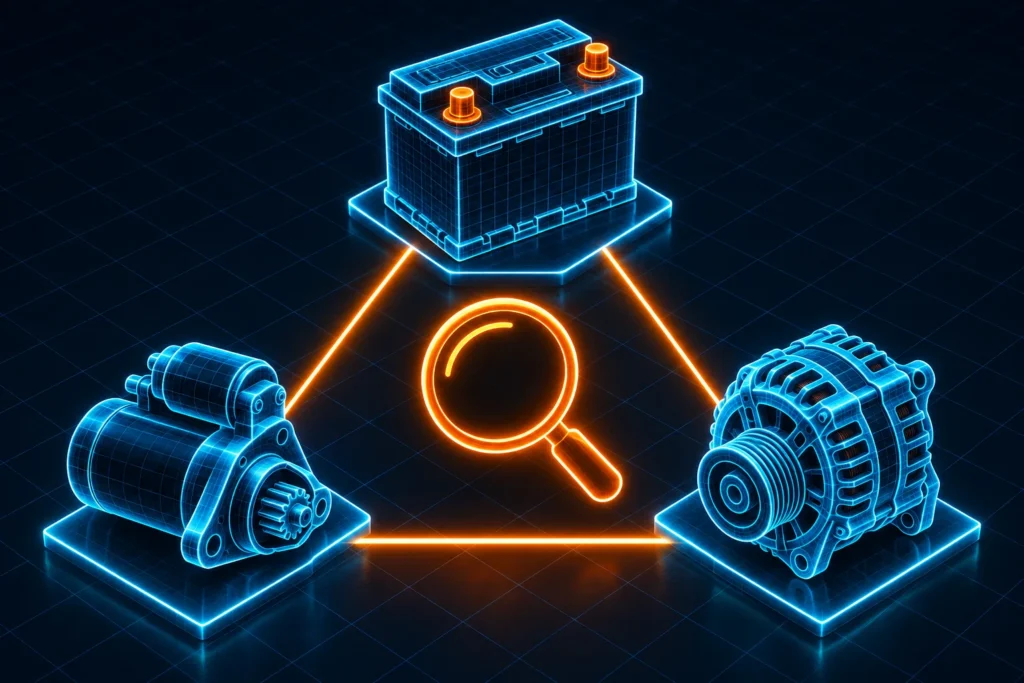
Short answer: Listen first. One loud click usually points to a dead battery. Rapid clicking points to a starter that gets power and cannot pass it on, or to a battery too weak to turn the engine. No sound with some electronics working may be a blown fuse. An engine that cranks and does not start is not a battery problem. A car that starts after a jump and then dies within minutes suggests the alternator. These are the readings that the sources we read give, and a technician can confirm them.
This page sorts the symptoms into the three parts: the battery, the starter and the alternator. How batteries die is in Why Does a Car Battery Die?. The warning signs of a weakening battery and how it is tested are in Signs Your Car Battery Is Failing. The steps for a jump are in How to Jump Start a Car.
What You Hear When You Turn the Key
Interstate Batteries lists these sounds and what each tends to mean.
| What you hear or see | What it usually points to | What Interstate advises |
|---|---|---|
| One loud click | A dead battery, or a starter not getting enough power | Do not keep turning the key past about 30 seconds |
| Rapid clicking | A starter that gets power but does not pass it to the engine | Stop trying, because repeated attempts can burn out the starter |
| No sound, only some electronics work | A likely blown fuse | Check the fuse box and have the cause diagnosed. Do not jump it |
| A strained, whirring noise, the engine cranks but does not start | A bad engine, body or power control module | Stop and see a repair shop. Starters are not made to run longer than about 30 seconds at a time |
| Dashboard lights fade or accessories act up | A nearly dead battery, a bad alternator or an ignition switch | Have the battery and the charging system tested |
| The car starts, then stalls | A failed ignition switch, which cuts power to the fuel system | Have it repaired |
| The engine sputters briefly | An empty tank, a clogged fuel filter or a bad fuel pump | Add fuel if the tank is empty, otherwise see a professional |
Two of the rows matter for this site. A single loud click and rapid clicking both involve the battery or the starter, and a jump will tell you which: a battery that was only flat will let the engine turn with the help of a jump starter. An engine that cranks well and does not start is not helped by a jump.
Battery or Alternator?
AAA Oregon/Idaho says to check the battery first, because it is the first step in the electrical process, and to investigate the alternator if the battery checks out or is relatively new.
Signs of a bad battery, according to AAA: clicking and stuttering before the engine turns over, trouble holding a charge especially after short drives or repeated jumps, dim or flickering lights, corrosion on the terminals, a rotten-egg smell or a swollen case, and a battery older than three to five years. A swollen case is a safety issue: AAA says to call a tow and not to handle it yourself.
Signs of a bad alternator, according to AAA: the car does not start with a jump, or starts and dies (AAA says it stalls within 10 to 15 minutes), lights that dim or brighten with engine speed, AM radio static, an engine whine or growl, a burning smell, and an alternator that is seven to 10 years old.
The dashboard battery light is not conclusive. AAA says the low-voltage icon can point to either the battery or the alternator.
Interstate gives voltage readings for the same question. A good battery should read more than 12.75 volts with the engine off, and about 14 volts while running. Readings that stay below 13.1 volts with the engine running point to an alternator problem, and lights that brighten or weaken with engine speed are a sign of a failing alternator. AAA gives about 12.6 volts for a normal battery with the engine off and 13 to 14.5 volts with the engine running as a sign that the alternator is charging. The two sources differ by a few tenths of a volt. Treat the numbers as rough guides, and have the test done with the right tool.
What a Jump Tells You
A jump is a test as well as a fix, if you do it correctly:
- The engine starts and keeps running. The battery was flat. Find out why: see Why Does a Car Battery Die?
- The engine starts and dies within minutes. AAA’s alternator signs include a car that starts and dies. Have the charging system tested.
- The engine does not start. Check the connections, the unit’s charge and its limits. If it still does not start, the problem may not be the battery. See Jump Starter Not Working: What to Check.
Things Not to Do
- Do not keep cranking. Interstate says starters are not designed to run for more than about 30 seconds at a time.
- Do not jump a car with a blown fuse or a suspected electrical fault. Interstate advises a diagnostic first.
- Do not handle a swollen or leaking battery. AAA advises calling for help.
- Do not replace the battery just because the car will not start. If the alternator or the starter is the cause, a new battery will be flat soon.
What We Do Not Say
We do not give a repair procedure. A mechanic or a reliable diagnostic can confirm the cause, and your owner’s manual describes the checks that are safe for you to do.
Frequently Asked Questions
What does a single click mean?
Interstate says one big loud click is the sign of a dead battery, and that one loud click can also mean the starter is not getting enough power.
What does rapid clicking mean?
The starter is getting power that is not reaching the engine, according to Interstate. A battery too weak to turn the engine can also click rapidly. Stop trying.
How do I tell a bad alternator from a bad battery?
Check the battery first. If it is fine or new, look at the alternator. A car that starts with a jump and then dies within minutes is a sign of the alternator.
Why does my car start but then die?
Interstate links it to a failed ignition switch and AAA links it to the alternator. Have it checked.
Can a jump starter fix a bad starter?
No. It supplies power. It does not repair a starter, an alternator or a fuse.
The Bottom Line
Listen to the click, note whether the lights stay bright and whether the engine cranks, and use a jump as a test. A flat battery starts with help. An engine that cranks, a blown fuse or a failing alternator are different problems, and a battery replacement will not fix them.
Sources
- Interstate Batteries, Why My Car Won’t Start If the Battery’s Still Good (sounds and symptoms, voltage readings, the 30 second limit): https://www.interstatebatteries.com/en-lx/blog/car-wont-start
- AAA Oregon/Idaho, Bad Alternator vs. Bad Battery: A Quick Guide (signs, stall window, voltage readings): https://info.oregon.aaa.com/bad-alternator-vs-bad-battery-a-quick-guide/