Jump Starter or Jumper Cables: Which Do You Need?
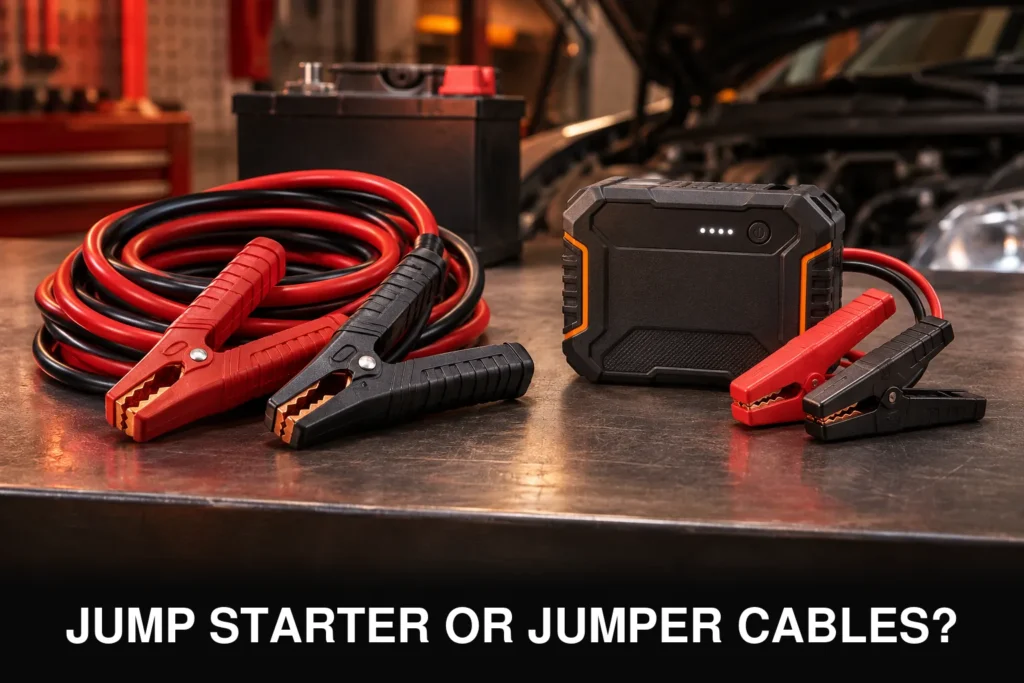
Quick answer: Jumper cables need a second running vehicle and a correct connection every time, and they cost you nothing to keep charged. A portable jump starter needs no second vehicle, has built-in protections against a wrong connection, and needs to be recharged every few months. Choose cables if you always have help nearby and never want another thing to maintain. Choose a jump starter if you drive alone, park where another car cannot reach, or want the lower chance of a connection mistake. Many drivers who care about being stranded carry the unit and still keep a set of cables as a backup.
Pick your situation
- I want the plain comparison: read “Side by Side”.
- I am worried about my car’s electronics: read “What Can Go Wrong With Each”.
- I want to know which one suits my life: go to “Which One for Which Driver”.
- I want the jump-starting steps themselves: this guide does not repeat them; see How to Jump Start a Car: Step by Step.
The Two Tools in One Paragraph Each
Jumper cables are two heavy cables with clamps. You connect them between your dead battery and the battery of a running vehicle, wait a few minutes and start your engine. The other vehicle supplies the power.
A portable jump starter is a lithium battery in a case with its own cables and clamps and a control board. You connect it to your battery and start the engine. No second vehicle is involved, and the unit has to be charged before you need it.
Neither tool repairs a bad battery or a failed starter. If you need a jump every few days, the problem is somewhere else, and the cause of a dead battery is its own subject. See Why Does a Car Battery Die?.
Side by Side
| Question | Jumper cables | Portable jump starter |
|---|---|---|
| Do you need another vehicle? | Yes, running and close enough for the cables to reach | No |
| Does it need charging? | No | Yes. The manuals we read ask for a recharge every three to six months |
| Wrong connection | Possible. The cables have no protection of their own | The units we cover list reverse polarity and short circuit protection |
| Works in a tight space | Only if the other car can park close | Yes |
| Sets of extras | None | Some units also charge phones and laptops, light your work area or inflate a tire |
| Limits | None printed on the cables | Start limits in the manual, for example three starts in a row or five in 15 minutes |
| Storage | No battery to protect | Temperature limits in the manual. Do not leave it in a hot car |
| Size and weight | A coiled cable set | From 1.65 pounds for the unit alone (the GB40, per NOCO) to about 5 pounds or more |
The limits in the table come from the maker documents we read, and the details differ by brand and revision. See How to Use a Jump Starter Safely for the model-by-model table.
What Can Go Wrong With Each
Jumper cables
AAA’s guidance for cables is specific. Park the vehicles so that they do not touch, turn off the ignition and the accessories in both, connect the red clamp to the positive terminal of the dead battery and then to the positive terminal of the good one, connect one black clamp to the negative terminal of the good battery, and connect the last black clamp to bare, unpainted metal on the dead vehicle’s engine block, not to its negative terminal. AAA warns that attaching that last clamp to the dead battery’s negative terminal can cause a spark and an explosion. The reason is that a battery gives off hydrogen, and a spark near it can ignite the gas. Midtronics, a maker of battery testers, says the same and adds that reversed polarity is easy to produce even for experienced technicians.
A reversed connection is the main risk. Jalopnik’s description of what happens is blunt: fuses and fusible links are designed to blow first, but the alternator may be damaged, the engine computer could be damaged, the cables could catch fire, and a battery could explode. These are consequences the article attributes to a reversed connection. The article cites no manufacturer or expert, so treat the list as a warning about what can happen, not as a rate.
A second concern is that a running donor vehicle and a dead battery connected together may expose electronics to a voltage surge. This claim appears in many articles, and most come from companies that sell jump starters or battery testers. We did not find an original measurement or a controlled study, and a forum thread we read argued that the voltage is the same either way. We do not rely on this claim. The safe position is the one that all the sources share: done correctly, a jump start is generally considered safe, and the owner’s manual is the authority for your vehicle.
Portable jump starters
A jump starter removes the donor vehicle. The units we cover list protection against reversed clamps and short circuits, and Midtronics says built-in safeties largely address the reverse polarity risk. A protection is still a claim: we found no independent lab test or standards certification that confirms any maker’s protection, and a manufacturer’s guarantee of zero damage is marketing, not a test result.
The risks that remain are different:
- A flat unit. A jump starter that has sat for months may not have enough charge. The A3 manual says its battery should show at least two bars before you jump a car, and manuals ask for a recharge every three to six months.
- Override and boost buttons. On NOCO units the guides say manual override disables the safety checks. The GBX155 guide warns that misuse can cause injury or death. The rules differ by brand, and How to Use a Jump Starter Safely explains them.
- Start limits and heat. The GBX155 guide allows five starts in 15 minutes, the GOOLOO A3 tutorial three in a row two minutes apart, and the 24Air eight in 10 minutes. Repeating a failed start does not help.
- Heat and cold. Do not leave a unit in a hot car. The A3 manual warns that above 60 degrees Celsius the cells may be damaged.
If a manual forbids jump starting for your vehicle, neither tool is the answer. Jalopnik quotes a Kia manual that says not to jump-start another vehicle with the hybrid, and a Tesla Model 3 manual that says the car cannot be used to jump-start another vehicle. Those quotations are about using the vehicle as a donor, not about jumping it, but they show why your own manual comes first.
Which One for Which Driver
The commuter who drives alone. A jump starter. You are the only person around more often than not, and a second vehicle is not guaranteed. Set a reminder to recharge it.
The family with two cars. Either tool works if the second car is at home. A jump starter is the safer choice on the road, where no second car may be near.
The owner of a garage or a classic car. Cables are enough if someone is always nearby, but a jump starter is easier for a car that sits, because you can carry it to the car. Read Jump Starters for Classic and Rarely Driven Cars for the storage side.
The person who drives in remote areas. A jump starter, with a margin on engine size. Cables are no help if there is no other vehicle for miles.
The person who does not want any maintenance. Cables. They never need charging.
The owner of a diesel truck or a large V8. Check the unit’s diesel and gasoline ratings before you buy. See What Size Jump Starter Do I Need?.
The Case for Owning Both
A jump starter fails in one way that cables do not: it can be flat. Cables fail in a way a jump starter does not: they need another vehicle. A small set of cables in the trunk costs little space and covers the case where the unit is empty and someone else is nearby. It is a reasonable backup, but the order is clear. Learn the connection order before you need it, and keep the unit charged.
What We Cannot Tell You
- No independent test compares the two tools. Everything in this guide that goes beyond the manuals comes from reports and maker statements.
- The voltage-surge claim is unproven. We found no original measurement.
- We found no manufacturer guidance on hybrids and electric vehicles in the maker documents we read. Your vehicle manual decides.
- We do not claim to have run our own measurements on any unit.
Frequently Asked Questions
Is a jump starter safer than jumper cables?
The units we cover list protection against reversed clamps, and cables have none, so a wrong connection is less likely to cause harm with a jump starter. No independent test confirms the protections, and a jump starter has its own limits and override rules. Follow the manual.
Can jumper cables damage a modern car?
A reversed connection can blow fuses and, according to Jalopnik, may damage the alternator or the engine computer. A correct connection is generally considered safe. Check your owner’s manual for your vehicle.
Do I still need a second vehicle with a jump starter?
No. That is the main reason to choose one.
How long does a jump starter stay charged?
The manuals we read ask for a recharge every three to six months in storage. Check yours.
Which one works faster?
We found no source that compares the time. In both cases a poor connection and a very flat battery are the likely reasons for a slow or failed start.
Should I buy a jump starter or have my battery tested?
If you need jump starts often, test the battery first. A jump starter does not fix a battery that cannot hold a charge.
The Bottom Line
Choose cables if you always have help and want nothing to maintain. Choose a jump starter if you drive alone, park in tight places or want a protected connection, and keep it charged. If you can, carry both. Whichever you use, learn the connection order and read your owner’s manual before you need it.
Sources and How We Checked
We read the maker documents for the units we cover and the sources below. We do not claim to have run our own measurements.
- AAA Oregon/Idaho, Jump Starting Your Car Battery: A Safe and Easy Guide (cable steps, final clamp on bare metal, spark warning): https://info.oregon.aaa.com/jump-starting-your-car-battery-a-safe-and-easy-guide/
- Midtronics, Jump Starter vs Booster Cables (vendor blog, no independent data): https://midtronics.com/blog/jump-starter-vs-booster-cables
- Jalopnik, Connecting Car Batteries Backwards Can Have Shockingly Bad Results: https://www.jalopnik.com/2259971/connecting-car-batteries-backwards-consequences-shocking-bad-results-jump-starting/
- Jalopnik, Never Jump Start a Modern Car Without Checking For These Things First: https://www.jalopnik.com/2091386/never-jump-start-modern-car-without-checking-these-first/
- NOCO Boost X GBX155 User Guide, June 26, 2024: https://no.co/media/wysiwyg/downloads/User_Guides/Boost_X/GBX155_User_Guide_06.26.2024.pdf
- GOOLOO A3 tutorial page (maker, read 2026-10-30): https://us.gooloo.com/blogs/tutorials/a3-jump-starter
- Manual copies for the GOOLOO A3 (JS-506), WOLFBOX MegaVolt 24Air and WOLFBOX MegaVolt24 V1.0 on third-party hosts (ManualsLib and manuals.plus).