How to Store and Recharge a Jump Starter: What the Maker Manuals Say
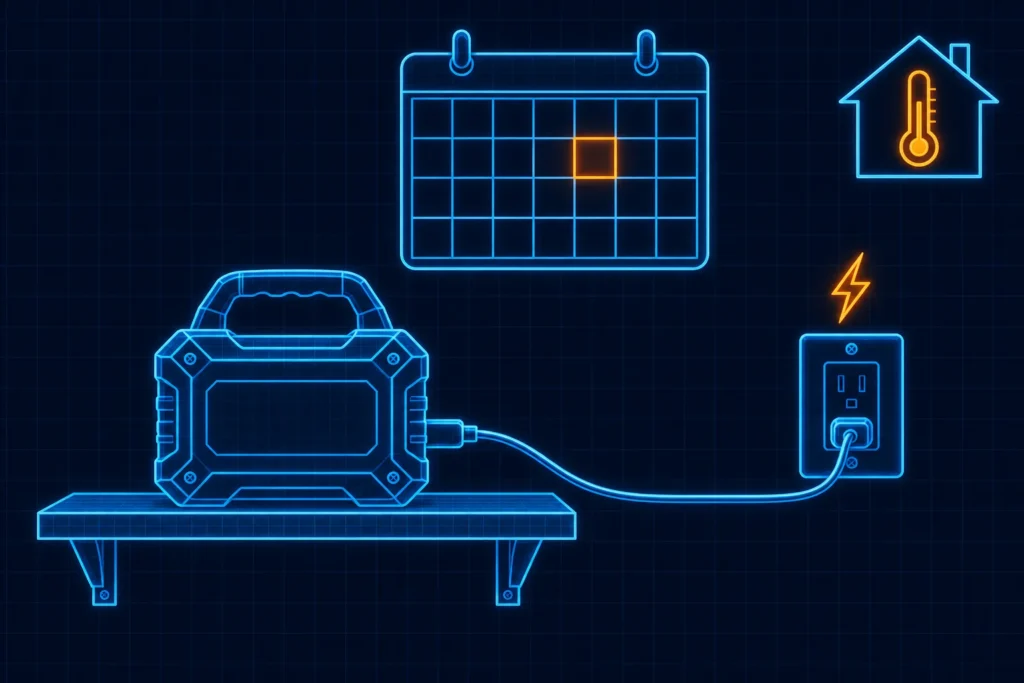
Short answer: Charge a new jump starter fully before you first rely on it, recharge it on the schedule in its manual, and keep it inside the temperature range the maker gives. The manuals we read ask for a recharge every three months (GOOLOO A3 and WOLFBOX MegaVolt24) or every six months (WOLFBOX MegaVolt 24 Air) in storage, and NOCO says an unused unit discharges over time. No maker we read publishes how fast a unit loses charge, so the schedule in your manual is the number to follow.
This page is about storage and charging. What a lithium jump starter is made of is a separate subject, and how to connect and use one is in How to Jump Start a Car.
Why a Jump Starter Needs Looking After
A jump starter is a battery, and a battery that sits for months loses charge. The failure people meet is simple: the unit is in the trunk, the car will not start, and the jump starter is flat too. The A3 manual tells you to check that the unit’s own battery shows at least two bars before you jump a car, and the WOLFBOX manual says its boost needs the unit’s battery to be at or above 50 percent. A unit with no charge cannot help.
Before First Use
Two of the makers say so directly.
- NOCO. The GBX155 guide says the unit ships partially charged and must be fully charged before use. The GB40 manual copy says to charge it fully before first use.
- GOOLOO. The A3 manual and tutorial page say to charge the unit before first use.
Use the cable that came with the unit. NOCO’s GBX155 guide says to use the included USB-C cable or a NOCO-approved charger, and it does not recommend third-party chargers or cables.
How Often to Recharge in Storage
| Unit | Interval the maker gives | Source |
|---|---|---|
| GOOLOO A3 | At least every three months | Manual copy (JS-506) and GOOLOO’s tutorial page |
| WOLFBOX MegaVolt24 (no compressor) | Every three months | Manual copy, V1.0 |
| WOLFBOX MegaVolt 24 Air | Every six months, fully | Manual copy |
| NOCO GBX155 | No interval. An unused unit discharges over time. Charge fully before use | User guide, June 26, 2024 |
| NOCO GB40 | No interval in the pages we read | Manual copy and data sheet |
| NOCO GB70 | No interval in the pages we read | User guide (2025) and data sheet |
Three months to six months is the range we saw across the units that give a number. A unit that has sat for a year is the one most likely to be flat. A simple habit is to charge it when you change the clocks, or once a season, and check the indicator before a long trip or a cold snap.
Charging Time, and How Not to Overdo It
Charging time depends on the charger. The sources we read give these figures:
- NOCO GB40. About 3 hours at 2 amps on USB, 6 hours at 1 amp and 12 hours at 0.5 amp, per NOCO’s data sheet.
- NOCO GB70. NOCO’s data sheet lists 7 hours at 2 amps, 14 hours at 1 amp and 28 hours at 0.5 amp over USB. Amazon says about six hours.
- NOCO GBX155. 2.7 hours over USB-C Power Delivery, per the Amazon listing. The guide says time depends on the charger and gives a range from 64 hours at a very low-power source to a fast charge with a 60 watt charger.
- WOLFBOX units. The listing for the unit without a compressor says 1.3 hours with a 65 watt Power Delivery charger, and its manual says about 1.5 to 2 hours. MacSources reports about an hour for the 24Air at 65 watts and no wall charger in the box.
Two cautions from the manuals:
- Do not leave a NOCO unit charging for long. The GB40 manual copy and the GBX155 guide say to disconnect the unit from power when you are not charging it and not to leave it charging for more than a week at a time.
- Do not charge and use at the same time where the manual warns against it. NOCO’s GB70 user guide does.
After a start, give the unit time to cool before you recharge it. GOOLOO’s tutorial page says to let the A3 cool for 30 minutes after jump starting before you charge it.
Where to Keep It
The temperature numbers in the manuals are not the same number. Operating, charging and storage ranges differ, and mixing them up is a common mistake.
| Unit | Operating | Charging | Storage and heat limits |
|---|---|---|---|
| GOOLOO A3 | Minus 20 to 60 C (manual) | 14 to 113 F (Amazon) | Storage minus 10 to 45 C (tutorial). Above 60 C the manual says cells may be damaged |
| WOLFBOX MegaVolt24 | Minus 20 to 60 C | 0 to 45 C | Temperature protection at 55 and 45 C on the hot side |
| WOLFBOX MegaVolt 24 Air | Minus 4 to 140 F | Not stated in the pages we read | Cold protection below 0 C, lifted above 5. Heat protection above 55, lifted below 45 |
| NOCO GBX155 | Minus 20 to 50 C | 0 to 40 C | Do not heat above 60 C. Keep indoors when not in use |
| NOCO GB40 | Minus 20 to 50 C | 0 to 40 C | No storage temperature in the text we read |
| NOCO GB70 | Minus 20 to 50 C | 0 to 40 C | Storage minus 20 to 50 C, with a recommended daily average of 0 to 25 C. Never exceed 80 C (NOCO GB70 user guide, document dated 03.07.2025A) |
What this means in practice:
- Do not leave a unit in a hot car. A parked car in sun can pass the limits above. The A3 manual says cells may be damaged above 60 degrees Celsius.
- Bring it indoors in winter and carry it to the car when you need it. NOCO’s guide says to keep its unit indoors when it is not in use, and the 24Air can stop working below 0 degrees Celsius until it warms.
- Do not charge a very cold unit. NOCO lists charging only from 0 to 40 degrees Celsius for the GBX155, GB40 and GB70. Let the unit warm up indoors before you charge it.
- Keep the ports closed and the unit dry. The ratings of IP64 and IP65 apply with the ports closed, per NOCO.
How to Tell If It Is Charged
Each unit has its own indicator. The A3 shows bars on its display and you want at least two before a jump. NOCO units show lights that the guides describe. Read the indicator section of your manual and test it once while the unit is charged so you know what a full unit looks like.
A Simple Routine
- Charge it fully when you buy it.
- Put a reminder in your phone for three months. Use the maker’s own number if your manual gives one.
- Keep it in the trunk in mild weather and indoors in a heat wave or a freeze.
- After any use, let it cool and recharge it.
- Check the indicator before a trip.
- If it does not hold a charge, contact the maker. Warranties we saw are one year for the NOCO units, 18 months for the A3 and 24 months for the WOLFBOX units.
What We Could Not Find
- How fast any unit loses charge. No maker we read publishes a self-discharge rate.
- A storage temperature for the NOCO GB40 in the text we read.
- A charging temperature for the 24Air in the pages we read.
- Anything about storing at a partial charge. We do not give advice the manuals do not give.
Frequently Asked Questions
How long does a jump starter hold its charge?
The makers do not say how fast it loses charge. They ask for a recharge every three to six months in storage.
Can I leave it plugged in?
NOCO’s guides say to disconnect the unit when it is not charging and not to leave it charging for more than a week at a time. Follow your manual.
Is it safe to keep a jump starter in the car?
Within limits. Keep it out of heat above the maker’s range and out of deep cold, and carry it indoors in extreme weather.
Why is mine flat after a few months?
Batteries lose charge when they sit. A unit that has not been recharged on schedule may be empty when you need it.
Can I charge it in the cold?
NOCO lists charging only between 0 and 40 degrees Celsius for the units that give a range. Warm it up first.
The Bottom Line
Charge it before first use, recharge it on the schedule in the manual, keep it inside the temperature range, and look at the indicator before you need it. The schedule is the maker’s, and no maker we read publishes how quickly a unit loses charge.
Sources
- NOCO Boost X GBX155 User Guide and Warranty, June 26, 2024: https://no.co/media/wysiwyg/downloads/User_Guides/Boost_X/GBX155_User_Guide_06.26.2024.pdf
- NOCO GB40 data sheet, December 2024: https://no.co/media/wysiwyg/downloads/brochures/Boost/GB40_Data_Sheet_12.05.2024.pdf and GB70 data sheet, December 2024: https://no.co/media/wysiwyg/downloads/brochures/Boost/GB70_Data_Sheet_12.05.2024.pdf
- NOCO GB70 User Guide & Warranty (NOCO, document dated 03.07.2025A): https://no.co/media/wysiwyg/downloads/User_Guides/Boost/GB70-User_Guide_03.07.2025A.pdf
- GOOLOO A3 tutorial page (maker, read 2026-10-30): https://us.gooloo.com/blogs/tutorials/a3-jump-starter
- Manual copies for the NOCO GB40, GOOLOO A3 (JS-506), WOLFBOX MegaVolt 24Air and WOLFBOX MegaVolt24 V1.0 on third-party hosts (ManualsLib and manuals.plus).
- Amazon listings for the units we cover (titles and bullets read on 2026-10-29).
- MacSources, WOLFBOX MegaVolt 24Air review (2026-07-17): https://www.linkedin.com/pulse/wolfbox-megavolt-24-air-4-in-1-jump-starter-compressor-review-8zetf/