What Size Jump Starter Do I Need? Engine, Fuel and Climate
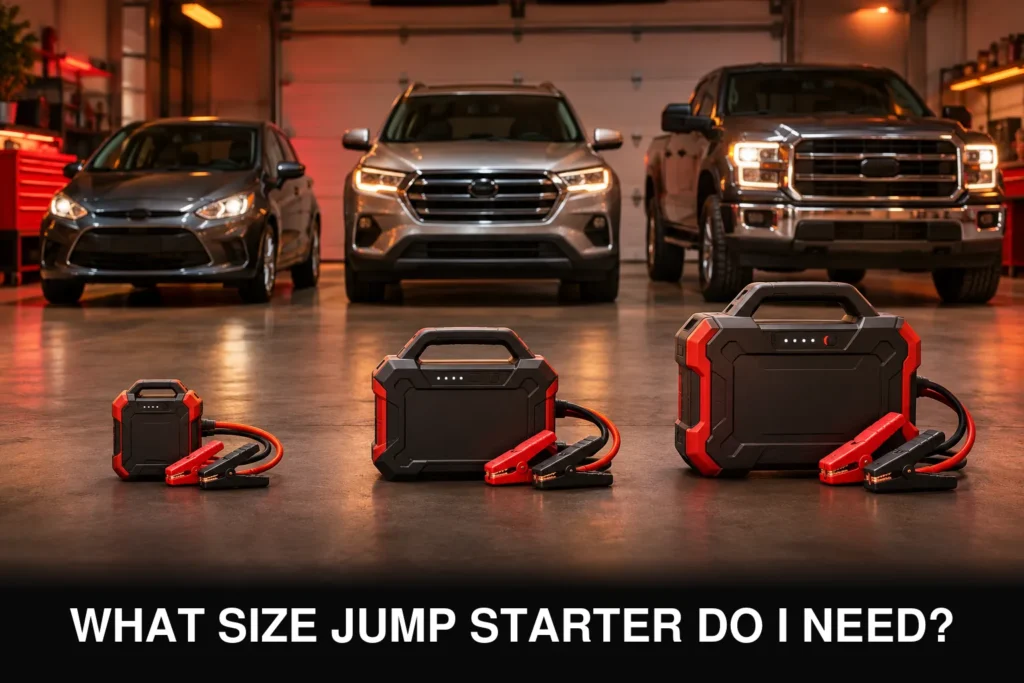
Quick answer: Choose a jump starter by the largest engine it is rated for, not by the amps on the box. Find your engine size in liters and whether it burns gasoline or diesel, read that unit’s rating for the same fuel, and pick a unit rated above your engine. Diesel engines, cold climates, older batteries and big engines all call for more margin. Peak amps only sort units into rough classes.
Pick your situation
- I do not know my engine size: read “Step 1: Find Your Engine Size and Fuel”.
- I want to understand the rating on the box: read “Step 2: Read the Rating the Right Way”.
- I want to see what the units we cover list: go to “Step 3: What the Units List”.
- I have a specific engine: go to “Size by Engine and Vehicle”.
- I live where it gets cold or my battery is old: go to “Climate and Battery Condition”.
Why Size Matters More Than Anything Else
A jump starter has one job: turn your engine once, when your own battery cannot. A unit that is too small may light its indicators, click and fail to turn the engine, and you will not know why. A unit that is far larger than you need will work, but you carry more weight than the job requires. The right size sits between the two, with margin for the days when the engine is cold or the battery is very flat.
Makers express size in two ways. One is peak amps, a large number on the box. The other is the largest engine the unit is rated for, in liters, with a separate number for diesel that is usually lower. The second is the one that answers your question. It is also a claim: in the documents we read, no maker explains how its engine rating was tested. That is why the last section of this guide is about margin.
If you want the full reasoning about peak amps, starting current and watt hours, read Portable Jump Starters. This guide stays on one question: how big a unit your vehicle needs.
Step 1: Find Your Engine Size and Fuel
You need two facts: the engine size in liters and the fuel type.
- Owner’s manual. The specifications section lists engine displacement, usually in liters or cubic centimeters, and the fuel.
- Under the hood. Many engines carry a label or a plastic cover that states the displacement, such as 2.0, 3.5 or 5.7.
- The vehicle’s badge or paperwork. Registration papers and the sales documents often list displacement.
Cubic centimeters convert to liters by dividing by 1,000, so 1,998 cc is about 2.0 liters. Note the fuel as well. A 3.0 liter diesel is a harder job for a jump starter than a 3.0 liter gasoline engine, and most makers we cover give diesel a lower limit for that reason.
If your vehicle is a hybrid or an electric vehicle, the question changes. The jump starter connects to the vehicle’s low-voltage system, which is a 12 volt battery on many hybrids and electric vehicles but not on all of them, and some manufacturers restrict jump starting altogether. Read the section on special cases below and your vehicle manual before you buy.
Step 2: Read the Rating the Right Way
Every unit we cover lists a gasoline limit and a diesel limit. Three rules make the numbers useful:
- Compare like with like. Use the gasoline number for a gasoline engine and the diesel number for a diesel engine. Never read a unit’s gasoline limit against a diesel engine.
- Treat the limit as a ceiling. A unit rated to 6.0 liters of gasoline is not promised to start every 6.0 liter engine in every condition. It is the largest engine the maker is willing to name.
- Look for margin, not equality. The independent tests we found used much smaller engines than the ratings suggest. That does not make the ratings false, but it does mean nobody has confirmed them at the limit.
Peak amps help only as a rough class. About 1,000 amps is a small unit, about 2,000 is mid-range, and 3,000 and above is large. Two manuals we read also list a starting current, which is a different and much smaller figure: 400 amps for the GOOLOO A3 and 1,000 amps for the WOLFBOX 4000A and 88.8Wh. Makers do not explain how any of these numbers were measured, so you cannot line up the amps of different brands and trust the order.
Step 3: What the Units List
These are the ratings on the Amazon listings for the units we cover. The maker’s manual or data sheet agrees, except where noted.
| Unit | Peak amps | Gasoline | Diesel |
|---|---|---|---|
| NOCO Boost GB40 | 1000 A | 6.0 L | 3.0 L |
| NOCO Boost HD GB70 | 2000 A | 8.0 L | 6.0 L |
| NOCO Boost X GBX155 | 4250 A | 10.0 L | 8.0 L |
| GOOLOO A3 | 3000 A | 9 L | 6.5 L |
| WOLFBOX MegaVolt 24Air | 4000 A | 10 L | 6 L on Amazon, 10 L in the manual copy |
| WOLFBOX 4000A and 88.8Wh | 4000 A | 10 L | 10 L |
Two of these deserve a warning. The 24Air’s Amazon title and its manual copy disagree on diesel size, so plan around the lower figure of 6 liters until the maker clarifies. The A3 has a high peak but, per its own manual, a starting current of 400 amps, and we found no controlled independent test of the unit.
What Independent Sources Actually Tested
The largest vehicles in the independent evidence we found are small compared with the ratings:
- A 4.0 liter V6 in cold weather for the GB40, and a 4.0 liter V6 for the GBX155 (TechGearLab).
- A 2010 Ford Explorer for a WOLFBOX MegaVolt24, three starts of a drained battery (TechGearLab).
- A Ford Escape and a Dodge Charger SRT Hellcat for the 24Air (MacSources).
- A 2003 Land Rover Discovery TD5 diesel for the GB70, one start, in a 2019 review.
- A diesel Ford F-350 shop truck for the 24Air, with no engine details (Popular Science).
TechGearLab says its overall testing included vehicles up to a 6.7 liter V8 diesel truck, but we cannot tie that test to a named unit. So no source we found has confirmed any unit at the top of its rating. This is the reason the practical rule is to choose a rating above your engine.
Size by Engine and Vehicle
Small gasoline engines, up to about 2.5 liters. Compact cars, small crossovers and most city cars. Every unit we cover is rated far above this size. Choose on weight, extras and the quality of the evidence, not on the rating. The GB40, rated to 6.0 liters of gasoline, is the lightest of the group, and NOCO lists the unit alone at 1.65 pounds.
Mid-size gasoline engines, about 3.0 to 4.0 liters. Many SUVs, minivans and sedans with V6 engines. This is the size independent testers actually used. A 4.0 liter V6 started in cold weather with the GB40 and quickly with the GBX155, and a 4.0 liter V6 Ford Explorer started three times with the MegaVolt24. Units rated to 8.0 liters and above sit comfortably over this class.
Large gasoline engines, about 5.0 to 6.2 liters. Half-ton pickups, full-size SUVs and performance V8 cars. The GB70, GBX155, A3, 24Air and WOLFBOX 4000A and 88.8Wh are all rated for it. The GBX155 gives the most room. The only independent evidence at this size is a supercharged V8 Dodge Charger SRT Hellcat started with the 24Air at MacSources. The GB40 is rated to 6.0 liters of gasoline, but its independent evidence ends at 4.0 liters, so look higher for this class.
Diesel pickups and vans. Check the diesel column and add margin. The WOLFBOX 4000A and 88.8Wh title lists 10 liters, the GBX155 8.0, the A3 6.5, the GB70 6.0 and the 24Air 6 on Amazon. A common heavy-duty pickup diesel is 6.7 liters, and on our list the WOLFBOX 4000A and 88.8Wh and the GBX155 list diesel ratings above it. Evidence is thin: one 2003 Discovery TD5 with the GB70 and one F-350 with the 24Air. A large diesel in the cold is the hardest case in this guide, so choose a rating well above your engine.
Engines above our ratings. Heavy trucks, large agricultural machines and anything with a 24 volt system need a different class of equipment. The GBX155 guide says the unit is for 12 volt lead-acid batteries only and reports a double flash when it detects a higher voltage at the clamps. Never use a 12 volt unit on a 24 volt system.
Climate and Battery Condition
The same engine is a harder job in the cold and on a flat battery. According to Interstate Batteries, a car battery works best at about 80 degrees Fahrenheit, its performance drops at 32 degrees and falls further at 0 degrees, which is the temperature at which the cold cranking amp rating is measured. Interstate also says heat above 90 degrees damages a battery by internal corrosion, and that a battery drained for even a few hours can suffer permanent damage.
What this means for the size you choose:
- Cold climate. Move up a class from what your engine alone would suggest, and read the unit’s own operating range. The GBX155, GB70 and GB40 list minus 20 to plus 50 degrees Celsius, and the 24Air describes cold protection below 0 degrees Celsius that can stop it until it warms. Keep any unit indoors in winter.
- Old or deeply drained battery. It is harder to start than a healthy one. Interstate says that a battery that has frozen solid should not be jump-started at all, and that you should get help instead.
- Rarely used vehicle. A car that sits for months asks for a unit that you will remember to recharge. The manuals we read ask for a recharge every three to six months.
Special Cases
- Battery type. NOCO’s GB40 data sheet lists wet, gel, MF, EFB and AGM lead-acid batteries. The GBX155 guide says 12 volt lead-acid only. Check that your battery type is supported.
- Start-stop and modern vehicles. Follow your vehicle manual. Some manuals restrict where you may connect or whether the vehicle may be jump-started.
- Hybrids and electric vehicles. Jalopnik quotes a Kia manual that says not to jump-start another vehicle with the hybrid, and a Tesla Model 3 manual that says the car cannot be used to jump-start another vehicle. A jump starter belongs only on the low-voltage connection points the vehicle maker names, never on the high-voltage battery, and that auxiliary system is 12 volt on many but not all hybrids and electric vehicles. Read your own manual first.
- Motorcycles, boats and tractors. Their engines are small, but the listings and manuals differ on what each unit supports. We cover those uses in Jump Starters for Motorcycles, Boats, ATVs and Tractors.
Do Extras Change the Size You Need?
No. A compressor, a power bank port or a light does not change how big an engine a unit can start. These extras share the battery with the jump starter, so a larger battery helps if you inflate tires or charge a laptop. See Jump Starters with Air Compressors for the compressor trade-off.
Four Buyers, Four Sizes
The commuter with a four-cylinder gasoline car. Any unit is enough. Choose the lightest one you will actually keep in the car.
The family with a midsize SUV and a V6. Any unit rated to 8.0 liters or more covers the engine with margin. Look at the evidence behind the unit and the battery capacity if you want it to charge devices.
The owner of a V8 pickup. Choose a unit rated to 8.0 liters of gasoline at least, and look at the GBX155 if you also tow in the cold.
The owner of a diesel truck. Start from the diesel rating, add margin for cold and age, and read the independent evidence critically, because it is thin.
One Table to Keep
| Your engine | What to look for | Units whose listed ratings cover it |
|---|---|---|
| Gasoline up to 2.5 L | Any rating, choose on weight | All of them |
| Gasoline 3.0 to 4.0 L | Rating of 6.0 L or more, margin in the cold | All of them (the GB40’s independent evidence is a 4.0 L V6) |
| Gasoline 5.0 to 6.2 L | Rating well above the engine | GB70, GBX155, A3, 24Air, WOLFBOX 4000A and 88.8Wh |
| Diesel up to 3.0 L | Diesel rating above the engine | All of them list at least 3.0 L |
| Diesel 4.0 to 6.0 L | Diesel rating with margin | GB70, GBX155, A3, 24Air, WOLFBOX 4000A and 88.8Wh |
| Diesel above 6.0 L | Highest diesel rating, strongest evidence | GBX155, WOLFBOX 4000A and 88.8Wh (10 L in its Amazon title) |
| 24 volt systems | A unit made for 24 volts | None of them |
Frequently Asked Questions
How many amps do I need to jump start a car?
There is no reliable number. Peak amps are the highest brief current a unit can reach, and makers do not say how they measure them. Use the engine rating in liters instead, and add margin.
Is a bigger jump starter always better?
No. A larger unit weighs more and may hold a bigger battery than you need. A bigger rating helps most for diesel engines, large V8s and cold climates.
Can a small jump starter damage a big engine?
A small unit is more likely to fail to start the engine than to damage it. The risk with any unit is a wrong connection or misuse of the override button, not the size of the engine. See Can a Jump Starter Damage the Battery or the Car’s Electrical System?
Do I need a different size for a diesel?
Yes. Diesel engines need more starting power than gasoline engines of the same size, so makers usually give them a lower limit. Use the diesel column.
Does the size of the battery matter?
Watt hours matter for repeated attempts and for extras like a compressor or a laptop. A jump start itself uses little energy: TechGearLab reported about 3 percent of the battery per start on its MegaVolt24.
What if my engine is exactly at the unit’s rating?
Choose the next size up. The rating is a ceiling, and no source we found confirmed any unit at the limit.
The Bottom Line
Find your engine size and fuel. Read each unit’s rating for your fuel, choose a rating above your engine and add margin for diesel, cold, an old battery and a vehicle that sits. Use peak amps only to sort units into rough classes, and read the evidence behind the rating before you trust it.
Sources and How We Checked
Ratings come from the Amazon listings for the units we cover (titles and bullets read on 2026-10-29), the NOCO GB40 and GB70 data sheets (December 2024), the NOCO GBX155 user guide (June 26, 2024) and manual copies for the GOOLOO A3, WOLFBOX MegaVolt 24Air and WOLFBOX MegaVolt24 on third-party hosts. We do not claim to have run our own measurements on any unit.
- Interstate Batteries, Why Your Car Battery Died (temperatures, battery life, frozen battery): https://www.interstatebatteries.com/blog/why-did-my-car-battery-die
- Jalopnik, Never Jump Start a Modern Car Without Checking For These Things First (Kia and Tesla manual quotations): https://www.jalopnik.com/2091386/never-jump-start-modern-car-without-checking-these-first/
- TechGearLab, Best Jump Starters (updated 2026-04-29): https://www.techgearlab.com/topics/tools/best-jump-starter
- Popular Science, Wolfbox 4-in-1 Jump Starter with Air Compressor review (2026-02-11): https://www.popsci.com/gear/wolfbox-4-in-1-jump-starter-with-air-compressor-review/
- MacSources, WOLFBOX MegaVolt 24Air review (2026-07-17): https://www.linkedin.com/pulse/wolfbox-megavolt-24-air-4-in-1-jump-starter-compressor-review-8zetf/
- 4×4 Australia, NOCO GB70 product test (2019-06-11): https://www.4x4australia.com.au/gear/electronics-gadgets/noco-gb70-jump-starter-pack-4×4-product-test
- NOCO Boost X GBX155 User Guide, June 26, 2024: https://no.co/media/wysiwyg/downloads/User_Guides/Boost_X/GBX155_User_Guide_06.26.2024.pdf
- NOCO GB40 data sheet, December 2024: https://no.co/media/wysiwyg/downloads/brochures/Boost/GB40_Data_Sheet_12.05.2024.pdf