Cold Cranking Amps Explained: What CCA on a Car Battery Means
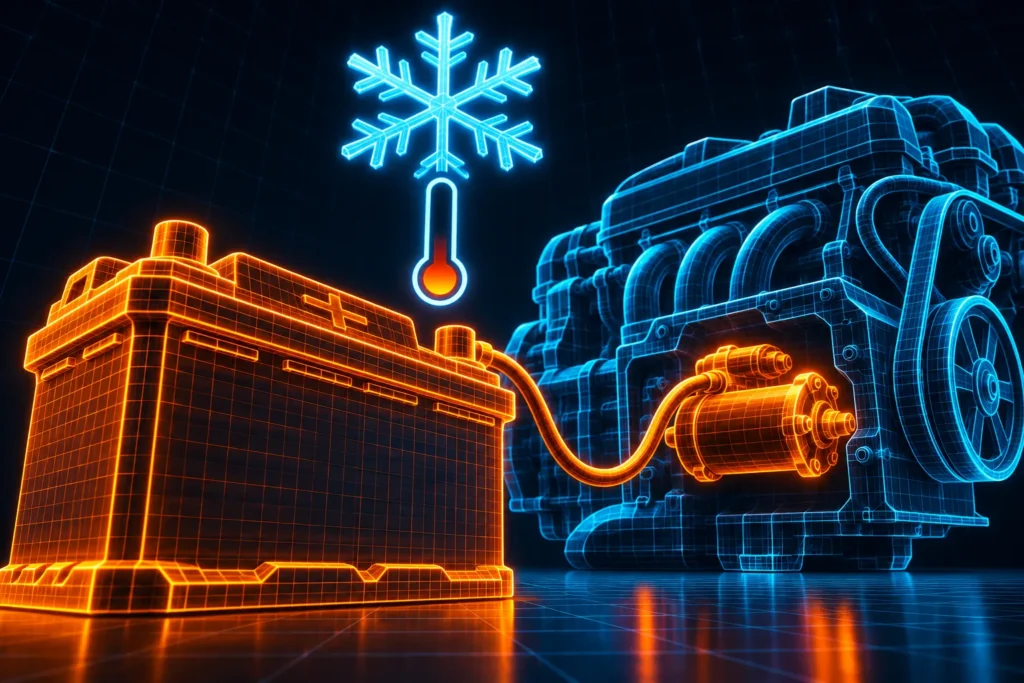
Short answer: Cold cranking amps (CCA) is a rating for a car battery, not for a jump starter. It is the current a new, fully charged 12 volt battery can deliver for 30 seconds at 0 degrees Fahrenheit (minus 18 Celsius) while keeping its terminal voltage at or above 7.2 volts. Choose a replacement battery that meets or exceeds the number in your vehicle’s specification. The peak amps printed on a jump starter are a different number, measured in a different way, and the two cannot be compared.
This page explains the rating. The types of battery are in Car Battery Types Explained, and the causes of a dead battery are in Why Does a Car Battery Die?.
What the Rating Measures
Optima Batteries describes CCA as a standardized rating from the Battery Council International. The test places a battery in a cold environment, 0 degrees Fahrenheit (minus 18 Celsius), and measures the discharge load in amperes that a new, fully charged battery can deliver for 30 seconds while maintaining a terminal voltage of 7.2 volts. The sources we saw add that the voltage must stay up for the whole 30 seconds, and that the battery fails if it drops below the limit.
Four things follow from that definition:
- It is a cold rating. The test is run at 0 degrees Fahrenheit because cold is the hardest condition. Interstate Batteries says a battery works best at about 80 degrees Fahrenheit, and that its performance drops at 32 degrees and falls further at 0, the temperature that the CCA rating measures.
- It is for a new battery. The rating describes a new, fully charged battery, not an old or a half-flat one. An older battery delivers less than its rating.
- It is a battery rating. It tells you what the battery can supply to the starter, not what a jump starter can supply.
- It is a comparison tool. Optima calls it an apples-to-apples, industry-wide comparison, even though it may not reflect typical real-world use.
The Other Ratings You Will See
- Cranking amps (CA), also called marine cranking amps (MCA). The same test at 32 degrees Fahrenheit (0 Celsius). Optima says the number is higher than the CCA number because the temperature is warmer.
- Hot cranking amps and pulse cranking amps. Optima describes these as marketing ratings that often show higher numbers and use the companies’ own specifications, which makes comparison difficult.
When you shop for a battery, compare CCA with CCA, and CA with CA. Do not compare a CA figure on one box with a CCA figure on another.
How to Choose a CCA Rating
Optima’s advice is that a battery should meet or exceed the manufacturer’s recommendation for cranking amps. It warns that buying a battery with an extra 300 CCA is not necessary and will probably cost more. These are a battery maker’s statements. The practical rule is to start from your vehicle’s specification, which is in the owner’s manual or on the label of the original battery. Colder climates and older batteries are reasons to read that number carefully, not reasons to buy a number far above it.
Why CCA Is Not the Same as a Jump Starter’s Amps
A car battery’s CCA and a jump starter’s peak amps are both amps, and they answer different questions.
- CCA is measured by a defined test: 0 degrees Fahrenheit, 30 seconds, 7.2 volts, for a new battery.
- Peak amps on a jump starter are the highest brief current the unit can reach. In the documents we read, no maker explains how the number was measured. Two manuals also list a starting current, a much smaller figure: 400 amps for the GOOLOO A3 and 1,000 amps for the WOLFBOX 4000A and 88.8Wh.
Interstate gives a useful sense of scale. It says a healthy battery of about 12.77 volts can deliver about 500 amps to start the engine. That is what the starter draws in ordinary conditions, and it is why a jump starter’s brief burst is large. It is not a reason to compare a 4,000 amp peak with a 600 CCA battery. The numbers sit on different scales, and neither maker nor standard connects them. To choose a jump starter, use the engine rating in liters. See What Size Jump Starter Do I Need?.
Reading a Battery Label
A battery label usually shows the voltage (12 V), the CCA figure, and sometimes the capacity and the group size, which is the physical size and terminal position. You need all of them to match a replacement to your vehicle. Cold cranking amps alone will not tell you whether a battery fits or is the right type.
What We Could Not Verify
- The text of the Battery Council International standard. We read a battery maker’s description of it and found other secondary sources that agree, but we did not read the standard itself.
- A recommended CCA margin. We do not give one. Optima’s advice is to meet or exceed the manufacturer’s recommendation.
Frequently Asked Questions
What does CCA stand for?
Cold cranking amps.
Is a higher CCA always better?
Meet or exceed your vehicle’s specification. Optima says an extra 300 CCA is not necessary and may cost more.
Does CCA apply to a jump starter?
No. It is a battery rating, and a jump starter’s peak amps are a different figure.
How many amps does it take to start a car?
Interstate says a healthy battery of about 12.77 volts can deliver about 500 amps to start the engine. The real figure depends on the engine, the temperature and the battery.
Why is CCA measured at 0 degrees Fahrenheit?
Cold is the hardest condition for starting. The rating shows what a new, fully charged battery can do in it.
The Bottom Line
CCA is a battery rating tested at 0 degrees Fahrenheit for 30 seconds above 7.2 volts. Use it to match a replacement battery to your vehicle, and do not compare it with a jump starter’s peak amps.
Sources
- Optima Batteries, What Does Cold Cranking Amps (CCA) Mean? (definition, test conditions, CA and MCA, marketing ratings, choosing a rating): https://www.optimabatteries.com/experience/blog/what-does-cold-cranking-amps-(cca)-mean
- Interstate Batteries, Why Your Car Battery Died (80, 32 and 0 degrees Fahrenheit, about 500 amps to start the engine): https://www.interstatebatteries.com/blog/why-did-my-car-battery-die
- GOOLOO A3 (JS-506) manual copy and WOLFBOX MegaVolt24 V1.0 manual copy (starting current figures) on third-party hosts.