Portable Jump Starters: How to Choose the Right One
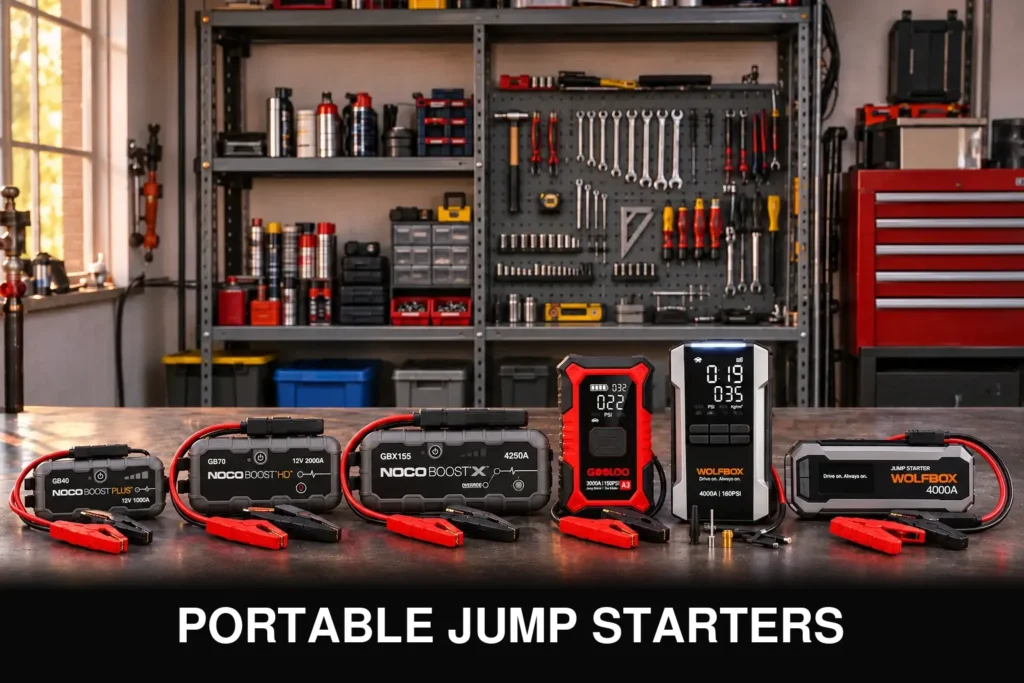
Quick answer: Start with your engine, then your climate, then the extras you want. A compact gasoline car needs a small, light unit. A V8 pickup, a diesel or a cold winter needs more margin. Treat the amps on the box as a rough class, not a promise, and check the maker’s own manual. Add a compressor only if you want one box for two jobs. Where the Amazon listing, the maker and independent reviewers disagree, this guide shows you every number and tells you which source said it.
Pick your situation
- I am not sure I need one at all: read “Do You Actually Need a Jump Starter?” and the two sections after it.
- I want to understand the numbers on the box: start at “Engine Size Ratings” and read through “Weight and Size”.
- I want to know whether a listing can be trusted: read “How to Read an Amazon Listing Without Getting Fooled” and “A Worked Example”.
- I already know my engine and want a pick: go to “Choose by Your Situation”.
- I want the detail on one model: go to the numbered chapters, 1 to 6.
- I want to avoid mistakes before I buy: go to “Eight Common Mistakes” and “Your Pre-Purchase Checklist”.
Do You Actually Need a Jump Starter?
Most drivers will have one dead battery at some point. It usually happens at the worst moment: a cold morning, a parking garage, a trailhead, a night with the kids in the back seat. The usual fix is a second car and a set of cables. That fix needs a helpful stranger, a car parked close enough and a cable long enough to reach.
A portable jump starter replaces all of that with one box. You connect it to your own battery, start the engine and put it away. No second vehicle is involved, and the whole thing takes a few minutes.
A jump starter makes sense if any of these describe you:
- You drive alone often, or at hours when help is hard to find.
- You park where another car cannot reach your hood, such as a garage, a tight driveway or a rural track.
- You own a car that sits for days or weeks between drives.
- You live where winter nights are cold, because cold is when weak batteries fail.
- You drive for work or carry family and cannot afford to be stuck.
- You help other people, and having a unit in the trunk makes you the person who can.
It makes less sense if your battery is dead every few days. A jump starter treats the symptom, not the cause. A battery that cannot hold a charge, or a car that drains it while parked, needs a battery test and a look at the charging system. We say this early because it is the most common way a good tool gets blamed for a different problem. See Jump Starter Not Working: What to Check.
A jump starter also does not replace a spare tire or a tow plan. It is one tool for one common failure, and it is a good one.
What a Jump Starter Is and How It Works
A modern jump starter is a lithium battery in a case, with a pair of cables and clamps and a small control board. The battery is much smaller than a car battery, but it can release a very large current for a few seconds. That brief burst is what a starter motor needs when your own battery is too weak to turn the engine.
You connect the red clamp to the positive terminal and the black clamp to the negative terminal or to bare metal on the engine or frame, as your manual says. The control board checks the connection before it lets current flow. Every unit we cover lists protection against reversed clamps and against short circuits, and several list spark-proof clamps. In plain words, the unit tries to refuse a wrong connection. Then you start the car. As soon as it runs, the alternator takes over and you remove the clamps.
Three ideas explain most of the numbers on the box:
- How big an engine it can turn. Makers list a largest engine in liters, with a separate number for diesel that is usually lower. This is the practical rating.
- How much current it can deliver. Makers list peak amps. This is a loose guide, and the section “Peak Amps or Starting Current?” explains why.
- How much energy it holds. This is the battery capacity in watt hours. It decides how many attempts you get and how much is left for a compressor or a phone.
Many units do more than jump a car. They can charge a phone, run a light, and some include an air compressor. Those extras are useful, but they share the same battery. A unit that has been used to inflate a tire has less left for the next start.
What a Jump Starter Cannot Fix
A jump starter only helps with a weak battery. It will not repair a starter motor that has failed, a broken connection in the starter circuit, a fuel or ignition fault or a vehicle that needs a security reset. This is general guidance, not from any of our manuals, and it is why you should not treat a jump starter as a diagnosis.
A few signs that the problem may be outside the battery: the engine cranks strongly and will not start, the dashboard lights are bright and the car only clicks even with the jump starter connected, or a jump works once and the car is dead again the next day. None of these is a diagnosis on its own. They are reasons to have the battery tested and to ask a mechanic.
It also will not work on batteries it does not support. The NOCO GBX155 user guide says the unit is for 12 volt lead-acid batteries only, and it reports a double flash when it detects a higher voltage at the clamps, such as a 24 volt system. A heavy truck with a 24 volt system needs a different tool. We found no manufacturer guidance for hybrid or electric vehicles in the documents we read, so check your own vehicle manual before using any unit on one.
The Types of Jump Starters
The units in this guide fall into four groups. The groups matter more than the brand names.
Compact units for small engines. The NOCO Boost GB40 is the example here. It lists 1,000 peak amps, gasoline engines to 6.0 liters and diesel to 3.0 liters. NOCO lists the unit alone at 1.65 pounds. It is the glove box choice.
Mid-range units with margin. The NOCO Boost HD GB70 lists 2,000 peak amps, gasoline to 8.0 liters and diesel to 6.0. It has attached clamps and a 12 volt output. It is a better fit for a larger gasoline engine, a pickup or a light diesel.
Heavy-duty units. The NOCO Boost X GBX155 lists 4,250 peak amps, gasoline to 10.0 liters and diesel to 8.0, with a 99 watt hour battery in NOCO’s guide. It is the heaviest at 5.82 pounds and the best documented of the NOCO units.
Combos and high-capacity units. Three units take a different approach. The GOOLOO A3 (44.4 watt hours) and the WOLFBOX MegaVolt 24Air (88.8) include an air compressor. The WOLFBOX 4000A and 88.8Wh has the large 88.8 watt hour battery without a compressor. These are bulkier or more capable, and they suit drivers who want more than a jump.
There is no best group. The right group depends on your engine and what else you want the box to do. The sections that follow explain each number you will see, and “Choose by Your Situation” matches the groups to situations.
Engine Size Ratings: What They Mean and What Is Proven
Every unit lists the largest engine it is rated for. A rating of 6.0 liters of gasoline means the maker says the unit can start a gasoline engine up to that size. Diesel ratings are usually lower because diesel engines are harder to turn over.
Here is what the units list on Amazon:
| Unit | Gasoline | Diesel |
|---|---|---|
| NOCO Boost GB40 | 6.0 L | 3.0 L |
| NOCO Boost HD GB70 | 8.0 L | 6.0 L |
| NOCO Boost X GBX155 | 10.0 L | 8.0 L |
| GOOLOO A3 | 9 L | 6.5 L |
| WOLFBOX MegaVolt 24Air | 10 L | 6 L (the manual copy says 10 L) |
| WOLFBOX 4000A and 88.8Wh | 10 L | 10 L |
These ratings are claims. In the documents we read, no maker explains how its rating was tested. So what do independent sources show? We found tests and reports on much smaller engines than the ratings suggest:
- A 4.0 liter V6 in cold weather for the GB40 (TechGearLab).
- A 4.0 liter V6 for the GBX155 (TechGearLab).
- A 2010 Ford Explorer for a WOLFBOX MegaVolt24, three starts of a drained battery (TechGearLab).
- A Ford Escape and a Dodge Charger Hellcat for the 24Air (MacSources).
- A 2003 Land Rover Discovery TD5 diesel for the GB70, one start, in a review from 2019.
- A diesel Ford F-350 for the 24Air, with no engine details (Popular Science).
None of these reaches the top of any rating. That does not mean the ratings are false. It means no source we found confirms them at the limit. The practical rule is simple: choose a rating above your engine, not equal to it. If you drive a large diesel, a cold climate or an old engine, add more margin. If you drive a four-cylinder car, any unit in this guide is far above what you need, and you can choose on weight and extras.
You can find your engine size in the owner’s manual or on a label under the hood.
Peak Amps or Starting Current?
The biggest number on every box is the peak current. Peak amps are the highest brief current the unit can reach, and no maker tells you how it measured that number. A different figure, starting current, describes what the unit can sustain to turn an engine. Only two of the manuals we read list both:
| Unit | Peak | Starting |
|---|---|---|
| GOOLOO A3 (manual) | 3000 A | 400 A |
| WOLFBOX MegaVolt24, no compressor (manual) | 4000 A | 1000 A |
The NOCO documents list a peak figure only. The 24Air manual we read lists no starting current, and we do not borrow the figure from the other WOLFBOX unit.
What does this mean for a buyer? First, a large peak number is not evidence of a strong start. The A3’s starting current is 400 amps, which is far below the 3,000 amp headline. Second, you cannot line up the peak figures of different brands and trust the ranking. NOCO’s 4,250 and WOLFBOX’s 4,000 are not measured the same way, and no source says how either was measured. Third, a unit that publishes both numbers is being more open than one that publishes only the biggest.
Use amps to sort units into rough classes: about 1,000 for a small unit, about 2,000 for mid-range, 3,000 and above for large. Then decide using the engine rating, independent starts and the manual’s own limits.
Watt Hours: How Much Energy Is Really There
Watt hours measure how much energy a battery holds. A bigger number means more attempts per charge and more left for a compressor or a laptop. If a maker lists milliamp hours, multiply by the voltage. WOLFBOX’s manual shows 24,000 mAh at 3.7 volts is 88.8 watt hours.
A jump start itself uses little energy. TechGearLab reported that its WOLFBOX MegaVolt24 used about 3 percent of its battery on each of three jump starts of a drained 2010 Ford Explorer. That is one lab, one unit and one vehicle, so treat it as an illustration. Watt hours matter more when you add a compressor or charge devices.
Labels can also be optimistic. TechGearLab drained several units fully to measure usable capacity:
| Unit | Claimed | Measured by TechGearLab |
|---|---|---|
| NOCO GB40 | 24 Wh | 15.57 Wh |
| NOCO GBX155 | 99 Wh (NOCO guide) | 86.1 Wh |
| WOLFBOX MegaVolt24 (no compressor) | 88.8 Wh | 82.3 Wh |
The measured value ran below the claim on all three, by about 35 percent on the GB40 and about 7 to 13 percent on the other two. A gap is normal for any battery, because a battery cannot be drained to the last drop. The point for a buyer is that a larger claim is only partly a promise.
Here is how the rest of the field stands. NOCO lists 56 watt hours for the GB70 in its data sheet. One third-party lab table lists 24, the same value it lists for the GB40. We keep that as a visible discrepancy and assign no measured value to the GB70. The A3 lists 44.4 watt hours in its manual and has no measurement. The 24Air lists 88.8 and has no measurement of its own. The WOLFBOX 4000A and 88.8Wh lists 88.8, and the 82.3 figure belongs to a same-named unit, linked by name only.
Cold, Heat and Storage
Cold is the hardest condition for a car battery and for a jump starter. Both lose output when it is cold, and a cold lithium battery can refuse to deliver current at all. Maker documents list these ranges:
- NOCO GBX155: operating minus 20 to plus 50 degrees Celsius, charging 0 to 40 (user guide).
- NOCO GB40 and GB70: the same operating and charging ranges (December 2024 data sheets). One third-party manual copy for the GB70 lists minus 30.
- GOOLOO A3: operating minus 20 to plus 60 degrees Celsius (manual copy). GOOLOO’s tutorial page gives a separate storage range of minus 10 to plus 45, and the manual warns that cells may be damaged above 60.
- WOLFBOX units: minus 4 to 140 degrees Fahrenheit. The 24Air manual describes cold protection below 0 degrees Celsius that can stop the unit until it warms above 5, and heat protection above 55 that lifts below 45.
Notice that operating, charging and storage ranges are different numbers. Do not swap them. A unit that works at minus 20 may not charge at minus 20.
Popular Science reports starting a mid-size SUV at about 0 degrees Fahrenheit with the 24Air. That is a hands-on report, not a controlled test. Keep the unit indoors in winter and carry it to the car when you need it. Do not charge it right after it has sat in a freezing trunk, and do not leave it in a hot car for long.
Recharge it on schedule. The manuals we read ask for a recharge every three to six months, depending on the model: at least every three months for the A3, three months for the WOLFBOX MegaVolt24 and every six months for the 24Air. A unit that has sat for a year may be flat when you need it, and the manuals warn about exactly that.
Safety Features, Boost and Override
Every unit we cover lists reverse polarity and short circuit protection, and several list spark-proof clamps. The differences are in the override or boost buttons and in the start limits, and they are not interchangeable between brands.
A normal start relies on the unit checking your connection. Many units also have a button for a battery so flat that the unit cannot sense it. On NOCO units, the guides say this mode switches off the spark-proof and reverse polarity protection. The GBX155 guide warns that it can cause injury or death if misused. With the checks off, nothing stops a wrong connection, and a wrong connection means sparks and heat. So the order matters: connect correctly first, keep the clamps apart, and press the button last.
| Unit | Override or boost | Start limits |
|---|---|---|
| GBX155 | Manual override below 3 V. Disables all safety measures and the 60 second timeout | Five starts in 15 minutes, then rest 15 minutes |
| GB70 (user guide 2025) | Manual override below 2 V. Removes safety protection | Five starts in 15 minutes |
| GB40 | Override hold of three seconds (data sheet). Below about 2 V (manual copy) | Not found in the pages we read |
| A3 | BOOST. Press only after the cable is connected correctly | Start within 30 seconds of the green LED. No more than three starts in a row, two minutes apart (GOOLOO tutorial page) |
| 24Air | BOOST for a battery from 0.0 to 10.5 V | Eight starts in 10 minutes, then rest 10 minutes |
| WOLFBOX 4000A and 88.8Wh | BOOST only if a normal start fails. Not below 9 V vehicle voltage, and the unit’s own battery not below 50 percent | Three starts in a row, then wait two minutes |
Two examples show why you must not mix them. The GBX155 stops its jump function after a 60 second countdown and detects batteries down to 3 volts, while the GB40 and GB70 documents we read use 2 volts. A habit learned on one brand can be wrong on another. Learn your unit’s rule before you need it, and read How to Use a Jump Starter Safely.
Air Compressor Combos: PSI, Flow and the Trade-Off
Two of the units we cover have a compressor. The A3 lists 150 PSI at 35 liters per minute. The 24Air lists 160 PSI at 45. PSI is the ceiling the pump can reach, and flow is its speed. Your tires need a lot less than 150 PSI, so the ceiling is not the interesting number. The battery is the real limit, because a compressor draws much more energy than a jump start, and no source we read says how many tires either unit fills on one charge.
What independent sources report is useful but not comparable:
- Popular Science topped off an SUV tire from 25 to 35 PSI in about a minute with the 24Air.
- Air Tool Lab reports the A3 raising a Model 3 tire from 30 to 36 PSI in about a minute, without a documented method.
- Men’s Journal describes inflating four tires with the A3 in about 15 minutes, including learning the unit, with the battery indicator down one bar of four.
- Car and Driver timed the 24Air on a 245/50R20 tire on a Hyundai Santa Cruz, starting from 10 PSI: 3 minutes 12 seconds to 30 PSI and 6 minutes 10 seconds to 45 PSI. It also measured 84.0 dBA of noise.
These reports used different tires and different starting pressures, and there is no matching timing for the A3. Do not read them as a race.
The trade-off is size and shared energy. A combo is bulkier than a unit that only jumps, and the battery serves both jobs. If you want one box for a dead battery and a soft tire, a combo makes sense. If you never inflate tires away from home, you are carrying a pump you do not need. For the full discussion, read Jump Starter Air Compressors: PSI, Flow and Limits and our guide to jump starters with air compressors.
USB-C, Power Bank and Light
Most units charge a phone. Only some can charge a laptop. The GBX155 lists a 60 watt USB-C port, and the 24Air and the WOLFBOX 4000A and 88.8Wh list 65 watts in and out. The A3’s ports are phone speed: its manual lists a 5 volt, 2 amp USB-C input and a 5 volt, 2.4 amp USB-A output. The GB40 and GB70 list 5 volts at 2.1 amps, which also suits phones. The GB70 adds a 12 volt output at 15 amps for 12 volt devices, per NOCO.
Light output on Amazon runs from 100 lumens on the GB40 to 500 on the GBX155, and the WOLFBOX 4000A and 88.8Wh lists an LED with SOS, strobe and high-beam modes. A built-in light helps when you work in the dark. It also drains the battery, and Popular Science lists that as a con on the 24Air.
If you travel or work from the car, a 60 or 65 watt USB-C port is the feature to look for. See Jump Starter Power Banks, USB-C and Emergency Lights.
Weight and Size
Weights disagree between sources more than any other number, partly because sources count different things. NOCO lists the GB40 at 1.65 pounds for the unit and 2.4 pounds with clamps and accessories. Amazon says 2.5, TechGearLab 2.4 and AutoGuide “just under 1.5”. NOCO lists the GB70 at 4 pounds for the unit and 5 with accessories, against Amazon’s 5.0 and TechGearLab’s 4.2. The GBX155 is 5.82 pounds in NOCO’s guide.
The 24Air is 3.42 pounds on Amazon and 5.3 in its manual copy and in Popular Science’s spec list, and Car and Driver weighed its test unit at 5.0. The WOLFBOX 4000A and 88.8Wh is 3.38 pounds in its manual copy and 3.2 at TechGearLab.
So which weight matters? If the unit lives in a glove box, you care about the whole kit, clamps and bag included. If you carry it in a bag, you care about the unit alone. When the numbers conflict, check the exact listing again before you buy, and weigh your own unit when it arrives.
How to Read an Amazon Listing Without Getting Fooled
Amazon is our commercial baseline, because it is the page you will buy from. It is not the whole truth. A listing is written to sell, and a few habits will protect you.
Check the exact product. Several of these units have near-twin names. The WOLFBOX MegaVolt 24Air has a compressor, and the WOLFBOX 4000A and 88.8Wh does not. TechGearLab tested a unit called the WOLFBOX MegaVolt24, which has no compressor, and its results belong to a different product than the 24Air. We never apply a result from one model to another.
Look for variants. On the 24Air page we saw options titled “3000A + 65W Fast Charging,” “4000A + 65W Charger” and “4000A + 65W Fast Charging.” They may differ in what is in the box and in other details, and we did not open each one. Choose the variant that matches the specifications you read.
Compare the title with the manual. The 24Air title says diesel up to 6 liters, and its manual copy says 10. That does not make the unit bad. It tells you to plan around the lower number and look again.
Separate peak from starting current. The headline amps are the peak. Look for a starting current in the manual.
Treat claims as claims. Starts per charge, charge cycles and certifications such as UL, FCC and CE are statements on the listing. We did not see the certificates, and no maker states a method for starts per charge.
Read what the page leaves out. In several rows below we write “not found in the content we checked.” That means we read titles and bullets and did not find the figure. It never means the page lacks it.
A Worked Example: One Unit, Three Sources
The best way to see why one source is not enough is to follow the WOLFBOX MegaVolt 24Air through three of them. Amazon says diesel up to 6 liters and about 3.42 pounds. The manual copy says 10 liters for gasoline and diesel and 5.3 pounds. Independent reviewers add a third weight (Car and Driver weighed its test unit at 5.0 pounds), a cold-weather SUV start and a diesel F-350 start at Popular Science, two cars at MacSources and a timed compressor test.
A careless buyer might conclude that the 24Air starts any diesel up to 10 liters and weighs three pounds. The evidence supports less: it starts real cars, its compressor was timed, and two documents disagree on size and weight. So we plan around 6 liters of diesel until the maker clarifies, and weigh the unit yourself. This is the habit the whole guide follows: show each number, name its source and say what is still unknown.
The Units at a Glance
Values below are from the Amazon listing, unless a cell names another source.
| Topic | GB40 | GB70 | GBX155 | A3 | 24Air | WOLFBOX 4000A/88.8Wh |
|---|---|---|---|---|---|---|
| Peak current | 1000 A | 2000 A | 4250 A | 3000 A | 4000 A | 4000 A |
| Gasoline | 6.0 L | 8.0 L | 10.0 L | 9L | 10L | 10 L |
| Diesel | 3.0 L | 6.0 L | 8.0 L | 6.5L | 6L | 10 L |
| Starts per charge | Up to 20 | Up to 40 | Up to 18 | Not found in the content we checked | Not found in the content we checked | Not found in the content we checked |
| Compressor | No | No | No | 150 PSI | 160 PSI | No |
| Light | 100 lm | 400 lm | 500 lm | Flashlight | 400 lm | LED, SOS, strobe |
| Weight | 2.5 lb | 5.0 lb | Not found in the content we checked | Not found | About 3.42 lb | Not found |
| Warranty | One year | One year | One year | 18 months | 24 months | Not found |
Maker values that Amazon did not list in the content we checked are in the next table. Do not read the two tables as one.
| Topic | GB40 | GB70 | GBX155 | A3 | 24Air | WOLFBOX 4000A/88.8Wh |
|---|---|---|---|---|---|---|
| Maker source | NOCO data sheet 12/2024 | NOCO data sheet 12/2024 (user guide 2025 for override) | User guide, June 2024 | Manual copy (JS-506) | Manual copy | MegaVolt24 V1.0 manual copy |
| Battery | 24 Wh | 56 Wh | 99 Wh | 44.4 Wh | 88.8 Wh | 88.8 Wh |
| Starting current | Not stated | Not stated | Not stated | 400 A | Not stated | 1000 A |
| Weight | Unit 1.65 lb, with accessories 2.4 lb | Unit 4 lb, with accessories 5 lb | 5.82 lb | Not stated | 5.3 lb | 3.38 lb |
| Operating temperature | Minus 20 to 50 C | Minus 20 to 50 C | Minus 20 to 50 C | Minus 20 to 60 C | Minus 4 to 140 F | Minus 20 to 60 C |
| Dust and water | IP65, ports closed | IP65, ports closed | IP65, ports closed | Not stated | IP64 | Not stated |
Choose by Your Situation
A compact car, mostly city driving. The GB40 does the job at the lowest weight. Its engine rating is well above a four-cylinder. The trade is a smaller battery, and TechGearLab measured it at 15.57 watt hours. That is enough for a start, and not for a long camping night.
A midsize SUV or crossover. The GB70, the 24Air and the WOLFBOX 4000A and 88.8Wh are all inside their gasoline ratings. Pick the GB70 for fixed clamps and a 12 volt output, the 24Air for a compressor, and the WOLFBOX 4000A and 88.8Wh for a documented starting current and no compressor.
A V8 pickup. The GB70, GBX155, 24Air and WOLFBOX 4000A and 88.8Wh are rated for it. The GBX155 gives the most margin. The 24Air was used on a supercharged V8 in one hands-on review.
A diesel truck. Use the diesel column and add margin. The GBX155 lists 8.0 liters. The GB70 lists 6.0 and started a smaller diesel in a 2019 review. The 24Air’s listing conflicts (6 or 10 liters), though Popular Science reports starting an F-350. The A3 is documented to 6.5 liters and has no controlled independent test, so a large diesel needs more margin than it offers.
A cold climate. Compare the temperature ranges in “Cold, Heat and Storage”. The GBX155’s guide gives the clearest numbers. Keep any unit warm until you need it.
A car with a slow-leaking tire. The 24Air or the A3 can top up a tire. See the compressor guide.
Here are the matches in one table. They are matches between a need and a unit, not rankings.
| For | Pick | Why |
|---|---|---|
| A compact gasoline car | NOCO Boost GB40 | Lightest NOCO. Amazon title lists 6.0 L gasoline and 3.0 L diesel |
| A larger gasoline engine or a light diesel | NOCO Boost HD GB70 | Amazon title lists 8.0 L gasoline and 6.0 L diesel. One older review started a diesel Discovery |
| The largest engines | NOCO Boost X GBX155 | 10.0 L gasoline and 8.0 L diesel. 99 Wh in NOCO’s guide, 86.1 Wh measured by a lab |
| A compressor in the same box | WOLFBOX MegaVolt 24Air | 88.8 Wh, 160 PSI, two hands-on reports including a cold-weather start, and a timed compressor test at Car and Driver |
| A smaller compressor combo | GOOLOO A3 | Manual lists 400 A starting current and 150 PSI. No controlled independent test found |
| High capacity with no compressor | WOLFBOX 4000A and 88.8Wh | Manual lists 1,000 A starting current. 82.3 Wh measured on a same-named unit |
The chapters that follow take each unit in turn, starting with the three NOCO units and then the GOOLOO A3 and the two WOLFBOX units. They are decision summaries, not copies of the reviews, and each one links to its full review.
1. NOCO Boost GB40: The Light, Simple Choice
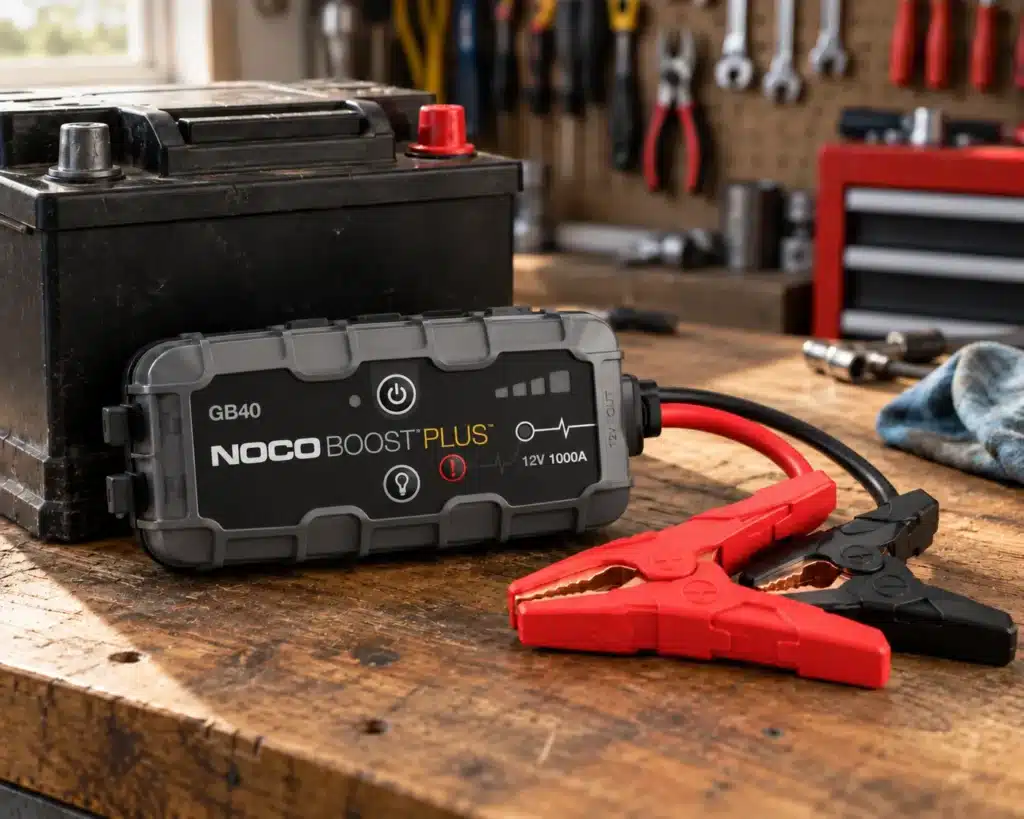
Who it is for. The GB40 is for the driver of a compact car, a crossover or a pickup with a modest gasoline engine, and for anyone who wants a jump starter that rides in a glove box and gets forgotten until the day it matters. It is the smallest of the three NOCO units we cover. It is not a tire inflator, and it is not the unit for a large diesel.
The numbers that matter. The Amazon title lists 1,000 peak amps, gasoline engines to 6.0 liters and diesel to 3.0. NOCO’s December 2024 data sheet agrees with all three and adds a 24 watt hour lithium-ion battery, up to 20 starts per charge, a USB port at 5 volts and 2.1 amps, an operating range of minus 20 to plus 50 degrees Celsius and IP65 protection with the ports closed.
NOCO lists the unit alone at 1.65 pounds and 2.4 pounds with the clamps and accessories. Amazon lists 100 lumens of light with seven modes, a USB-C charging cable in the box and a one year warranty.
What independent sources say. Two outlets covered it, and both name the model. TechGearLab gave the NOCO Boost Plus GB40 a score of 64 out of 100, with power 7, battery 5, craftsmanship 8, ease of use 6 and versatility 5. It reports that the GB40 started a midsize 4.0 liter V6 three times in a row at 33° (TechGearLab’s roundup prints no temperature unit; we read it as Fahrenheit).
It also measured the usable battery at 15.57 watt hours against the 24 claimed, which is about 65 percent. AutoGuide picked the GB40 as its Editor’s Pick in a roundup published on October 9, 2026, praising the clamps and the compact size. The same editors called the claimed engine sizes, 6 liters of gasoline and 3 of diesel, optimistic and noted micro-USB charging.
The name differs a little between Amazon and TechGearLab, and the model number matches, so we treat the link as probable and say so.
What that tells you. The GB40 starts a 4.0 liter gasoline V6 in cold air and has strong clamps. Neither outlet supports a 3.0 liter diesel start or 20 starts per charge, and neither states a method for those figures. So treat 6.0 liters as a ceiling you hope never to approach, and 3.0 liters of diesel as the limit.
How it fits real situations. A four-cylinder commuter car is far inside its rating, and this is the home use. A midsize SUV with a 3.5 or 4.0 liter engine matches the one thing a lab reported. A large V8 is allowed on paper, and we found no independent test at that size.
A large engine in the cold is the hardest job for a small unit, so we would not choose a GB40 for a 5.0 or 6.0 liter engine if the car lives somewhere cold. A diesel pickup is not what this unit is built for.
The battery tells the same story. Fifteen watt hours is enough for a short burst and a phone top-up. It is not a power bank for a weekend. Compare the 86.1 watt hours TechGearLab measured on the GBX155 in the same test. The GB40 is built to deliver a short start, and it does that.
What to watch. There is no air compressor. The charging port may differ by revision, because NOCO’s data sheet and Amazon show USB-C and AutoGuide and Automoblog reported micro-USB. NOCO’s manual copy says Manual Override switches off the spark-proof and reverse polarity protection, so use it only after a normal start fails and connect the clamps correctly the first time.
We found no start limit for the GB40 in the sources we read, and we do not apply the GB70’s or GBX155’s numbers to it. NOCO’s manual copy asks you to charge it fully before first use, to disconnect it from power when you are not charging it and not to leave it charging for more than a week at a time.
Check the charge twice a year, since other brands in this category ask for a recharge every three to six months.
Compared with its neighbors. Against the GB70, the GB40 gives up diesel capability (3.0 liters against 6.0), starts per charge (20 against 40 on the listings) and light (100 lumens against 400), and it gains weight savings: NOCO lists the unit alone at 1.65 pounds against 4 for the GB70. Against the WOLFBOX 4000A and 88.8Wh, the trade runs the other way.
WOLFBOX lists higher peak amps, a larger battery and a 10 liter engine rating for both gasoline and diesel, and its manual lists 3.38 pounds against NOCO’s 2.4 for the GB40 with accessories, so the price of the bigger battery is size. Against the two compressor units, the GB40 is simpler and lighter and cannot inflate a tire.
Your first day with it. Charge it fully, because NOCO’s manual copy says to charge it before first use. Read the light signals: a white Boost light means a proper connection, and a solid red Error light means the clamps are reversed. Then put it where you will find it, and set a reminder to check the charge twice a year.
Choose it if you drive a gasoline car, crossover or small SUV, want the lightest NOCO and do not need a compressor. It also suits a second car or a trunk kit, because a unit this small is easy to keep in the car you use least.
Skip it if you drive a diesel above about 3.0 liters, a large V8 in a cold climate or anything where margin matters more than weight. Look at the GB70 or GBX155 instead. If you want a tire inflator in the same box, look at the A3 or the 24Air.
Read the full NOCO GB40 review and the GB40 vs GB70 comparison.
2. NOCO Boost HD GB70: More Margin Without Much More Bulk

Who it is for. The GB70 is the middle NOCO. It is for the driver of a larger gasoline engine, a pickup, a full-size SUV or a light diesel who wants more margin than the GB40 offers without carrying the heaviest unit. It suits the buyer who prefers clamps attached to the unit and wants a 12 volt output. It has no compressor.
The numbers that matter. Amazon lists 2,000 peak amps, gasoline engines to 8.0 liters, diesel to 6.0 and up to 40 starts per charge, a 400 lumen light and a recharge of about six hours. It lists 5.0 pounds and a one year warranty.
NOCO’s December 2024 data sheet adds what the Amazon bullets we read leave out: a 56 watt hour battery, a 12 volt XGC output at 15 amps, a USB port at 5 volts and 2.1 amps, an operating range of minus 20 to plus 50 degrees Celsius and IP65 with the ports closed. NOCO lists 4 pounds for the unit and 5 pounds with the clamps and accessories.
What independent sources say. TechGearLab gave the Boost HD GB70 71 out of 100, with power 8, battery 5, craftsmanship 9, ease of use 7 and versatility 6. The battery score is low, but it rests on a capacity figure of 24 watt hours that differs from NOCO’s 56, so we do not lean on it. Automoblog reviewed the GB70 on December 17, 2023, and says NOCO supplied the unit.
The author kept it in a winter emergency kit and found it held its charge longer than expected, charged it in about three hours and used the 12 volt port to run a tire inflator.
He named no vehicle he started. 4×4 Australia tested it in a review published June 11, 2019, on a 2003 Land Rover Discovery TD5, a diesel that had sat idle for about a month and would not start. The unit started it once, and the reviewer found the leads short.
What that tells you. The GB70 starts real engines, including a diesel in 2019, and its clamps are well regarded. It does not show that the unit starts any given engine up to its rating. The diesel evidence is one start on one vehicle, on an older revision.
Which revision are you buying? The GB70 has been sold for years, and its documents and reviews date from different years. NOCO’s current user guide (document dated 03.07.2025A) says the unit includes a USB charge cable and does not state the connector type. We do not claim a change history. Check the exact listing before you buy.
How it fits real situations. A full-size SUV with a 3.5 to 5.0 liter engine is well inside the gasoline rating, and that is the use the GB70 is built for. A half-ton pickup with a 5.0, 5.7 or 6.2 liter V8 is covered on paper, and a very flat battery in the cold is the hard case.
A light diesel is covered up to 6.0 liters on paper, and the Discovery is one data point on a smaller engine. If your diesel is above about 5.0 liters or you live somewhere cold, the GBX155 is the safer choice. A trailer, boat or tractor works too, and the 12 volt output powers small 12 volt devices at up to 15 amps per NOCO.
What to watch. There is no compressor. The override threshold is from NOCO’s user guide (document dated 03.07.2025A), which says below 2 volts, a three-second hold and no more than five consecutive starts within 15 minutes. NOCO’s December 2024 data sheet also describes the three-second hold. The capacity discrepancy remains: 56 watt hours per NOCO, 24 in one third-party table, and no measured value for the GB70.
The 12 volt output, in practice. NOCO lists the XGC output at 12 volts and 15 amps, an XGC input of 12 volts at 3 amps for fast charging and an XGC extension cable with male and female 12 volt adapters in the box. Automoblog ran a tire inflator from the 12 volt port. It is a convenience for small 12 volt devices, not a second battery, and NOCO’s user guide recommends against charging and using the unit at the same time.
Compared with its neighbors. Against the GB40, you gain 6.0 liters of diesel capability on paper, a 56 watt hour battery, a 12 volt output and a brighter light (400 lumens against 100), and you carry about 4 pounds instead of 1.65 for the unit alone.
Against the GBX155, you give up engine margin (8.0 and 6.0 liters against 10.0 and 8.0), the 99 watt hour battery and the 60 watt USB-C output, and you save weight, since NOCO lists the GBX155 at 5.82 pounds. Against the WOLFBOX 4000A and 88.8Wh, the GB70 has fixed clamps and a 12 volt output, but a smaller battery and no published starting current.
Your first day with it. Keep the USB charging cable that came with the unit stored with it. Read the guide that came with it, because the thresholds in NOCO’s guide may not apply to your revision. Practice the connection once in daylight, and remember that the white Boost LED lights when the unit is properly connected.
Choose it if you drive a larger gasoline engine or a diesel up to about 6.0 liters, want fixed clamps and a 12 volt output and accept a unit that weighs 4 to 5 pounds.
Skip it if your engine is small and weight matters most, in which case the GB40 is lighter. Skip it too if you drive the largest diesels, where the GBX155 gives the most margin, or if you want a compressor.
Read the full NOCO GB70 review and the GB40 vs GB70 comparison.
3. NOCO Boost X GBX155: For the Largest Engines
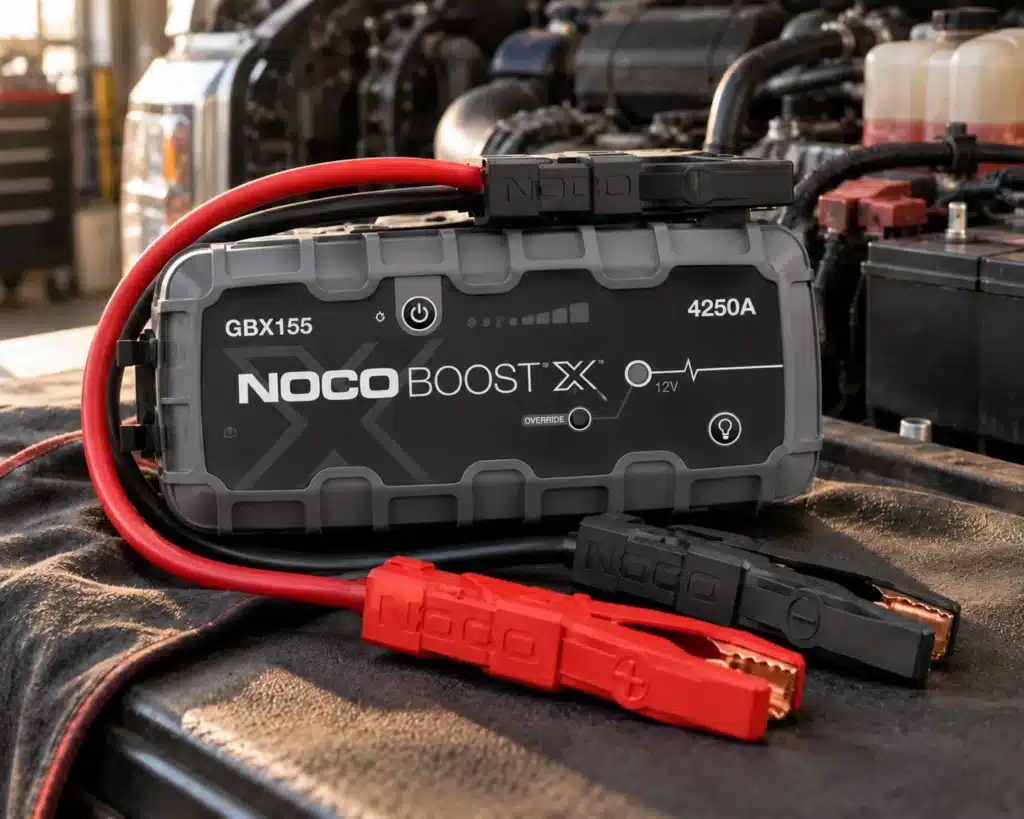
Who it is for. The GBX155 is the strongest NOCO we cover, and it is for the driver of a large truck, a diesel pickup, a work van or a boat with a big engine. It is also for a buyer who wants a jump starter that doubles as a laptop charger and accepts that it is the heaviest of the group at 5.82 pounds in NOCO’s guide. If you only need to start a compact car, a smaller unit is easier to carry.
The numbers that matter. The Amazon title lists 4,250 peak amps, gasoline engines to 10.0 liters and diesel to 8.0. The listing adds up to 18 starts per charge, a full recharge in 2.7 hours over USB-C Power Delivery, a 60 watt USB-C output and a 500 lumen light with seven modes.
NOCO’s user guide, dated June 26, 2024, fills in what the Amazon content we checked did not show: a 99 watt hour lithium-ion battery, IP65 with the ports closed, an operating range of minus 20 to plus 50 degrees Celsius, charging from 0 to 40 and 5.82 pounds. Warranty is one year.
The one battery number you can lean on. TechGearLab fully drained its test units to measure usable capacity, and it measured the GBX155 at 86.1 watt hours against the 99 claimed. That is about 13 percent below the label, which is a normal gap for a portable battery. It is also the only close independent battery measurement among the three NOCO units. In practice, the GBX155 holds several times the energy of the GB40, and that helps with repeated attempts and with charging a laptop afterward.
What independent sources say. TechGearLab scored it 86 out of 100 and named it its Top Pick for Big Engines, with power 9, battery 9, craftsmanship 9, ease of use 7 and versatility 6. It says it tested 13 jump starters, including vehicles from a 650 cc motorcycle to a 6.7 liter V8 diesel truck, but we cannot tie that largest vehicle to a named unit.
For the GBX155 by name, the report is a 2010 Ford Explorer with a 4.0 liter V6, which it started quickly. That is a single lab and a test vehicle far below the 10.0 liter limit. The rating at the top end rests on the maker and the listing.
How the guide shapes real use. The user guide is the most readable of the NOCO documents. When the connection is right, a white Boost LED lights and a 60 second countdown starts. If the engine does not start, you wait 20 to 30 seconds and try again. After 60 seconds the jump function stops, and you turn the unit off and on to start a new sequence.
The guide limits you to five consecutive starts within 15 minutes, then a 15 minute rest. A Cold LED and a Hot LED warn when the internal temperature is outside the safe range. The unit is for 12 volt lead-acid batteries only.
Manual override works on batteries below 3 volts. You hold the button for three seconds and the Boost LED flashes white. The guide is blunt about the risk: manual mode disables all safety measures and also the 60 second timeout, and it warns that misuse can cause injury or death. Do not transfer these numbers to the GB40 or GB70, whose guides give different thresholds.
How it fits real situations. A diesel pickup or heavy-duty truck is the use the GBX155 is built for, and the 8.0 liter diesel rating covers common pickup diesels on paper. A work van that starts many times a day and sits in the cold suits a larger battery, although the five-starts limit applies. A boat or a tractor works if the battery is 12 volt lead-acid, so check the type first.
On a road trip, the 60 watt USB-C output can charge a laptop, and a PD charger tops the unit up quickly. A family with several cars can use one unit for a compact car and a large truck, and if the smaller car is the main use, the GB40 saves weight.
What to watch. There is no air compressor. The engine ratings are claims, and the independent test used a 4.0 liter V6. Starts per charge is a claim with no published method. The unit is heavy for a glove box. Treat the guide’s “keep indoors when not in use” advice as part of owning it, especially in winter.
Compared with its neighbors. Against the GB70, the GBX155 adds 2.0 liters of gasoline and diesel rating, a 99 watt hour battery in NOCO’s guide (86.1 measured) against 56 for the GB70, a 60 watt USB-C output and a documented countdown and start limit, and it adds weight, 5.82 pounds against 4 for the GB70’s unit alone.
Against the two high-capacity WOLFBOX units, the GBX155 lists a higher peak (4,250 against 4,000), while the WOLFBOX 4000A and 88.8Wh is lighter at 3.38 pounds in its manual and lists a starting current. Against the compressor units, it gives you no pump and more engine margin.
Your first day with it. The guide says the unit ships partly charged and must be fully charged before use. Charge it with the included USB-C cable or a NOCO-approved charger. Learn the Cold and Hot LEDs and the double flash that means high voltage at the clamps. Then check that your battery is 12 volt lead-acid, and keep the unit indoors when it is not in use.
Choose it if you drive a large gasoline engine or a diesel and want the strongest NOCO and the best documentation in the group.
Skip it if you drive a compact car and want the lightest option, or if you want a compressor in the same box. The GB70 is the better pick for a midsize engine and a lighter load.
Read the full NOCO GBX155 review.
4. GOOLOO A3: A Compact Combo That Is Honest About Its Numbers
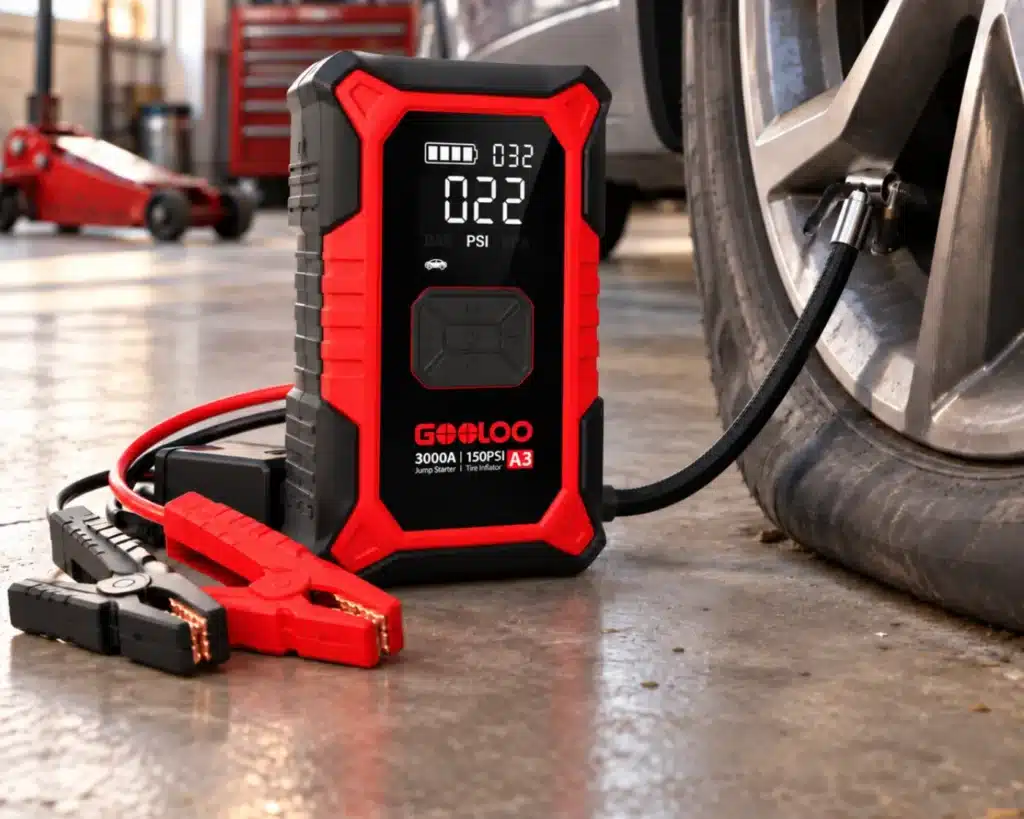
Who it is for. The A3 is for the driver who wants one box for a dead battery and a soft tire, drives a car or a small SUV and does not need a large power bank. It suits someone who values a manual that lists starting current as well as peak. It does not suit someone who wants independent proof for a given model, because we found none.
The numbers that matter. The Amazon title lists 3,000 peak amps, gasoline engines to 9 liters and diesel to 6.5, with a compressor that reaches 150 PSI at 35 liters per minute. The listing names ten protections, five inflation modes, five nozzles, a flashlight and an 18 month warranty.
The manual, for model JS-506 (the listing names Carku as the maker), agrees on the main figures and adds the two that matter most: a starting current of 400 amps and a battery of 44.4 watt hours. Its USB-C port is an input at 5 volts and 2 amps, and its USB-A port is an output at 5 volts and 2.4 amps, which is ordinary phone-charging speed.
The unit operates from minus 20 to plus 60 degrees Celsius per the manual.
Why the two amp figures matter. The 3,000 amps is the peak. The 400 amps is what the manual says the unit can sustain to start an engine. Both can be true, and no test method comes with either. The WOLFBOX 4000A and 88.8Wh manual lists 4,000 peak and 1,000 starting, so on the makers’ own numbers the A3’s starting current is well below that unit’s. The A3 is not a bad unit for that. It is a compact unit, and the manual is open about it.
What independent sources say. We found no controlled independent test of the A3, meaning no reviewer who measured its current, battery or engine limits. We found practical reports. Men’s Journal, in a review dated January 25, 2026, inflated four car tires in about 15 minutes, including getting to know the unit, with the battery indicator down one bar of four. It did not test jump starting or give pressures.
Air Tool Lab, on September 25, 2026, says the author started a car with an almost-dead battery on a chilly morning after pressing BOOST and saw a Tesla Model 3 tire rise from 30 to 36 PSI in about a minute. The vehicle and temperature are not given, and no method is documented.
A third review, by NikkTech, repeats specifications and covers a different model as well, so we do not use its figures for the A3.
What that tells you. The engine ratings, the compressor numbers and the starting current rest on the maker’s own statements. The Amazon listing and the manual agree with each other, which is a good sign but not independent evidence, since both come from the maker. Until a controlled test appears, give the engine rating a margin. If you drive a large diesel or live in a hard freeze, the GBX155 has a stronger case.
How it fits real situations. A compact or midsize car is the main use, with engines up to a few liters well inside the rating. A family car with a slow leak can be topped up in the driveway without a gas station. On a road trip, one box can replace a jumper kit and a plug-in inflator.
A motorcycle, ATV, bicycle or ball is possible, and the listing names a motorcycle mode and bike and ball pumps. The 44.4 watt hours must cover jump starting and inflating, and we found no source that says how many tires one charge fills.
What to watch. GOOLOO’s tutorial page sets the limits: start within 30 seconds of the solid green LED, no more than three consecutive jump starts with two minutes between them, and 30 minutes of cooling before you recharge the unit. BOOST overrides some checks, so press it only after the cable is correctly connected. The manual asks for a recharge at least every three months in storage.
Above 60 degrees Celsius it warns the cells may be damaged, and the tutorial page gives a narrower storage range of minus 10 to plus 45. The sources do not state a weight or a dust and water rating, so check the listing. Use a separate gauge now and then, since we have no accuracy data for the built-in one.
Compared with its neighbors. Against the 24Air, the other compressor unit, the A3 is smaller, with 44.4 watt hours against 88.8, 150 PSI against 160, a phone-speed USB output against 65 watts and a warranty of 18 months against 24, and it has no independent compressor timing. It does have a starting current in its manual, and the 24Air manual lists none.
Against the GB40, it adds a compressor and a starting current, and it lists a 9 liter gasoline rating against 6.0. Against the WOLFBOX 4000A and 88.8Wh, the A3 has a compressor and a lower starting current, 400 amps against 1,000.
Your first day with it. Charge it fully, as the manual says, and check that its own battery shows at least two bars before you ever jump a car. Practice with the smart jumper cable and learn the solid green LED, then try the compressor on a tire with a separate gauge beside it. Set a reminder for the three-month recharge, and if the unit has sat for months, check the battery bars before you rely on it.
Choose it if you want a compact two-in-one for a car and accept that its numbers come from the maker.
Skip it if you want a larger battery and more independent coverage, in which case the 24Air is the other combo. Skip it also for a large diesel or a hard freeze.
Read the full GOOLOO A3 review and the A3 vs 24Air comparison.
5. WOLFBOX MegaVolt 24Air: The Larger Combo With Real Coverage

Who it is for. The 24Air is for the driver who wants a jump starter, a compressor and a power bank in one box, drives a gasoline car or SUV and has room for a bulkier unit. It is the larger of the two combos we cover and the one with the most outside coverage. It is not the lightest option, and its own listing contradicts itself on two points.
The numbers that matter. Amazon sells it as model MV24A, with the item model “megavolt 24 air,” and lists 4,000 peak amps, gasoline to 10 liters and diesel to 6, an 88.8 watt hour battery (24,000 mAh), a compressor rated at 160 PSI and 45 liters per minute, a 65 watt USB-C port, USB-A at 12 or 18 watts, a 160 watt DC output, a 400 lumen light, operation down to minus 4 degrees Fahrenheit and a 24 month warranty.
The manual copy agrees on most of this and adds IP64 and a temperature range of minus 4 to 140 degrees Fahrenheit. The manual lists no starting current, and we do not borrow the figure from the other WOLFBOX unit.
The two disagreements. Amazon’s title says diesel to 6 liters, and the manual copy says 10 for both gasoline and diesel. Amazon says about 3.42 pounds and the manual copy says 5.3, while Car and Driver weighed its test unit at 5.0. We recommend planning around the lower diesel figure and checking the weight yourself. This unit is not the WOLFBOX MegaVolt24 that has no compressor, and we never apply one’s results to the other.
What independent sources say. There are three hands-on or timed sources and one owner report. Popular Science, on February 11, 2026, reports starting a mid-size SUV in about 0 degrees Fahrenheit weather, where it “fired up almost immediately,” plus a crossover, a six-cylinder pickup and a diesel Ford F-350 shop truck that had been sitting too long, with no engine details for the F-350.
It topped off an SUV tire from 25 to 35 PSI in about a minute. Its cons are a slightly heavy unit, a hose that can be short for some valves and a light that drains the battery in long use.
MacSources, on July 17, 2026, used it on a 2013 Ford Escape and a 2019 Dodge Charger SRT Hellcat, reports a recharge of about one hour at 65 watts and lists no wall charger, no car charging adapter, a bulkier body and unknown long-term durability as cons.
Car and Driver tested the compressor by name on a 245/50R20 tire on a Hyundai Santa Cruz, from 10 PSI: 3 minutes 12 seconds to 30 PSI and 6 minutes 10 seconds to 45 PSI, with 84.0 dBA of noise. That is a compressor test only, and it says nothing about jump starting or the 4,000 amp rating.
A DashcamTalk owner reported weak or dead batteries started, a compressor that ran to 3.3 bar without struggling, a 15 volt DC output, an 8 hour timer on the USB ports and a four-bar charge display.
What that tells you. The 24Air starts real vehicles, including a cold SUV and one reported diesel truck, and its compressor has an independent timing. It does not have a measured battery capacity for this model, a controlled diesel test, a number of tires per charge or a resolved weight.
How it fits real situations. A full-size SUV or crossover sits inside the 4,000 amp and 10 liter gasoline figures, and MacSources used it on an Escape. A high-output V8 has some evidence, because of the Hellcat. A pickup tire is claimed at about 2.5 minutes by the listing, but Car and Driver’s timing was for a passenger-car tire, and a larger tire starting lower will take longer.
A camping trip benefits from the 160 watt DC output and the 65 watt USB-C. A diesel needs the lower 6 liter figure in your plan until the listing is clarified.
What to watch. The manual describes cold protection below 0 degrees Celsius that can stop the unit until it warms above 5, and heat protection above 55 that lifts below 45, so in a cold garage the unit may refuse to work until it warms up. The starting limit is eight starts in 10 minutes, then a 10 minute rest.
If pressure does not reach 20 kPa in 50 seconds, the manual says to check for leaks. The compressor is loud. The manual copy is on a third-party host, and the manual asks you to charge fully every six months.
Compared with its neighbors. Against the A3, the 24Air has double the battery (88.8 watt hours against 44.4), a 65 watt USB-C port and more independent coverage, and it is bulkier, with a listing that disagrees with its manual on diesel size and weight.
Against the WOLFBOX 4000A and 88.8Wh, it adds the compressor and carries the same battery, but the other unit lists a starting current and a manual weight of 3.38 pounds. Against the GBX155, it adds the pump and the power bank, and its Amazon title lists less diesel margin, 6 liters against 8.0.
Your first day with it. Charge it fully. The manual asks for a full charge every six months, and MacSources reports about an hour at 65 watts and no wall charger in the box, so have a PD charger ready. Check the exact variant you received against the listing you read. Learn BOOST and the cold lockout, and try the compressor with a separate gauge, since Popular Science found the hose can be short for some valves.
Choose it if you want one box for starting, inflating and charging, you drive a gasoline engine and you value independent coverage.
Skip it if you want the lightest unit, in which case the GB40 is the answer, or if you do not need a compressor. The WOLFBOX 4000A and 88.8Wh offers the same battery size without the pump.
Read the full WOLFBOX 24Air review and the A3 vs 24Air comparison.
6. WOLFBOX 4000A and 88.8Wh: High Capacity, No Compressor

Who it is for. This WOLFBOX is for the driver who wants a high-capacity unit with a documented starting current and does not need a compressor. It suits a full-size SUV, a pickup or a large gasoline V8, and a person who works from the car and wants a 65 watt USB-C port. It does not inflate tires.
The numbers that matter. The Amazon title is “WOLFBOX 4000A & 88.8Wh Battery Jumper Starter Portable (10L/10L), with Booster.” It lists 4,000 peak amps, 10 liters for both gasoline and diesel engines, an 88.8 watt hour battery, an HD LCD screen, 65 watt USB-C in and out, a QC3.0 USB-A port, an LED with SOS, strobe and high-beam modes, IP64 and a range of minus 4 to 140 degrees Fahrenheit.
The manual, for the MegaVolt24 V1.0 published October 25, 2024, calls 4,000 the peak and lists a separate starting current of 1,000 amps, a weight of 3.38 pounds and a two-year limited warranty. That starting figure is 2.5 times the A3’s on the makers’ own numbers, and neither maker publishes how it was measured.
The identity question. TechGearLab reviewed a unit it calls the WOLFBOX MegaVolt24, which has no compressor, and named it Best Overall with 82 out of 100 (power 9, battery 8, craftsmanship 8, ease of use 8 and versatility 6). It lists 4,000 amps, 10 liters for both fuels and 1.45 kilograms, and it measured 82.3 watt hours against the 88.8 claimed by fully draining the unit.
The Amazon bullets use the same name, and the capacity and engine ratings match. We have no serial number or revision to prove the tested unit is the same hardware as the one in your box, so we link the evidence by name only. It is a different product from the 24Air.
What the lab and the hands-on report say. In TechGearLab’s test, the unit used about 3 percent of its battery on each of three jump starts of a drained 2010 Ford Explorer.
Its cons are that the clamps are stubby and do not fit tight spaces well, there is no compressor and the power button can be pressed inside the carrying case, so it could switch on and drain the battery over months. Live Work Dream, in an article supplied by WOLFBOX, started a borrowed Toyota FJ with a dead battery.
The unit arrived at 72 percent charge, the author did not press Boost, and he says a full charge takes about 1.3 hours and that the jumper leads are about eight inches long. We count it as a modest, friendly report.
What the sources disagree on. Amazon says a full charge takes 1.3 hours and the manual says about 1.5 to 2, with the 67 watt charger its FAQ mentions. Live Work Dream also says 1.3, so plan on the longer figure to be safe. The manual also contradicts itself on starts: it mentions about 40 consecutive starts and also says not to start more than three times in a row. Use the stricter limit. The 40 figure has no stated method.
How it fits real situations. A full-size SUV or crossover is well inside the rating. A pickup or large gasoline V8 is covered, and the lab’s test vehicle was a 2010 Ford Explorer, with a higher rating on paper. A diesel truck has only the maker’s rating and the lab unit’s 10 liter listing behind it. A boat works if you check the battery type. Working from the road is a good fit, since the 65 watt USB-C port can charge a laptop.
What to watch. The manual says to remove the clamps within 30 seconds, to start no more than three times in a row and then wait two minutes, and to use BOOST only if a normal start fails. It also says not to use BOOST when the vehicle voltage is below 9 volts or when the unit’s own battery is below 50 percent.
The unit shuts off after two minutes of standby, and the light turns off after four hours. The listing says it passed UL, FCC, CE and CA65 checks, and we did not see the certificates. Keep the power button from being pressed in the bag.
The screen, the light and the temperature limits. The HD LCD screen is one of the things Amazon lists first. The manual copy gives an operating range of minus 20 to 60 degrees Celsius and allows charging at 0 to 45. Temperature protection starts at 55 and 45 degrees on the hot side, and at minus 20 and between 0 and 3 degrees on the cold side. The unit switches itself off after two minutes on standby, and the light turns off after four hours.
Compared with its neighbors. Against the 24Air, this unit has no compressor and a documented starting current of 1,000 amps, and its manual weight is 3.38 pounds against 5.3 for the 24Air’s. Against the GBX155, the battery is similar (88.8 watt hours claimed against 99, and 82.3 measured on the same-named unit against 86.1), and the GBX155 lists a higher peak, 4,250 against 4,000, with the better documentation of the two. Against the A3, it has twice the battery and 2.5 times the starting current, and it cannot inflate a tire.
Your first day with it. Charge it with a PD charger, and plan on the longer 1.5 to 2 hour figure. Learn the screen and the BOOST conditions, and keep the button from being pressed in the bag. Then practice the connection once in daylight and re-read the three-start limit.
Choose it if you want high capacity, a documented starting current and no compressor.
Skip it if you want to inflate tires, in which case the 24Air is the answer, or if you want the strongest documentation for the largest engines, where the GBX155 is the better documented unit.
Read the full WOLFBOX 4000A and 88.8Wh review.
How We Chose and How We Checked
We chose units that are common on Amazon and have enough public information to compare. For each, we read:
- The Amazon.com listing for the exact ASIN. This is our commercial baseline for standard specifications.
- The maker’s documents, where we could read them. NOCO’s GB40 and GB70 data sheets (December 2024) and its GBX155 user guide are primary sources. Other manuals are copies on third-party sites, and we say so.
- Independent tests and reviews that name the model. We link a result to a unit only when the name matches, and we say when the link is by name only.
Throughout this guide, each important number carries one of these labels:
- Amazon listing: what the page says.
- Maker: what the maker’s document says.
- Measured: a number an independent reviewer measured.
- Hands-on: a reviewer used the unit and described what happened.
- Owner report: one person’s forum post.
When the labels disagree, we show both numbers rather than pick the more convenient one. For the Amazon column, we read each listing’s title and bullets. We did not read every part of every page, so “not found in the content we checked” never means the page lacks the figure. Our picks come from reading these sources, and we do not claim to have run our own measurements on any unit.
Where the Sources Disagree
| Unit | Disagreement | What we do |
|---|---|---|
| 24Air | Diesel 6 L (Amazon title) against 10 L (manual) | Show 6 L first. Plan around it |
| 24Air | Weight 3.42 lb (Amazon) against 5.3 lb (manual and Popular Science’s spec list) | Show the figures with their sources. Car and Driver weighed 5.0 lb |
| WOLFBOX 4000A/88.8Wh | Recharge 1.3 h (Amazon) against 1.5 to 2 h (manual) | Plan on the longer figure |
| WOLFBOX 4000A/88.8Wh | Manual lists about 40 consecutive starts and also three in a row | Use the stricter limit |
| NOCO GB70 | Capacity 56 Wh (NOCO data sheet) against 24 Wh (TechGearLab table) | Show both, use NOCO’s 56 |
| NOCO GB70 | Weight 5.0 lb (Amazon, NOCO with accessories), 4 lb unit (NOCO), 4.2 lb (TechGearLab) | Different contexts, show each |
| NOCO GB40 | Weight 2.5 lb (Amazon), 2.4 lb with accessories and 1.65 lb unit (NOCO), just under 1.5 lb (AutoGuide) | Different contexts, show each |
What the Evidence Cannot Tell You
- No source we found tested the top of any unit’s engine rating. TechGearLab says its overall test included a 6.7 liter V8 diesel truck, but we cannot tie that test to a named unit.
- The GOOLOO A3 has no controlled independent test that we found. Two practical reports exist (Air Tool Lab and Men’s Journal), and neither measured current or energy.
- MegaVolt24 and 24Air are different products. Results for one are never applied to the other.
- Starts per charge are claims. No maker states a method.
- Our Amazon reading is partial. We read titles and bullets.
- Some documents are second-hand. Two manual copies are on third-party hosts, and the NOCO specifications pages for the GB40 and GB70 are cited without our own confirmation.
- Revisions change. The GB70 has been sold for years, and its documents describe different hardware.
- We cannot say how many tires a charge inflates. No source we read gives that figure for either compressor.
Independent Evidence We Used
| Unit | Source and date | Type |
|---|---|---|
| GB40 | TechGearLab, updated 2026-04-29, 64 of 100 | Measured and hands-on |
| GB40 | AutoGuide roundup, 2026-10-09 | Hands-on |
| GB70 | TechGearLab, 71 of 100, weight 4.2 lb | Hands-on, capacity unclear |
| GB70 | Automoblog review, 2023-12-17 | Hands-on, supplied by NOCO |
| GB70 | 4×4 Australia, 2019-06-11, one diesel start | Hands-on, older revision |
| GBX155 | TechGearLab, 86 of 100, 86.1 Wh | Measured |
| A3 | Air Tool Lab, 2026-09-25 (one BOOST start, one tire top-up, no method) | Anecdotal |
| A3 | Men’s Journal, 2026-01-25 (four tires in about 15 minutes, indicator down one bar of four, no jump start) | Practical report |
| A3 | GOOLOO tutorial page (start limits, charging, storage) | Maker |
| 24Air | Popular Science, 2026-02-11 | Hands-on |
| 24Air | Car and Driver, updated 2026-02-17 (compressor timing, 245/50R20, from 10 PSI) | Independent timed test, model named |
| 24Air | MacSources, 2026-07-17 | Hands-on |
| 24Air | DashcamTalk, thread from 2025-11-09 | Owner report |
| WOLFBOX 4000A/88.8Wh | TechGearLab MegaVolt24, 82 of 100, 82.3 Wh (linked by name) | Measured |
| WOLFBOX 4000A/88.8Wh | Live Work Dream (MegaVolt24, supplied by WOLFBOX), one start of a borrowed Toyota FJ, charge about 1.3 h | Hands-on, modest |
TechGearLab says it bought 13 jump starters and measured usable capacity by fully draining each one.
Eight Common Mistakes
- Buying on peak amps alone. The A3’s peak is 3,000 and its starting current is 400. Look for the starting number and the engine rating.
- Ignoring the diesel rating. It is usually lower than the gasoline rating, and a diesel needs more margin.
- Mixing up override and boost between brands. The thresholds and the consequences differ, and on NOCO units the override switches off the safety checks.
- Pressing boost or override before the cables are connected. Connect correctly first, press the button last.
- Skipping the recharge schedule. Manuals ask for a recharge every three to six months.
- Leaving the unit in a hot car. The A3 manual warns that above 60 degrees Celsius the cells may be damaged.
- Believing the first number you see. The 24Air shows why: the listing and the manual disagree on diesel size and weight.
- Expecting a jump starter to fix a bad battery or starter. It will not, and a battery that dies every few days needs a test.
Your Pre-Purchase Checklist
Before you buy, run through these questions:
- What is my engine size, and is it gasoline or diesel? Is the rating above it, with margin?
- Do I live where it gets very cold? Does the unit list a cold range and cold protection?
- Do I want a compressor, or will it just add bulk?
- Do I need to charge a laptop? If so, does the unit list a 60 or 65 watt USB-C port?
- Where will it live, and what weight matters: the unit alone or the whole kit?
- Which exact listing am I on, and is it the variant I read about?
- Does the maker’s manual list a starting current, start limits and an override rule?
- Do I know my unit’s connection light and what it means?
- Have I set a reminder to recharge it every three months?
- Where will I read the manual: in the glove box or on my phone before I need it?
After the unit arrives, charge it fully, read the manual and practice the connection once in daylight. Learning the lights and the boost rule on a quiet afternoon is much easier than on a dark roadside.
Frequently Asked Questions
What size jump starter do I need?
One rated above your engine size, with margin for diesel and cold. Your engine size is in the owner’s manual or on a label under the hood.
Which jump starter is best for a V8?
The GB70, GBX155, 24Air and WOLFBOX 4000A and 88.8Wh are rated for large gasoline engines. The GBX155 gives the most margin.
Which has the largest battery?
The GBX155 at 99 watt hours in NOCO’s guide (86.1 measured), then the WOLFBOX units at 88.8.
Do I need a compressor?
Only if you want one box for two jobs. A compressor makes the unit bulkier, and it shares the battery.
Can they charge a laptop?
The GBX155, 24Air and WOLFBOX 4000A and 88.8Wh list USB-C ports of 60 or 65 watts. The A3’s ports are phone speed.
Can a jump starter damage my car?
Used correctly, jump starters have protections against reversed clamps and short circuits. Connect the cables correctly, follow the manual and treat boost and override as a last resort.
How often should I charge it?
Follow your manual. Three to six months is the range we saw.
Can I leave it in my car?
Do not leave it in a hot car. The A3 manual warns of cell damage above 60 degrees Celsius. In winter, keep it indoors and carry it out when you need it.
How many starts can I try in a row?
It depends on the unit: five in 15 minutes for the NOCO guides, eight in 10 minutes for the 24Air and three in a row for the A3 and the WOLFBOX 4000A and 88.8Wh. Check your own manual.
What does peak amps mean?
It is the highest brief current the unit can reach. Starting current is what it can sustain, and only some manuals list it.
Is it the same as a battery charger?
No. A jump starter gives a short burst to start the engine. It does not repair or recharge a car battery for long-term use.
Are the specifications on Amazon always right?
Not always. Amazon is our baseline, but the maker’s document sometimes differs, as on the 24Air. We show both.
What if my jump starter does not work?
Check its own charge, the clamp connection, the temperature and the start limits before blaming the car. See Jump Starter Not Working: What to Check.
Where to Go Next
- How to Choose a Jump Starter
- How to Use a Jump Starter Safely
- Jump Starters with Air Compressors
- NOCO GB40 vs GB70
- GOOLOO A3 vs WOLFBOX MegaVolt 24Air
The Bottom Line
Match the unit to your engine, add margin for diesel and cold, treat amps as a rough class and read the maker’s own limits. A simple, light unit suits a compact car. A larger unit suits a V8 or a diesel. A combo suits a gasoline car owner who wants one box. Where our sources are thin, we say so, and you should check the exact listing before you buy.
Sources and How We Checked
- Amazon listings (titles and bullets read on 2026-10-29): GB40 listing, GB70 listing, GBX155 listing, A3 listing, 24Air listing, WOLFBOX 4000A and 88.8Wh listing.
- NOCO Boost X GBX155 User Guide and Warranty, June 26, 2024: https://no.co/media/wysiwyg/downloads/User_Guides/Boost_X/GBX155_User_Guide_06.26.2024.pdf
- NOCO GB40 data sheet, December 2024: https://no.co/media/wysiwyg/downloads/brochures/Boost/GB40_Data_Sheet_12.05.2024.pdf
- NOCO GB70 data sheet, December 2024: https://no.co/media/wysiwyg/downloads/brochures/Boost/GB70_Data_Sheet_12.05.2024.pdf and specifications page: https://no.co/gb70/specs. User guide (NOCO, document dated 03.07.2025A): https://no.co/media/wysiwyg/downloads/User_Guides/Boost/GB70-User_Guide_03.07.2025A.pdf
- GOOLOO A3 tutorial page (maker, read 2026-10-30): https://us.gooloo.com/blogs/tutorials/a3-jump-starter
- Manual copies for the NOCO GB40, GOOLOO A3 (JS-506), WOLFBOX MegaVolt 24Air and WOLFBOX MegaVolt24 V1.0 on third-party hosts (ManualsLib and manuals.plus).
- TechGearLab, Best Jump Starters (updated 2026-04-29): https://www.techgearlab.com/topics/tools/best-jump-starter. Model pages: https://www.techgearlab.com/reviews/tools/jump-starter/noco-boost-plus-gb40, https://www.techgearlab.com/reviews/tools/jump-starter/noco-boost-x-gbx155 and https://www.techgearlab.com/reviews/tools/jump-starter/wolfbox-megavolt24
- AutoGuide, The Best Portable Car Jump Starters (published 2026-10-09): Editor’s Pick, engine size comments.
- Automoblog: NOCO GB70 review (2023-12-17) https://www.automoblog.com/noco-gb70-review/ and NOCO GB40 vs. NOCO GB70 (2024-02-12) https://www.automoblog.com/noco-gb40-vs-noco-gb70/
- 4×4 Australia, NOCO GB70 product test (2019-06-11): https://www.4x4australia.com.au/gear/electronics-gadgets/noco-gb70-jump-starter-pack-4×4-product-test
- Popular Science, Wolfbox 4-in-1 Jump Starter with Air Compressor review (2026-02-11): https://www.popsci.com/gear/wolfbox-4-in-1-jump-starter-with-air-compressor-review/
- MacSources hands-on review of the WOLFBOX MegaVolt 24Air (2026-07-17), a LinkedIn repost with a link on record: https://www.linkedin.com/pulse/wolfbox-megavolt-24-air-4-in-1-jump-starter-compressor-review-8zetf/
- DashcamTalk thread (owner report): https://dashcamtalk.com/forum/threads/wolfbox-megavolt-24air-jump-starter-with-air-compressor.57990/
- Live Work Dream (WOLFBOX MegaVolt24, supplied by WOLFBOX): https://liveworkdream.com/2024/05/15/how-the-wolfbox-megavolt24-jump-starter-made-everything-go-as-planned/
- Air Tool Lab, GOOLOO A3 (2026-09-25), anecdotal: https://airtoollab.com/gooloo-a3-12v-3000a-jump-starter-review-reliable-portable/
- Car and Driver, Tested: The Best Portable Tire Inflators (updated 2026-02-17): https://www.caranddriver.com/car-accessories/g42589683/best-portable-tire-inflators-tested/
- Men’s Journal, GOOLOO A3 inflator review (2026-01-25), practical report: https://www.mensjournal.com/shopping/gooloo-a3-jump-starter-tire-inflator-review