How a Lithium Jump Starter Works: Cells, Protections and Limits
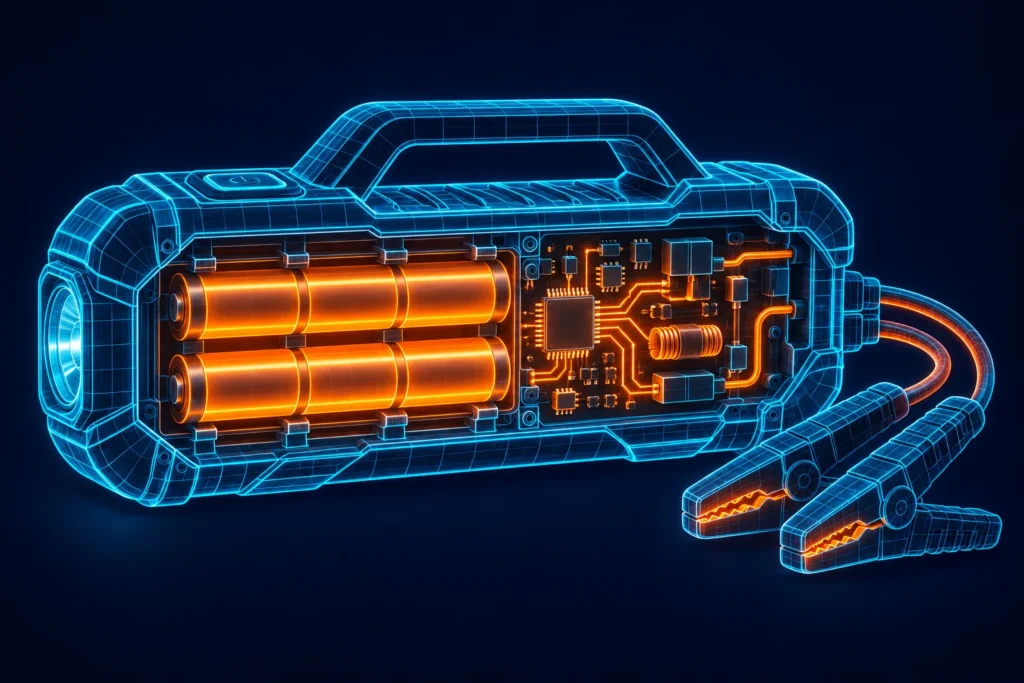
Short answer: A lithium jump starter is a pack of lithium-ion cells, a control board and a pair of cables. The cells store energy and can release it in a strong burst. The control board watches the voltage, the current and the temperature, checks the connection and shuts the output off when something is wrong. Those protections guard against outside abuse, such as a short or a reversed connection. They do not repair a damaged cell, and they do not make a unit safe in a hot car or after it has been damaged.
This page explains how the technology works. Storage and recharge rules are in How to Store and Recharge a Jump Starter, the damage question is in Can a Jump Starter Damage the Battery or the Car’s Electrical System?, and the electricity basics are in Volts, Amps and Watt Hours.
The Parts
The cells. Lithium-ion cells store energy in a compact, light pack. This is why a unit that starts a car can weigh a few pounds: NOCO lists the GB40 unit alone at 1.65 pounds and the GBX155 at 5.82.
The control board. A circuit that monitors the pack and the output. Makers call it a battery management system or simply protection circuitry. It switches the output on only when the connection looks right and switches it off when a limit is crossed.
The cables and clamps. They carry the current to the vehicle. Some units have the cable attached and some use a plug-in cable. The clamps carry a sensing signal on some units, which is how the board decides the connection is correct.
The extras. A unit may add a USB port, a light or a compressor. They draw from the same cells.
How It Delivers a Strong Burst
Lithium cells can release their energy quickly. The unit does not hold much energy in absolute terms: the units we cover list capacities from 24 to 99 watt hours. What it must do is deliver a large current for a few seconds, and that is why makers quote peak amps. The burst uses little energy. TechGearLab reported about 3 percent of a unit’s battery per start on a WOLFBOX MegaVolt24. The unit then needs to be recharged, because it has lost energy and because lithium cells discharge slowly when stored.
What the Protections Do
Battery University, a reference site on batteries, describes the protections used in lithium-ion packs. The ideas apply to jump starters, though we do not know the exact design of any unit we cover.
- A protection circuit stops charging when a cell reaches about 4.30 volts and cuts the current at about 2.20 volts per cell, to prevent over-discharge. These are Battery University’s example figures for lithium-ion cells in general, not the limits of any unit.
- A PTC device guards against current surges.
- A fuse can cut the current if a cell’s skin temperature approaches about 90 degrees Celsius (194 degrees Fahrenheit).
- A separator in the cell can shut down the flow of ions above a temperature threshold.
- A circuit interrupt device and a safety vent open the circuit at a certain internal pressure and release gas at a higher one.
Makers add protections of their own. The units we cover list reverse polarity and short circuit protection, and several list spark-proof clamps, overheat protection and low-temperature protection. The 24Air manual describes cold protection below 0 degrees Celsius that is lifted above 5, and heat protection above 55 that is lifted below 45. The GOOLOO A3 listing names ten protections.
What the Protections Cannot Do
Battery University is clear about the limits:
- They guard against outside abuse. The protection circuit stops a short or a faulty charger. It cannot stop an internal defect in a cell, such as metal contamination.
- They can fail. A switch inside the circuit can fail in the on position without the user noticing, and overcharging can follow. Heat and bulging are early warnings, but some batteries fail without warning.
- They are not the same in every pack. The article notes that large multi-cell packs often omit some protections, and that a cascade can follow.
- They are not a test result. For the units we cover, no maker explains how its protections were tested, and we found no independent test that confirms them.
What this means for you:
- Do not use a damaged unit. The NOCO GBX155 guide says not to use the product if it is damaged.
- Watch for heat and swelling. Stop using a pack that gets unusually hot or that bulges.
- Respect the temperature limits. The A3 manual warns that cells may be damaged above 60 degrees Celsius.
- Do not switch off the protections without a reason. On NOCO units, the guides say manual override switches off the spark-proof and reverse polarity protection.
Why Cold Matters
Temperature limits apply both to using a unit and to charging it, and they are different numbers. NOCO lists charging for its units only from 0 to 40 degrees Celsius, and operating from minus 20 to plus 50. The WOLFBOX 24Air stops below 0 degrees Celsius until it warms. Battery University notes that stopping use and charging when a pack’s temperature rises by more than 10 degrees Celsius during a regular charge is a sound precaution.
Why Capacity Is Lower Than the Label
A battery cannot be drained to the last drop. TechGearLab measured usable capacity on several units and found 15.57 watt hours against 24 claimed for the NOCO GB40, 86.1 against 99 for the GBX155 and 82.3 against 88.8 for the WOLFBOX MegaVolt24. Part of the gap is the voltage limits in the previous section, which keep the cells from being drained too far.
What We Could Not Verify
- The design of any unit’s protection circuit. Makers describe the features, not the circuit.
- Whether a unit’s protections work in every case. No independent test.
- Battery chemistry details for each unit. The manuals we read describe lithium cells in general terms. The A3 manual calls its battery lithium polymer.
Frequently Asked Questions
Is a lithium jump starter safe?
Used within its limits and undamaged, makers design them to be. The protections are a safeguard, not a guarantee, and a damaged or overheated pack should not be used.
What is a battery management system?
A term makers use for the circuit that monitors the cells and the output and protects them. We found no independent test of any unit’s.
Why does a jump starter weigh so little?
Lithium-ion cells store a lot of energy for their weight. NOCO lists the GB40 unit alone at 1.65 pounds.
Can a jump starter explode?
Lithium packs can fail under abuse, damage or heat. Follow the manual, keep the unit inside its temperature range and do not use a damaged one.
Why do manuals warn about heat?
Heat shortens the life of the cells and can damage them. The A3 manual warns that cells may be damaged above 60 degrees Celsius.
The Bottom Line
A lithium jump starter stores energy in cells and releases it in a strong burst under the control of a protection circuit. The protections guard against outside abuse, they have limits and they are the maker’s claim. Respect the temperature limits, do not use a damaged unit and do not switch off the protections without a reason.
Sources
- Battery University, BU-304b: Making Lithium-ion Safe (protection devices, limits, operating limits): https://www.batteryuniversity.com/article/bu-304b-making-lithium-ion-safe/
- TechGearLab, Best Jump Starters (measured capacity, 3 percent per start, updated 2026-04-29): https://www.techgearlab.com/topics/tools/best-jump-starter
- NOCO Boost X GBX155 User Guide, June 26, 2024 (damaged units, temperature ranges, override): https://no.co/media/wysiwyg/downloads/User_Guides/Boost_X/GBX155_User_Guide_06.26.2024.pdf
- NOCO GB40 and GB70 data sheets, December 2024: https://no.co/media/wysiwyg/downloads/brochures/Boost/GB40_Data_Sheet_12.05.2024.pdf
- Manual copies for the GOOLOO A3 (JS-506) and WOLFBOX MegaVolt 24Air on third-party hosts.