Car Battery Types Explained: Flooded, EFB and AGM
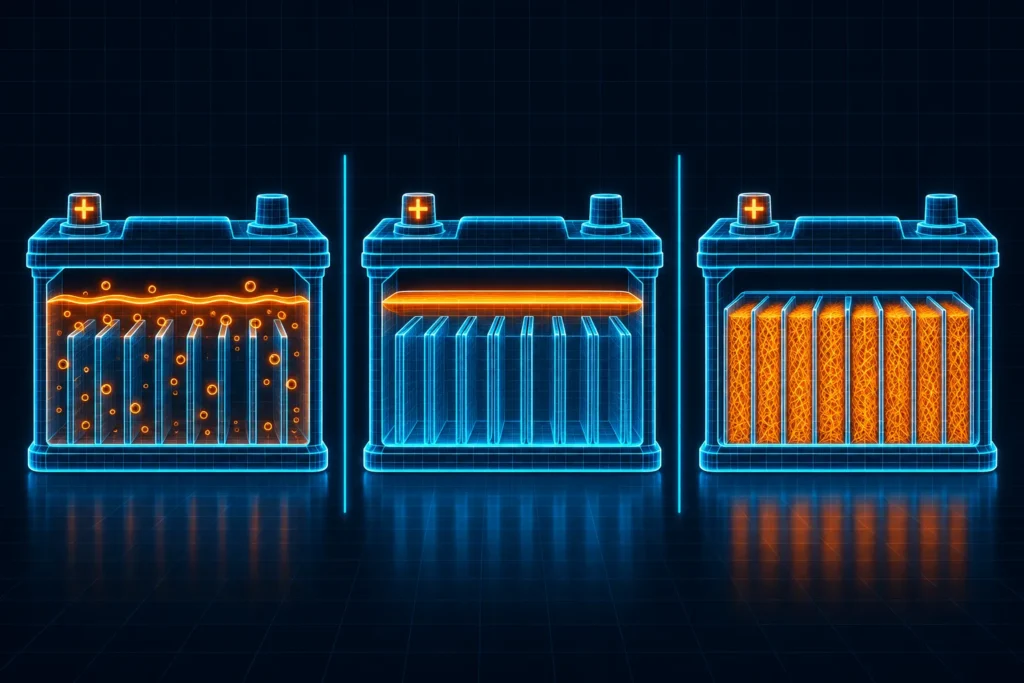
Short answer: Most cars use one of three types of 12 volt lead-acid battery. A standard flooded battery is the conventional design for ordinary loads. An enhanced flooded battery (EFB) is a wet battery built for frequent charge and discharge, and a number of start-stop cars use it. An absorbent glass mat (AGM) battery holds its electrolyte in glass mats and suits many newer cars with start-stop or heavy electrical loads. Replace a battery with the type your vehicle needs, and check that your jump starter lists that type.
This page explains the types. How to read a battery’s cold cranking rating is in Cold Cranking Amps Explained. The causes of battery failure are in Why Does a Car Battery Die?.
The Three Types
Standard flooded. Interstate Batteries describes the standard battery as a lead-acid battery used to crank a car’s engine, suited to ordinary electrical loads. It names the Toyota Tacoma, Toyota Corolla and Lexus RX as vehicles that use it.
Enhanced flooded battery (EFB). An EFB is wet, like a standard flooded battery, but Interstate says it is more durable, stores more energy and has a longer life. It is described as start-stop friendly because it handles the quick charge and discharge cycles that come from regenerative braking. Interstate gives start-stop versions of the Fiat 500, Toyota Yaris and the Ford ECOnetic range as examples, and calls EFB more affordable than AGM.
Absorbent glass mat (AGM). An AGM battery uses glass mats that absorb all of the electrolyte, which makes it spill proof, according to Interstate. The article calls AGM the standard for modern cars because of their higher power demands, and “the smart choice” for many new cars with start-stop technology or power-hungry accessories, naming the Buick Encore, Jeep Compass and Ford F-150. Interstate says AGM has low internal resistance, which lets it charge faster and last longer in those cars, and that a pure lead AGM can have up to twice the cycle life of a flooded battery. That last figure is the retailer’s claim.
Why Start-Stop Cars Matter
A start-stop system shuts the engine off at a stop and restarts it when you move. The battery works harder: it starts the engine many more times and powers the car while the engine is off. This is why some vehicles ask for an EFB and others for an AGM.
Interstate is direct about substitution. When you replace a battery it is essential to get the right one. A standard flooded battery might not suit a vehicle that needs more than the usual power load, and an AGM is a must for cars that already come with one. Interstate also notes that a vehicle can have several battery configurations, and that the vehicle’s PR codes, on a tag near the spare tire or in the warranty booklet, help you choose the one that matches.
How to Find Out What Your Car Uses
- Look at the battery label. The label states the type.
- Read the owner’s manual. It lists the battery specification.
- Check the PR code tag near the spare tire or the warranty booklet, as Interstate suggests.
- Ask a battery seller or a mechanic to match the battery to your exact vehicle.
Do not guess from the price or the size. A battery that fits the tray may not be the type the car needs.
What the Type Means for a Jump Starter
A jump starter connects to the battery and sends a burst of current to the starter. The makers’ documents that we read list battery types in two different ways:
- NOCO GB40. The data sheet lists lead-acid batteries of the wet, gel, MF, EFB and AGM types.
- NOCO GBX155. The user guide says the unit is for 12 volt lead-acid batteries only.
- GOOLOO A3, WOLFBOX MegaVolt 24Air and WOLFBOX 4000A and 88.8Wh. We did not find a list of battery types in the manual pages we read.
So before you use a jump starter, check that your manual allows your battery type. We found no maker guidance that says an AGM or an EFB needs a different procedure, and we do not invent one. Your vehicle manual may name a jump-start point and may restrict jump starting for vehicles with start-stop or high-voltage systems.
Many hybrids and electric vehicles have a 12 volt auxiliary battery too, but this is not universal: low-voltage designs and approved external-power procedures vary by vehicle, model year and battery configuration. A jump starter should never be connected to the high-voltage battery, and you should follow the vehicle manufacturer’s instructions before connecting one. See Jump Starting a Hybrid or Electric Vehicle for the vehicle makers’ rules.
What We Do Not Know
- Which battery types are safe with each unit. For four of the units we cover, the manual pages we read do not list battery types.
- Whether the type changes the way a jump start works. We found no source that says it does.
- Lifespan by type. The only figure we saw is a retailer’s claim of up to twice the cycle life for a pure lead AGM against a flooded battery.
Frequently Asked Questions
Can I use a standard battery in a start-stop car?
Interstate says to get the right one and that an AGM is a must for cars that come with one. Follow your manual.
Is an AGM battery better?
It is built for heavier demands and costs more, according to Interstate. It is the right choice if your vehicle needs one, and not an upgrade to chase for a simple car.
How do I know which battery my car has?
The battery label, the owner’s manual and the PR code tag.
Does a jump starter work on an AGM battery?
Check the unit’s manual for the battery types it lists. The NOCO GB40 data sheet lists AGM. For the other units, we did not find a list.
Do I need a special charger?
Check the charger’s and the battery’s documents. We did not read a source on this and make no claim.
The Bottom Line
Flooded, EFB and AGM are three versions of the 12 volt lead-acid battery. Use the type your vehicle needs, and check that your jump starter lists that type before you use it.
Sources
- Interstate Batteries, The Difference Between AGM and Enhanced Flooded Batteries (types, start-stop vehicles, substitution warnings, PR codes): https://www.interstatebatteries.com/blog/absorbed-glass-mat-enhanced-flooded-battery-whats-the-difference
- NOCO GB40 data sheet, December 2024 (battery types): https://no.co/media/wysiwyg/downloads/brochures/Boost/GB40_Data_Sheet_12.05.2024.pdf
- NOCO Boost X GBX155 User Guide, June 26, 2024: https://no.co/media/wysiwyg/downloads/User_Guides/Boost_X/GBX155_User_Guide_06.26.2024.pdf