Volts, Amps and Watt Hours: The Basic Electricity Behind a Jump Starter
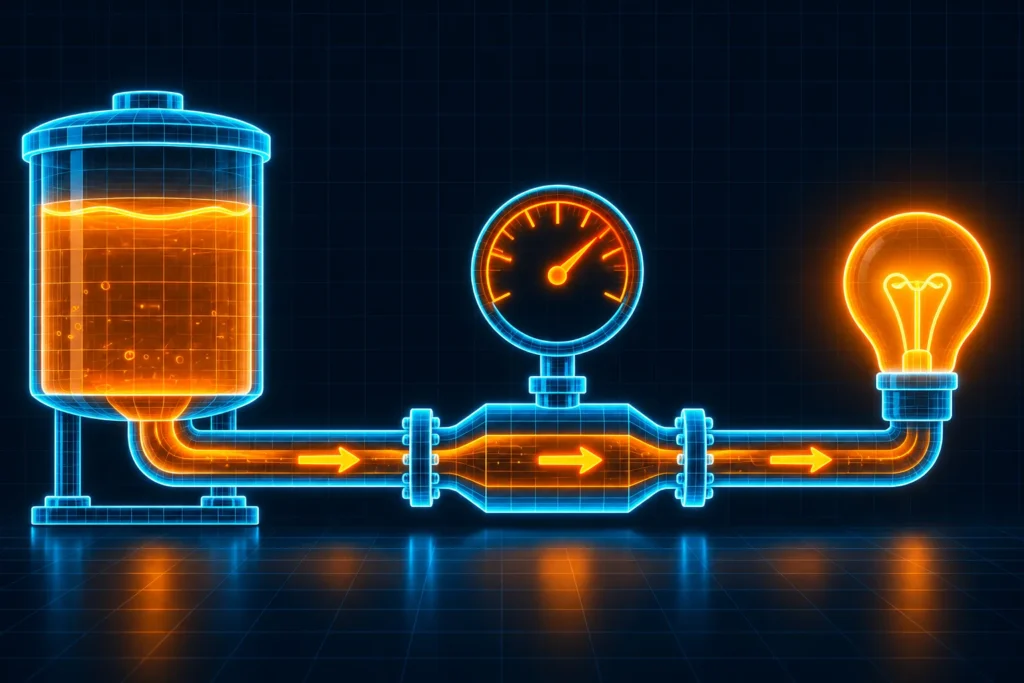
Short answer: Volts measure the electrical pressure, amps measure the flow, watts are volts times amps, and watt hours measure the energy a battery holds. A jump starter delivers a very large current for a few seconds, so it needs power more than energy. Watt hours matter when you ask the battery to do longer work, such as inflating a tire or charging a laptop. To convert milliamp hours to watt hours, multiply by the voltage and divide by 1,000.
This page teaches the electricity. How to compare the units we cover, and the measured capacities, are in Portable Jump Starters. The terms are also defined in the Jump Starter Glossary.
Volts: The Pressure
Voltage is the push that moves current through a circuit. A car runs on a 12 volt system. Interstate Batteries gives a healthy car battery as about 12.77 volts when it is at rest. A jump starter built for cars delivers 12 volts to match. Heavy trucks may use 24 volts, and a unit made for 12 volts is not the right tool for them. The NOCO GBX155 guide says the unit is for 12 volt lead-acid batteries only, and that a double flash means it detected a higher voltage at the clamps.
Voltage also explains why the clamps must go on the right terminals. The system is built around one direction of current, and a reversed connection pushes it the wrong way. That is the subject of Can a Jump Starter Damage the Battery or the Car’s Electrical System?.
Amps: The Flow
An ampere (amp) measures how much current flows. The starter motor of an engine draws a very large current for a short time. Interstate says a healthy battery can deliver about 500 amps to start an engine. A phone charger, by comparison, draws a small fraction of one amp to a couple of amps. The USB ports on the units we cover are listed at about 2 amps: the NOCO GB40 and GB70 at 5 volts and 2.1 amps, and the GOOLOO A3 at 5 volts and 2 amps in and 2.4 amps out.
The big numbers on a jump starter box are amps. They are peak amps, the highest brief current the unit can reach. In the documents we read, no maker says how it measured that figure, and two manuals add a separate, smaller starting current. These numbers are covered in Portable Jump Starters, not here.
Watts: Volts Times Amps
A watt is the rate at which energy is used. You get it by multiplying volts by amps. Two examples from the units we cover show the idea.
- A USB-C port at 20 volts and 3 amps is 60 watts. The NOCO GBX155 guide lists its USB-C output at 5, 9, 12, 15 and 20 volts at 3 amps, up to 60 watts.
- A car starter at 12 volts and 500 amps is about 6,000 watts for the few seconds that it runs. The 500 amps is Interstate’s figure for a healthy battery.
Watts tell you how fast energy moves. They do not tell you how much is stored.
Watt Hours: The Energy
A watt hour (Wh) is one watt used for one hour. It measures how much energy a battery holds. A larger number means more total work.
Makers often print milliamp hours (mAh) instead. The two are linked by the voltage, and the conversion is one line:
Wh = mAh multiplied by volts, divided by 1,000.
The WOLFBOX manual gives the example. A battery of 24,000 mAh at 3.7 volts holds 88.8 watt hours (24,000 times 3.7 is 88,800, divided by 1,000). Without the voltage, mAh numbers cannot be compared. A 10,000 mAh phone power bank is not the same size as a 10,000 mAh car battery.
For a battery rated in amp hours (Ah), multiply the amp hours by the voltage. The FAA’s passenger guidance uses the same arithmetic: a 12 volt battery rated at 8 amp hours is 96 watt hours.
How Much Energy Does a Jump Start Use?
Very little, because the burst is short. As an illustration, if the starter drew about 6,000 watts for three seconds, that is 18,000 watt seconds, or about 5 watt hours. That is an illustration with an assumed three seconds, not a measurement.
A real data point exists. TechGearLab reported that its WOLFBOX MegaVolt24 used about 3 percent of its battery on each of three jump starts of a drained 2010 Ford Explorer. It measured that unit at 82.3 watt hours against 88.8 claimed. Three percent of 82.3 is about 2.5 watt hours. That is one lab, one unit and one vehicle, and it is consistent with the idea that a start uses a few watt hours. This is why a small battery can start a car, and why a large one is not needed just for the start.
When Watt Hours Do Matter
Watt hours become important when you ask the battery for longer work:
- Inflating tires. A compressor draws much more energy than a jump start. The GOOLOO A3 lists 44.4 watt hours and the WOLFBOX 24Air lists 88.8. No source we read says how many tires either unit fills on one charge.
- Charging a laptop or a phone. A laptop needs far more energy than a phone, and the unit must also supply the watts. The GBX155, the 24Air and the WOLFBOX 4000A and 88.8Wh list USB-C ports of 60 or 65 watts.
- Running a light. Popular Science lists the light draining the 24Air’s battery in long use as a con.
- Repeated start attempts. A cold engine in winter may need more than one try.
Claimed and Measured
A label gives the capacity the maker claims. TechGearLab drained several units fully to measure usable capacity and found the measured figure below the claim in each case: 15.57 against 24 watt hours for the NOCO GB40, 86.1 against 99 for the GBX155, and 82.3 against 88.8 for the WOLFBOX MegaVolt24. A gap is normal for any battery. The practical lesson is that the number on the box is an upper limit.
A Worked Reading of a Box
Suppose a box says “4,000A peak, 24,000 mAh, 65W USB-C, 160 PSI.” Read it in this order:
- Peak amps. A rough class, not a promise.
- 24,000 mAh. Meaningless alone. At 3.7 volts it is 88.8 watt hours.
- 65W USB-C. The unit can supply 65 watts to a device. The cable and the device must accept it.
- 160 PSI. A compressor rating, unrelated to electricity, and it shares the battery.
What We Could Not Verify
- The FAA’s page. We could not open it directly, and we rely on a summary of its guidance for the Wh arithmetic.
- Typical energy for a start. We give an illustration and one lab’s reading. We found no standard figure.
Frequently Asked Questions
How do I convert mAh to Wh?
Multiply the mAh by the battery voltage and divide by 1,000. The WOLFBOX manual shows 24,000 mAh at 3.7 volts as 88.8 Wh.
Is a higher mAh always a bigger battery?
Only at the same voltage. Compare watt hours.
How many watt hours does a car battery hold?
We did not find a figure in the sources we read. A car battery is a different kind of battery from a jump starter’s lithium pack, and the units are rated differently.
Do amps or watt hours matter more for a jump starter?
For the start itself, the current and the engine rating matter. For everything else the battery does, watt hours matter.
Why does my jump starter list so many numbers?
Because each answers a different question: the current, the energy, the charging power and the pump pressure.
The Bottom Line
Volts are pressure, amps are flow, watts are the rate of energy use and watt hours are the energy stored. A jump start needs a large current for a few seconds and uses little energy, so watt hours matter for the extras. Convert mAh to watt hours with the voltage, and treat the printed capacity as an upper limit.
Sources
- Interstate Batteries, Why Your Car Battery Died (about 12.77 volts at rest, about 500 amps to start): https://www.interstatebatteries.com/blog/why-did-my-car-battery-die
- WOLFBOX MegaVolt24 V1.0 and WOLFBOX MegaVolt 24Air manual copies (24,000 mAh at 3.7 V equals 88.8 Wh) on third-party hosts.
- NOCO Boost X GBX155 User Guide, June 26, 2024 (USB-C output, 12 volt, double flash): https://no.co/media/wysiwyg/downloads/User_Guides/Boost_X/GBX155_User_Guide_06.26.2024.pdf
- NOCO GB40 and GB70 data sheets, December 2024 (USB ratings): https://no.co/media/wysiwyg/downloads/brochures/Boost/GB40_Data_Sheet_12.05.2024.pdf
- TechGearLab, Best Jump Starters (measured capacity and the 3 percent per start figure, updated 2026-04-29): https://www.techgearlab.com/topics/tools/best-jump-starter
- FAA PackSafe, Airline Passengers and Batteries (watt-hour arithmetic; read through a search summary, page not opened): https://www.faa.gov/hazmat/packsafe/airline-passengers-and-batteries
- Popular Science, Wolfbox 4-in-1 Jump Starter with Air Compressor review (2026-02-11): https://www.popsci.com/gear/wolfbox-4-in-1-jump-starter-with-air-compressor-review/