Signs Your Car Battery Is Failing, and How a Battery Test Works
Short answer: A failing battery often gives hints before it fails: slow cranking in the cold, flickering lights, glitches that clear after a drive, a short pause before the starter turns, or frequent jump starts. The way to know is a battery test, which takes about a minute with the right tool, and the sensible times to test are before winter and before summer. A voltage reading with a multimeter shows how charged a battery is, not how healthy it is.
This page is about the warning signs and the tests. The symptoms of a car that will not start at all are in Car Won’t Start: Battery, Starter or Alternator?, and the causes of battery failure are in Why Does a Car Battery Die?.
Warning Signs Before It Fails
Interstate Batteries says batteries usually die without warning, and then lists signs that can show up first:
- Headlights that flicker at idle. Steady beams suggest a healthy battery.
- Electronic glitches. Slow power windows, flickering cabin lights, or lost radio and Bluetooth settings.
- A rough start. Hitches or jolts right after the engine starts that fade once you are moving.
- An odd starter sound. A pause of about a quarter of a second before the engine turns over.
- Slow starts in the cold. The engine does not catch instantly on cold mornings.
- Glitches that clear after driving. If problems go away after 20 to 30 minutes of driving, the battery may not be supporting the electronics well.
- An unreliable warning light. The dashboard light may never come on if you drive more than 30 minutes every day.
AAA Oregon/Idaho adds signs of a bad battery: trouble holding a charge, especially after short drives or repeated jump starts, corrosion on the terminals, a rotten-egg smell or a swollen case, and a battery older than three to five years. A swollen case is a safety matter. AAA says to call a tow and not to handle the battery yourself.
How a Battery Is Tested
Interstate describes four ways.
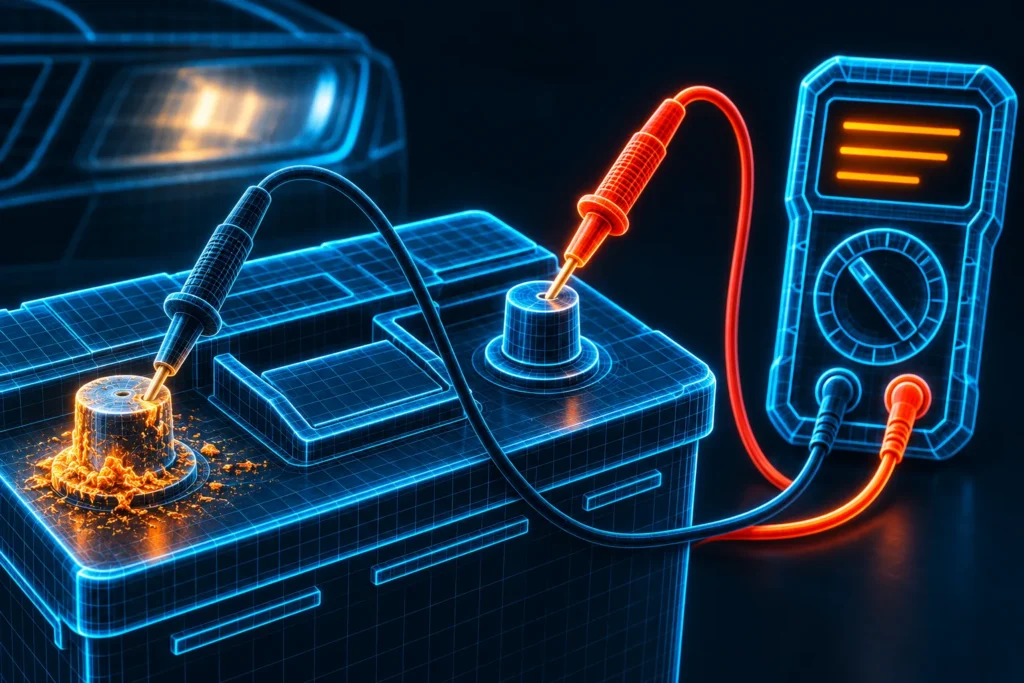
A voltage check (do it yourself). With a multimeter you read the direct-current voltage across the terminals. Interstate says voltage shows the charge level, not the health, and advises turning the headlights on for a couple of minutes first to clear the surface charge. Its reading table:
| Resting voltage | State of charge |
|---|---|
| 12.88 volts | 100 percent |
| 12.64 volts | 75 percent |
| 12.39 volts | 50 percent |
| 12.09 volts | 25 percent |
| 11.80 volts | 0 percent |
AAA says a normal reading with the engine off is about 12.6 volts. If it is lower, the battery struggles to hold a charge, and AAA’s advice is to charge it, let it rest for two days and test again.
A conductance test (shop equipment). Interstate calls it the most accurate. The tester sends a signal through the battery and measures how well it conducts, and resistance points to hidden weakness.
A load test. The tester compares the battery’s readings before and after it draws current. Interstate warns that running several load tests in a row can drain the battery flat.
A cold cranking amps comparison. Compare the CCA on the label with the CCA from a test. Interstate says a healthy battery often tests above its label rating in warm weather, and that if the actual CCA is below what your engine needs, the battery is about to fail. For what CCA means, see Cold Cranking Amps Explained.
A shop test gives a simple result: good, weak or replace now. Interstate says it takes less than a minute.
Why a Good Voltage Can Mislead
A battery that has just been charged can read as full and still be worn. Interstate and the sources we saw both warn that a resting voltage shows only charge level. That is why a battery can pass a voltage check in the morning and fail the next cold day. If the signs above are present and the voltage looks fine, get a proper test.
When to Test
Interstate recommends testing at least twice a year, before winter and before summer, which it calls the hardest seasons for batteries. A good result means you probably do not need to worry for at least another six months, according to the article. A worn battery can fail at higher temperatures than you expect. Interstate says it could die at 40 degrees Fahrenheit, or 60 if severely weakened, instead of near freezing.
When to Replace a Battery
Interstate’s guidance is to replace the battery when the test reads weak or replace now, and when the actual CCA falls below your engine’s requirement even after a full charge. Car batteries last three to five years on average. Choose the type and size your vehicle needs. See Car Battery Types Explained.
Interstate also claims that about a quarter of cars on the road will need a new battery before the end of the year. That is a figure from a battery retailer that promotes its own testing, and we do not rely on it.
What a Jump Starter Does and Does Not Do Here
A jump starter can start an engine on a weak battery. It does not make the battery healthy. If you have needed more than one jump, test the battery and the charging system. See How to Jump Start a Car.
What We Do Not Say
We do not give a replacement price, a brand or a number of months a given battery will last. The sources give a general range, and the real figure depends on the battery, the climate and the driving.
Frequently Asked Questions
How do I know my car battery is dying?
Slow cranking, flickering lights, electronics that glitch and clear after a drive, a pause before the starter turns, and frequent jumps are the usual signs.
What voltage means a battery is bad?
A resting reading of about 12.6 volts is normal according to AAA, and Interstate’s table gives 12.64 for 75 percent. A low reading means the battery is not holding a charge, and a normal reading does not prove it is healthy.
How often should I test the battery?
Interstate says at least twice a year, before winter and before summer.
Can I test it at home?
You can check the voltage with a multimeter. A conductance or load test needs shop equipment.
Should I replace a battery that was jumped once?
A jump may be a one-off, for example after lights were left on. If it dies without an obvious reason or keeps dying, test it.
The Bottom Line
Watch for the signs, test the battery twice a year with a proper tester and replace it when the test says weak or the CCA falls below what your engine needs. A voltage reading alone is not enough.
Sources
- Interstate Batteries, When Your Car Battery Is at Death’s Door (warning signs, test types, voltage table, testing schedule, replacement guidance): https://www.interstatebatteries.com/blog/get-a-battery-test
- AAA Oregon/Idaho, Bad Alternator vs. Bad Battery: A Quick Guide (signs of a bad battery, 12.6 volts, swollen case): https://info.oregon.aaa.com/bad-alternator-vs-bad-battery-a-quick-guide/