IP Ratings Explained: What IP64 and IP65 Mean on a Jump Starter
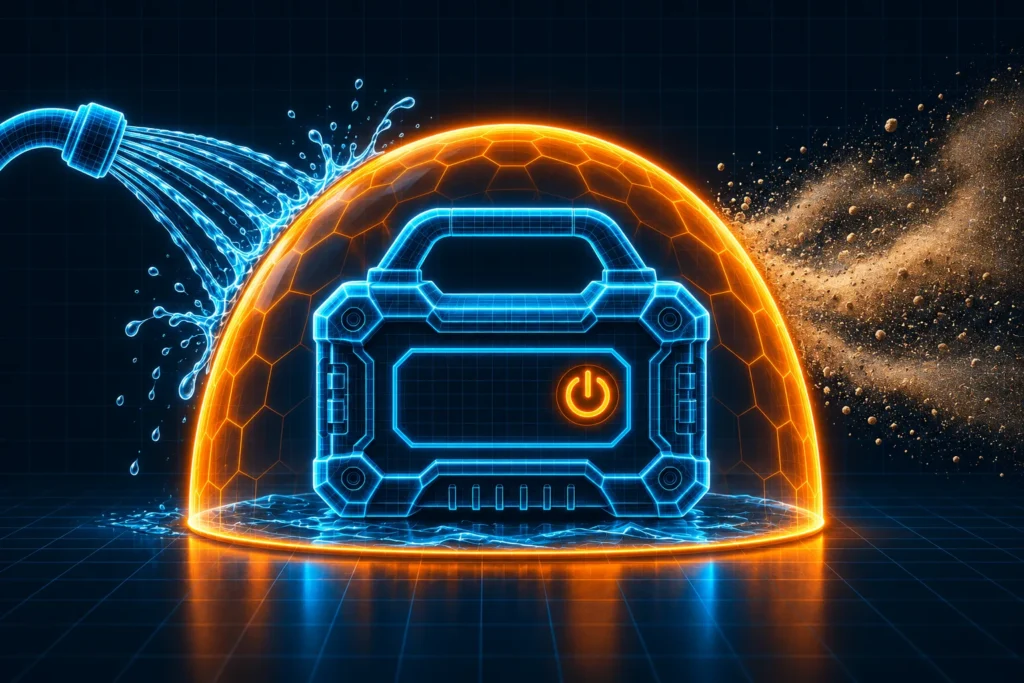
Short answer: An IP rating is a two-digit code for protection against dust and water, defined by the standard IEC 60529. The first digit is protection against solid objects such as dust, and the second is protection against water. IP64 means dust-tight and protected against splashing water. IP65 means dust-tight and protected against water jets, a higher level of water protection than IP64. Neither means a unit can be left in water, and on the units we cover the rating applies with the ports closed.
This page explains the code. Where the units stand and how they state it is below, and the wet-weather safety question is in How to Jump Start a Car.
How the Code Is Built
The code is the letters IP followed by two digits, and sometimes a letter. IP stands for ingress protection. The sources we read agree on the structure:
- The first digit rates protection against solid objects, from dust to fingers and tools. It runs from 0 to 6, and a higher number means better protection. A 6 means dust-tight.
- The second digit rates protection against water. It runs from 0 to 9 in the sources we read, and a higher number means a more demanding test.
The sources we found were vendor and engineering blogs describing the standard, not the standard itself, so check the text of IEC 60529 or a maker’s data sheet for exact test conditions before you rely on a rating for a specification.
IP64 and IP65
- IP64. Dust-tight, and protected against splashing water from any direction, not against jets.
- IP65. Dust-tight, and protected against water jets, which the sources call foul weather or spray proof and rate above IP64 for water.
The difference between them is the second digit. Both share the dust rating.
What an IP Rating Does Not Promise
- It is not an immersion rating. Jets and splashes are not submersion, so a unit with IP65 is not meant to sit in water.
- It is a test of the enclosure as built. A rating describes the sealed case in the test. An open port is an opening.
- It is not a safety clearance for use in the rain. A rating does not make wet cables or a wet engine bay safe. Dry the area before you connect.
- It can wear. We found no source that says how long a rating lasts. A cracked or damaged case should not be trusted.
How the Units We Cover State Their Rating
| Unit | Rating we found | Where |
|---|---|---|
| NOCO Boost GB40 | IP65 with the ports closed | Amazon lists IP65. NOCO’s data sheet adds the ports-closed condition |
| NOCO Boost HD GB70 | IP65 with the ports closed | Amazon and NOCO’s data sheet |
| NOCO Boost X GBX155 | IP65 with the ports closed | NOCO’s user guide |
| WOLFBOX MegaVolt 24Air | IP64 | The manual copy |
| WOLFBOX 4000A and 88.8Wh | IP64 | Amazon |
| GOOLOO A3 | Not stated in the sources we read |
NOCO ties the rating to the ports being closed. A jump starter has a USB port, a charging port and a cable connection, and the rating applies when those are shut. After you use a unit in the rain, dry it before you open the ports, and do not charge it wet.
Does the Rating Matter for Buying?
It matters if you use the unit outdoors, in rain or in a dusty workshop. It does not change how big an engine the unit can start, and it does not replace the manual’s guidance on wet conditions. Treat a rating as one more claim to read, and note which units state one and which do not.
What We Could Not Verify
- The standard’s text. We read secondary descriptions.
- The tests behind any maker’s rating. No maker explains who tested the unit.
- A rating for the GOOLOO A3. None in the sources we read.
Frequently Asked Questions
What does IP65 mean?
Dust-tight and protected against water jets. On the NOCO units the rating applies with the ports closed.
Is IP64 waterproof?
No. It describes protection against splashing water, not immersion.
Can I use a jump starter in the rain?
Some units list a rating. A rating does not make wet cables safe, so dry the area first and follow the manual.
Is IP65 better than IP64?
For water, yes: jets are a more demanding test than splashing. The dust rating is the same.
Does the A3 have an IP rating?
We did not find one in the manual and listing pages we read.
The Bottom Line
IP64 and IP65 both mean dust-tight, with IP65 giving more water protection. They are claims about a closed case, not permission to leave a unit in the rain. Read how your unit states its rating, and keep the ports closed.
Sources
- Engineering and vendor explanations of IEC 60529 returned by search on 2026-11-02 (structure of the code, IP64 and IP65), for example Tameson, IP Rating Chart and Definitions: https://tameson.com/ip-rating-chart-definitions.html and the Electrical Engineering Portal, IP Protection Degree (IEC 60529) Explained: https://electrical-engineering-portal.com/ip-protection-degree-iec-60529-explained (neither page could be opened directly; read through a search summary).
- Fahad Refai, IP Rating for Electrical Equipment, Fahad’s Electrical Encyclopedia (a trainer’s educational page; first digit 0 to 6, second digit 0 to 9, IP64 splashing from any direction, IP65 water jets; text supplied by the site owner on 2026-11-02; a secondary description, not the standard).
- NOCO GB40 and GB70 data sheets, December 2024, and NOCO Boost X GBX155 User Guide, June 26, 2024: https://no.co/media/wysiwyg/downloads/User_Guides/Boost_X/GBX155_User_Guide_06.26.2024.pdf
- Amazon listings for the units we cover (titles and bullets read on 2026-10-29) and the WOLFBOX MegaVolt 24 Air manual copy on a third-party host.