Jump Starting a Hybrid or Electric Vehicle: What the 12 Volt Battery Does
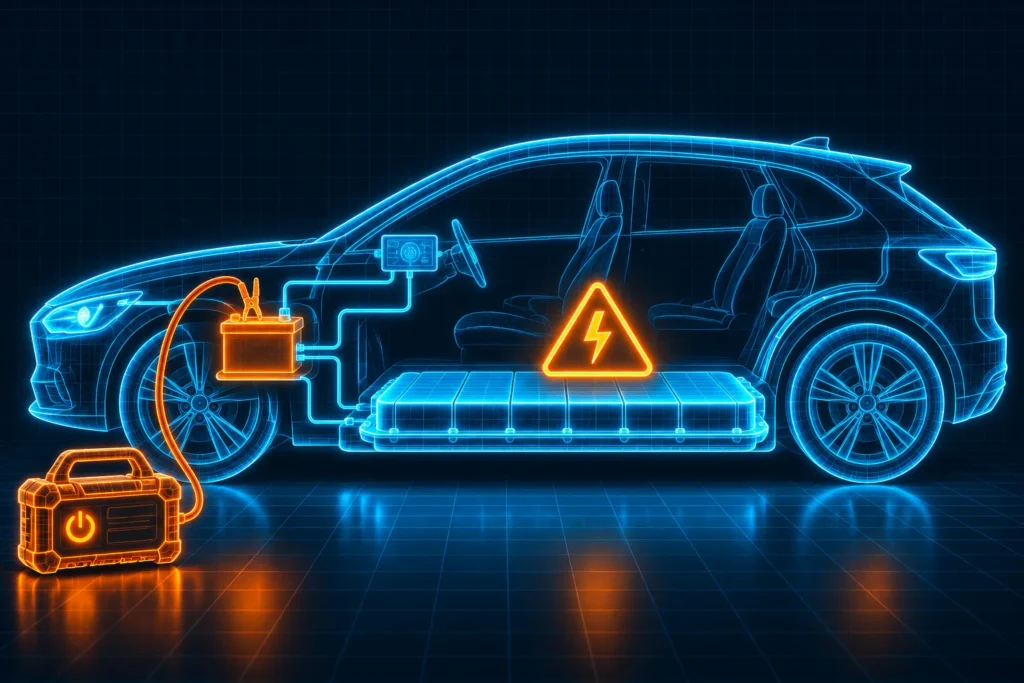
Short answer: Many hybrid and electric vehicles have a high-voltage battery that drives the car and a 12 volt auxiliary system that runs the electronics and wakes the car up, but this is not universal. Low-voltage system designs and approved external-power procedures vary by vehicle, model year and battery configuration. A jump starter or jumper cables must never be connected to the high-voltage battery. Always follow the vehicle manufacturer’s instructions on where to connect, and on whether it may be done at all, before connecting a jump starter. Manuals differ: some give a jump procedure and a dedicated terminal, some restrict using the vehicle to jump another one, and some tell you to call roadside assistance.
This page explains the principle and quotes what we could read. It is not a procedure for any vehicle. The general steps are in How to Jump Start a Car, and the damage question is in Can a Jump Starter Damage the Battery or the Car’s Electrical System?.
Two Batteries, Two Jobs
A hybrid or an electric vehicle carries a large high-voltage battery for propulsion and a separate low-voltage system. In the Toyota Prius, Hyundai Ioniq 5 and Kia Niro manuals we read, that system is a conventional 12 volt battery, which powers the lights, the computers and the systems that wake the car up. Midtronics, a maker of battery testers, says that a failed 12 volt battery can prevent the high-voltage system from powering on. That is why a hybrid or an EV can be “dead” with a full traction battery.
A conventional jump starter works on the 12 volt auxiliary battery only, according to the same source, and not on the high-voltage battery. Jalopnik gives the same advice for hybrids: connect cables only to the 12 volt battery and stay away from high-voltage components. Both sources describe vehicles with a 12 volt auxiliary battery.
This is not the same on every vehicle. Tesla’s Cybertruck owner’s manual says the truck uses a 48V low voltage architecture. For jump starting, it describes an external power source capable of supplying at least 12V, such as a portable jump starter or another vehicle, under conditions it spells out, and it says the Cybertruck cannot be used to jump start another vehicle. The voltage of the vehicle’s own low-voltage system and the external power the maker prescribes are two different things. This page does not tell you whether a particular jump starter suits any vehicle, so use the manual for your exact model and year.
What the Manuals Say
We read two vehicle manuals in full for this page, the Toyota Prius and the Hyundai Ioniq 5, plus the Tesla Model Y and Kia Niro manual pages supplied to us, and the Ford statement comes from a support page read through a search result. Read your own manual.
- Toyota Prius (read in full). We read the section “If the 12-volt battery is discharged” in the European edition of the Prius owner’s manual (document OM47871E). It says the procedure may be used to start the hybrid system if the 12-volt battery is discharged, and that you can also call an authorized dealer or repairer. For a vehicle with a second vehicle and jumper cables, it tells you to open the hood and the fuse block cover and to open the cover of an “exclusive jump starting terminal”. The positive clamp goes to that terminal, not to the battery. The negative clamp on your vehicle goes to a solid, stationary, unpainted metal point away from the terminal and moving parts. The manual then has the second vehicle’s engine run at slightly raised speed for about five minutes, the hybrid system started with the power switch, the READY indicator checked, and the cables removed in the exact reverse order. It also states that the hybrid system cannot be started by push-starting, that the exclusive terminal cannot be used to jump start another vehicle, that the vehicle should be inspected by a dealer or other qualified professional as soon as possible, and that the hybrid system may not start if the 12-volt battery has been removed or is discharged. The manual describes jumper cables and a second vehicle. It does not mention a portable jump starter. This is one model from one edition, and other vehicles differ.
- Hyundai Ioniq 5 (read in full). We read the section “Jump Starting (12 V Battery)” in the 2027 US owner’s manual. It begins by saying that jump starting can be dangerous if done incorrectly, and that if you are in doubt you should have a service technician or towing service do it. It says to use the jumper terminal in the motor compartment, to park the vehicles close without letting the bodies touch, to switch off all electrical devices, to put both vehicles in Park with the parking brake set and switched off, and to open the hood, remove the battery cover in the front trunk and remove the fuse box cover. The cable order it shows is the positive jumper terminal of your vehicle, the positive terminal of the assisting vehicle, the negative terminal of the assisting vehicle, and then the black negative chassis ground of your vehicle. A warning says not to connect the cable to the negative jumper terminal of the discharged battery because a spark could cause an explosion. After the start, the manual says to keep the vehicle running at least 30 minutes, and that a completely discharged battery may need as long as 60 minutes, otherwise the battery may not restart. It also says not to jump start if the battery is frozen, to use only a 12 V power supply (battery or jumper system), not to push-start, and that the vehicle cannot shift gears while the 12 V battery is discharged. The manual’s procedure is written around a second vehicle and jumper cables, and it does not say whether a portable jump starter may be used or whether the Ioniq 5 may be used to jump another vehicle. We found no statement either way.
- Kia Niro (text supplied from Kia’s online owner’s manual, UK English edition, hybrid vehicle). The “Jump starting” page warns that the discharged battery must not be frozen, that flames and sparks must be kept away, and that the two jumper cables must not touch. A caution says: “Do not jump start another vehicle with your hybrid vehicle”, because doing so will damage the hybrid vehicle’s 12 volt battery. We could not find this caution on the 2023 Niro (second generation) jump starting pages for the US and UK editions at ownersmanual.kia.com, which word the procedure differently, so check the manual for your own model year. A note says to use only a 12 V jumper system, because a 24 V supply can damage the starting motor, ignition system and other electrical parts, and to make sure the booster battery is 12 V with its negative terminal grounded. The cable order is: the charging terminal inside the engine compartment fuse panel, the positive terminal of the booster battery, the negative terminal of the booster battery, and then a solid, stationary metallic point away from the battery, such as the engine lifting bracket. The negative cable must not go to the negative terminal of the discharged battery. If the booster battery is in another vehicle, that vehicle is started first and run at about 2,000 rpm for several minutes. The manual then tells you to press the “12V BATT RESET” button, and, once the car starts, to disconnect the negative cable at the booster first. Afterwards the vehicle should run for at least about 30 minutes, and a professional workshop should inspect it if it is not obvious why the battery was discharged. The text speaks of a “booster battery” and says “if the booster battery is in another vehicle”, so it does not limit the power source to a second car. It does not name a portable jump starter. This is one model and one market edition, and the page we read refers to the hybrid.
- Tesla Model Y (text supplied from the owner’s manual). The “Jump Starting” page says its instructions assume an external low voltage power supply, “such as a portable jump starter”, and that if you jump start the Model Y with another vehicle you should follow that vehicle manufacturer’s instructions. It warns that the Model Y cannot be used to jump start another vehicle and that doing so can result in damage, and that short circuits, such as connecting cables to the wrong jump post or touching the leads together, can damage the car. The procedure depends on the type of low voltage battery, and the page gives both. Cars built at Gigafactory Shanghai before about October 2021 and at Fremont before about December 2021 have a lead-acid low voltage battery, and later cars have a lithium-ion one. The page tells the owner to check which one the car has on the touchscreen (Controls, Software, Additional Vehicle Information). For the lead-acid battery, the steps open the hood (with a separate page for opening it with no power), remove the maintenance panel and connect the supply’s positive cable to the positive terminal of the battery and the negative cable to its negative terminal, with a warning that the positive cable must not touch other metal such as the tie-down bracket. For the lithium-ion battery, the cables go instead to dedicated jump posts: the positive post is under a seal and a red cover, and the negative post is a filter bolt that, on cars built after about February 2025, may be hidden under a plastic trim piece. In both cases you then switch on the external supply, touch the screen to wake the vehicle, which may take several minutes, and disconnect both cables, black negative first, when external power is no longer required. Jalopnik quotes the Model 3 manual in the same sense about jumping other vehicles, and adds, as its own advice, never to use one EV to jump another EV.
- Ford. Ford’s support page for the Mustang Mach-E says the vehicle’s controls are electric, so power is needed to open the door and the hood before cables can reach the 12 volt battery, and it directs owners to the Crash and Breakdown Information section of the owner’s manual for the steps. That is a statement about one vehicle.
Three things follow. A manual may name a special terminal or post under the hood, as the Prius, Tesla and Ioniq 5 manuals do. It may restrict using the vehicle as a donor. And manuals differ on the power source: the Prius manual describes jumper cables and a second vehicle only, while the Tesla Model Y page assumes an external supply such as a portable jump starter. If yours does not say which is acceptable, ask the maker or a dealer. Jalopnik advises using remote terminal posts instead of the battery in cars that have them.
What to Check Before You Try
- Your owner’s manual. Find the section on jump starting, the 12 volt battery or roadside emergencies.
- Where the 12 volt battery or the jump terminal is. It may be under the hood, under a seat or in the luggage area.
- Whether the vehicle can be opened with no power. Some EVs need power to open the hood or the door, as Ford’s page for the Mach-E notes.
- Whether your jump starter is made for 12 volts and lists the battery type. The NOCO GBX155 guide says the unit is for 12 volt lead-acid batteries only, while Tesla’s Model Y page describes a lithium-ion low voltage battery in newer cars and still names a portable jump starter as an example of the external supply. Neither document tells you whether a given jump starter suits that battery, so read the jump starter’s manual as well as the car’s, and ask the makers if they disagree.
- Whether the maker allows jump starting at all. If the manual says to call roadside assistance, do that.
What We Found No Source For
- A universal procedure. Procedures differ by model and year.
- A statement from a jump starter maker about hybrids and EVs. The maker documents we read for the units we cover do not address them.
- How a jump starter’s override behaves with an EV’s electronics. We found no source, and we do not guess.
Frequently Asked Questions
Can you jump start a hybrid?
Many manuals describe a way to jump the 12 volt battery. Some also restrict using the hybrid to jump another car. Read your manual.
Can you jump start a Tesla?
Tesla’s Model Y manual page on jump starting assumes an external low voltage power supply such as a portable jump starter, and the connection points depend on whether the car has a lead-acid or a lithium-ion low voltage battery (battery terminals in the first case, dedicated jump posts in the second). It also says the car cannot be used to jump start another vehicle. We read that one page for the Model Y only, so check the manual for your model and year.
Can an electric car jump another car?
Several manuals say no. The Kia Niro text supplied to us says not to jump start another vehicle with the hybrid (we could not find that caution on the 2023 Niro pages we checked), the Tesla Model Y manual says it cannot be used to jump start another vehicle, and the Prius manual says its jump terminal cannot be used for that. The Ioniq 5 manual we read says nothing either way. Do not do it unless your manual allows it.
Do I connect to the big battery?
No. A jump starter must never be connected to the high-voltage battery. Use only the connection points your vehicle manual names, and stay away from high-voltage components.
Why will my EV not start with a full battery?
A failed 12 volt battery can stop the high-voltage system from powering on, according to Midtronics.
The Bottom Line
Many hybrids and EVs have a 12 volt auxiliary battery that a jump starter may help, but low-voltage systems vary by model and year, and the high-voltage battery must never be touched. The vehicle manual decides the connection point and whether a jump is allowed. If it says to call roadside assistance, call.
Sources
- Hyundai Ioniq 5 2027 Owner’s Manual (US), chapter 8 “Jump Starting (12 V Battery)” and the driving chapter on a discharged 12 V battery (read in full, 2026-11-02): https://owners.hyundaiusa.com/content/dam/hyundai/us/myhyundai/manuals/glovebox-manual/2027/ioniq-5/NE1a-2027-en_US-WEB-1C.pdf
- Tesla Model Y Owner’s Manual, “Jump Starting” page (US English; full text of the page, covering both the lead-acid and lithium-ion low voltage battery, supplied by the site owner on 2026-11-02 because the Tesla site blocked our request): https://www.tesla.com/ownersmanual/modely/en_us/GUID-3567D5F4-A5F4-4323-8BE0-023D5438FFC6.html
- Tesla Cybertruck Owner’s Manual, “Jump Starting” page (US English; 48V low voltage architecture, external power source capable of supplying at least 12V; read 2026-11-02): https://www.tesla.com/ownersmanual/cybertruck/en_us/GUID-2C9FAB79-5A7B-40BB-B572-D10CDF7661E6.html
- Kia Niro Owner’s Manual, “Jump starting” page (UK English online edition; text supplied by the site owner on 2026-11-02, model year not recorded). Checked for comparison on 2026-11-02, and not containing the “another vehicle” caution: the 2023 Niro UK edition and US edition.
- Jalopnik, Never Jump Start a Modern Car Without Checking For These Things First (12 volt battery, remote posts): https://www.jalopnik.com/2091386/never-jump-start-modern-car-without-checking-these-first/
- Midtronics, Jump Starter vs Booster Cables (vendor blog; 12 volt auxiliary battery; failed 12 volt battery): https://midtronics.com/blog/jump-starter-vs-booster-cables
- Toyota Prius owner’s manual, European edition, document OM47871E, section 5-2 “If the 12-volt battery is discharged” and section 1-1 on charging (read in full, 2026-11-02): https://myportalcontent.toyota-europe.com/Manuals/Toyota/PRIUS_OM_OM47871E_(EE).pdf
- Ford, How do I jump-start my Mustang Mach-E? (support page, read through a search summary): https://ford.ca/support/how-tos/more-vehicle-topics/batteries/how-do-i-jump-start-my-mustang-mach-e
- NOCO Boost X GBX155 User Guide, June 26, 2024: https://no.co/media/wysiwyg/downloads/User_Guides/Boost_X/GBX155_User_Guide_06.26.2024.pdf