Jump Starter vs Power Bank vs Portable Power Station: What Each One Can Do
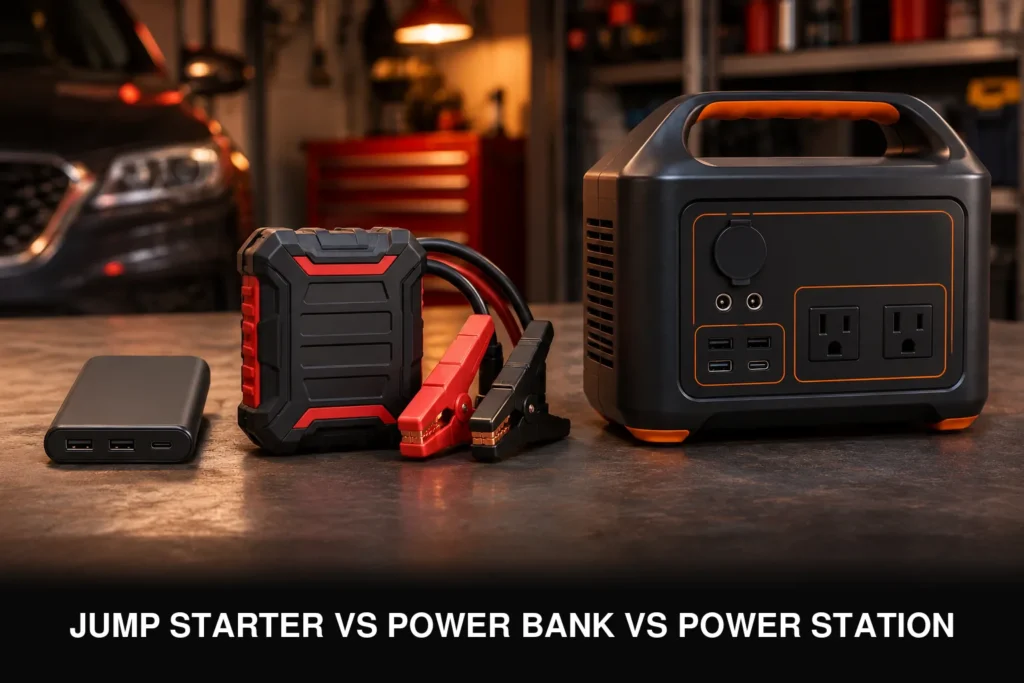
Quick answer: A jump starter, a power bank and a portable power station all store energy in a battery, but they are built for different jobs. A jump starter is built to deliver a very large current for a few seconds to turn an engine. A phone power bank is built to deliver a small current to charge devices, and it normally cannot start a car. A portable power station is built to hold a lot of energy and run appliances for hours, and whether it can start an engine depends on the model: some makers say theirs cannot, and some sell a hybrid that can. The label on the box does not settle it. Look for a stated jump-start function and a peak current for starting. Many jump starters can also charge a phone, which is why the categories blur.
Pick your situation
- I have a power bank and want to know if it can start my car: read “Can a Power Bank Start a Car?”.
- I own a power station and want the same answer: read “Can a Power Station Start a Car?”.
- I want a device that does both: read “The Hybrids”.
- I want to know which one to keep in the trunk: go to “Which One for Which Job”.
Three Devices in One Paragraph Each
A jump starter is a lithium battery with a control board and a pair of clamp cables, made to start a vehicle. It also often has a USB port and a light. How it works is explained in How a Lithium Jump Starter Works.
A power bank is a battery pack for charging phones, tablets and similar devices through USB ports. It has no clamps and no starting function.
A portable power station is a larger battery with outlets, which can run appliances and tools. It stores much more energy than a jump starter or a power bank, and it is a different kind of product.
What Separates Them: Current, Voltage and Energy
Two numbers decide whether a battery can start an engine, and they are not the ones that sell power stations.
- Current at the moment of starting. An engine’s starter motor draws a very large current for a short time. A healthy car battery can deliver about 500 amps, according to Interstate Batteries, as cited in Volts, Amps and Watt Hours Explained. A jump starter is built to deliver a current in that range. The USB ports on the units we cover are listed at about 2 amps.
- Voltage and connection. A car uses 12 volts. A phone power bank outputs the 5 volts of a USB port. One vendor comparison table our search returned lists a standard power bank at 5 volts and 3 amps maximum, against a dedicated jump starter at 12 volts and a surge of 400 to 1,000 amps. That table is a vendor’s illustration, not a standard.
- Energy. How long a device can run things is a matter of watt hours, not of starting. A power station may hold far more energy than a jump starter and still be unable to deliver a starting current, and a jump starter that starts a large engine holds very little energy by comparison. The units we cover list from 24 to 99 watt hours, and TechGearLab measured about 3 percent of a unit’s battery per start in one test.
Peak amps on a box are a maker’s figure. We found no independent test that verifies any maker’s number for the units we cover. See What Size Jump Starter Do I Need? for how to read them.
Can a Power Bank Start a Car?
A typical smartphone power bank cannot, according to the sources our search returned. The reasons are the ones in the section above: the output is a low-current 5 volt USB output, and the device has no clamps and no protections for a car battery. We found no manufacturer document that says otherwise for a phone power bank.
The risk goes beyond failure. A vendor page warned that connecting a small power bank to a car battery with makeshift adapters can cause short circuits, especially if the polarity is reversed. We did not find an independent measurement of that, but the advice is consistent with the manuals we read for jump starters: use the cables and the connection the maker designed.
The units we cover are different. They are jump starters that also work as power banks. TechGearLab notes that the WOLFBOX MegaVolt24 doubles as an emergency power bank for mobile devices, and it evaluated the units as backup power banks too. So the useful comparison is not “power bank or jump starter” but “does the jump starter also charge phones.” Many do.
Can a Power Station Start a Car?
The answer depends on the product, and the sources do not agree because they describe different products.
- Some makers say their power stations cannot. The search summary we read quotes Jackery, a power station maker, saying that its portable power stations cannot jump-start a car. We could not open the Jackery page itself, because the site refused our request, so we cannot quote the wording.
- Some makers sell a unit that does both. The same summary reports that Battery Tender sells a model it calls a 2000 amp power station that works as both a jump starter and a power bank. We did not read that listing, and we do not rate it.
The conclusion is narrow. Do not assume that a power station, an inverter or an outlet can start an engine, and do not connect one to a car battery unless the maker’s manual describes a jump-start function and the connection to use. If the manual does not mention it, treat the device as unable to jump a car.
The Hybrids
Because the categories overlap, products carry mixed names: a jump starter with a power bank function, a power bank with a jump function and a power station with a jump port. What helps is a short checklist:
- Does the manual describe jump starting a vehicle? If it does not, it is not a jump starter.
- What current is stated for starting, and what engine sizes does the maker give? See What Size Jump Starter Do I Need?.
- Does the unit protect against reversed clamps and short circuits? The units we cover list these protections, and we found no independent test that confirms any of them.
- What does the maker say about temperature? NOCO’s guides give charging and operating ranges, and the A3 manual warns that cells may be damaged above 60 degrees Celsius.
- Does it say how many starts you can attempt? The limits we read are, for example, five starts in 15 minutes for the NOCO GBX155 and three in a row for the GOOLOO A3.
Which One for Which Job
A car that may not start. A jump starter. A power bank cannot do it, and a power station only if its manual says so.
Charging phones on a trip or a power cut. A power bank is the lighter tool. A jump starter with a USB port can do it in an emergency, but it should be kept charged for its main job.
Running a fridge, a tool or an appliance for hours. A power station. A jump starter is not made for it.
A camper or a van that needs both. One option is a jump starter for the engine and a power station for the cabin, as two devices. A hybrid saves space and brings the same questions about its manual.
Charging the jump starter itself. Charging rules are in How to Store and Recharge a Jump Starter. Using the jump starter’s USB port drains the same battery that you need for a start, so do not run it down before a trip.
What We Cannot Tell You
- Which power station can start a car. We did not read a manual for one, and we cover jump starters here.
- How much current a phone power bank can supply. Models differ. The figure we quote is one vendor’s illustration.
- Whether any maker’s peak amps is correct. No independent test of the units we cover.
- Air travel. A jump starter, a power bank and a power station are all lithium batteries, and the rules for them are in Can You Take a Jump Starter on a Plane?.
- We do not claim to have run our own measurements on any unit.
Frequently Asked Questions
Can I jump start a car with a power bank?
A typical phone power bank cannot. Its output is 5 volts and a small current, and it has no clamps. Use a jump starter or jumper cables.
Is a jump starter just a big power bank?
It is a battery pack like a power bank, but built to deliver a starting current at 12 volts through clamps with protections. Many units also have a USB port, so they can act as a power bank too.
Can a portable power station start a car?
Some makers say theirs cannot, and some sell hybrid units that can. Check the model’s manual for a jump-start function. If it has none, do not try.
Can I charge my phone with a jump starter?
Many can. The units we cover list USB ports of about 2 amps. Charging draws on the battery you need for starting.
Which is better to keep in the car?
The jump starter, because it is made for the one job a power bank cannot do. A power bank is a convenience, and a power station is not usually a car-trunk item.
What if I only have jumper cables?
You need a second vehicle. The comparison is in Jump Starter or Jumper Cables.
The Bottom Line
A jump starter, a power bank and a power station differ in how much current they can deliver and what they are made for. Only a device that describes jump starting in its manual should be connected to a car battery. A phone power bank cannot start a car, a power station depends on the model, and a jump starter is the tool made for it. Read the manual, check the stated starting current and keep the unit charged.
Sources and How We Checked
We compare device types and do not rate power banks or power stations. We do not claim to have run our own measurements.
- TechGearLab, Best Jump Starters (the WOLFBOX MegaVolt24 as an emergency power bank; claimed and measured capacity; updated 2026-04-29): https://www.techgearlab.com/topics/tools/best-jump-starter
- Einhell, Jump starters vs. battery chargers (jump starters work as power banks; capacity too small to charge a car battery; polarity and manual advice; 2023-02-08): https://einhell.de/en/blog/workshop/jump-starters-vs-battery-chargers
- Search summaries on 2026-11-02 of vendor pages (Jackery, Battery Tender, Fanttik, AMPRoad and others) for the power bank and power station statements; the pages could not be opened directly (rate limited) and no specific claim is relied on beyond what is attributed in the text.
- Interstate Batteries, as cited in Volts, Amps and Watt Hours (about 500 amps to start an engine).
- NOCO Boost X GBX155 User Guide, June 26, 2024: https://no.co/media/wysiwyg/downloads/User_Guides/Boost_X/GBX155_User_Guide_06.26.2024.pdf
- Manual copies for the GOOLOO A3 (JS-506) and the WOLFBOX units (MegaVolt 24Air and MegaVolt24 V1.0) on third-party hosts.