Choosing a Jump Starter for Cold Climates: What the Spec Sheet Does and Does Not Tell You
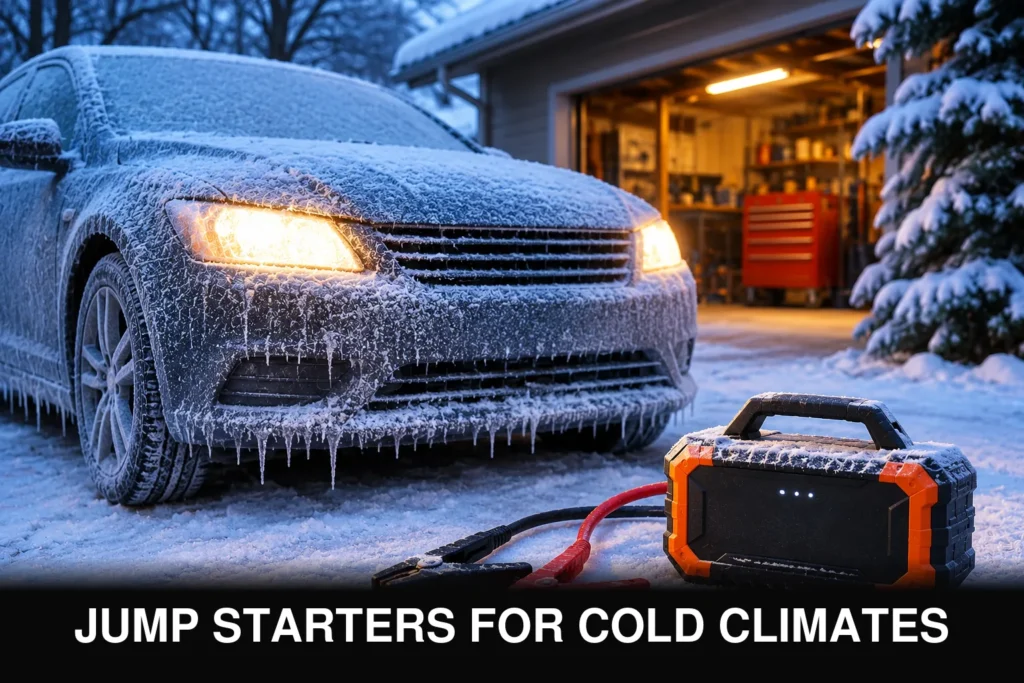
Quick answer: In the cold, two batteries are in trouble at once: your car’s and the jump starter’s. Cold cuts what a car battery can deliver, which is why the jump is needed, and it limits what a lithium jump starter may do, because lithium cells can discharge in the cold but should not be charged below freezing. For a cold climate, read four things on the spec sheet: the operating range, the charging range, any cold protection that can stop the unit until it warms, and the engine rating with margin. Then plan the habit: keep the unit warm, charged, and ready to carry to the car. A unit left in a freezing car overnight is the one most likely to disappoint.
Pick your situation
- I want to know what to check before buying: read “Four Things to Read”.
- I want to know why cold is a problem for lithium: read “Why Cold Matters Here”.
- I want to see how the units we cover state their cold limits: read “How the Units We Cover Differ”.
- I want the winter routine: read “A Winter Routine”.
This guide is about the jump starter in the cold. The storage temperature table and the recharge rules are in How to Store and Recharge a Jump Starter, the engine size logic is in What Size Jump Starter Do I Need?, and why the car battery fails in the cold is in Why Does a Car Battery Die?.
Why Cold Matters Here
The car battery. Interstate Batteries says a car battery works best at about 80 degrees Fahrenheit, that its performance drops at 32 degrees and falls further at 0, the temperature at which the cold cranking amp rating is measured. Cold is the hardest condition for starting, which is why the same engine that starts easily in autumn needs help in January. See Cold Cranking Amps Explained.
The jump starter. Battery University, a reference site on batteries, is clear about lithium-ion cells in general: batteries can be discharged over a large temperature range, but the charge temperature is limited. For lithium-ion it lists charging from 0 to 45 degrees Celsius and discharge from minus 20 to 60. It says that no charging is permitted at freezing temperatures and that charging below 0 degrees Celsius can cause metallic lithium plating on the anode. It adds that consumer-grade packs are not meant to be charged below 0 degrees Celsius even though they may appear to charge normally. These are general figures for lithium-ion cells, not the limits of any unit we cover.
Two consequences for you:
- A cold unit can usually deliver but should not be charged. If your unit has been in a freezing car, using it to jump is within the general range, and recharging it right afterward may not be.
- A unit with a built-in low-temperature cutoff can stop altogether. That is a protection, and it is a design choice the maker states.
Four Things to Read
1. The operating range. The temperature range in which the unit is meant to deliver current. The units we cover list ranges that start at minus 20 degrees Celsius, and the 24Air gives its range as minus 4 to 140 degrees Fahrenheit, which is the same minus 20 in Celsius.
2. The charging range. A separate number, and a narrower one. NOCO lists charging only from 0 to 40 degrees Celsius for the GBX155, GB40 and GB70. Do not recharge a unit that has been sitting in the cold until it has warmed indoors.
3. Cold protection that can stop the unit. The WOLFBOX MegaVolt 24Air manual describes cold protection below 0 degrees Celsius, lifted above 5, and heat protection above 55, lifted below 45. A unit that stops itself in the cold is protecting its cells. It is also a unit that will not help you in a freezing parking lot until it warms. The operating range we saw for this unit is wider than that cold protection suggests, so read both lines and plan for the more cautious one.
4. The engine rating with margin. A cold engine on a cold battery asks more of the unit. The sizing guide’s rule is to choose a rating above your engine and to move up a class in a cold climate. The independent evidence is limited: TechGearLab’s roundup reports that the NOCO GB40 started a 4.0 liter V6 three times in rapid succession in “chilly 33° weather” (the article prints no temperature unit, so we read it as Fahrenheit), and that the NOCO GBX155 started a 4.0 liter V6, with no temperature stated for the GBX155 test. We found no independent test of any unit at minus 20.
How the Units We Cover Differ
| Unit | What the maker documents say about cold |
|---|---|
| NOCO GB40, GB70 and GBX155 | Operating minus 20 to plus 50 C, charging 0 to 40 C. The GBX155 guide says to keep the unit indoors when it is not in use |
| GOOLOO A3 | Operating minus 20 to 60 C in the manual, storage minus 10 to 45 C in the tutorial. The Amazon listing gives charging 14 to 113 F |
| WOLFBOX MegaVolt24 | Operating minus 20 to 60 C, charging 0 to 45 C |
| WOLFBOX MegaVolt 24Air | Minus 4 to 140 F in the listing. Cold protection below 0 C, lifted above 5 C |
| WOLFBOX 4000A and 88.8Wh | Minus 4 to 140 F in the Amazon listing. The MegaVolt24 V1.0 manual copy, linked to this unit by name only, gives operating minus 20 to 60 C and charging 0 to 45 C |
The sources are manual copies on third-party hosts, the maker’s pages and Amazon listings. They are not identical in what they state, and the ranges are claims. We found no independent test of how any of these units behaves at its stated low limit.
Does a Bigger Unit Help in the Cold?
It can help with the rating, because a larger rating leaves more room over the engine. It does not change the temperature limits on charging, and a large unit that is cold stays cold. Weight is the other side: the NOCO GBX155 is listed at 5.82 pounds for the unit alone, and a larger unit is more effort to carry in from the house. The choice is the rating with margin plus a habit that keeps the unit warm.
A Winter Routine
- Charge it fully before the cold season. Check the indicator, as in How to Store and Recharge a Jump Starter.
- Keep it indoors. NOCO says to keep its unit indoors when not in use. A hallway or a closet is enough.
- Carry it to the car when you need it, not the night before. The point is to keep it above its limits.
- If you must keep it in the car, read the range and know that a freezing car is outside the comfort zone of every lithium unit in general. The storage limits for the A3 start at minus 10 degrees Celsius.
- Do not charge it cold. Bring it in and let it warm before recharging.
- Do not spend its charge on other things before a trip. Phone charging draws on the same battery.
- Note the start limits in the manual. A cold engine tempts repeated attempts, and the limits (five in 15 minutes for the GBX155, three in a row for the A3) exist for the unit’s sake.
- Do not use a damaged or swollen unit. The GBX155 guide says not to use the product if damaged.
What a Jump Starter Cannot Do in the Cold
- It does not fix the battery. A battery that fails in the cold is often at the end of its life. See Signs Your Car Battery Is Failing.
- It does not thaw a frozen battery. Battery University notes that freezing a lead-acid battery leads to permanent damage. We found no jump starter maker advising what to do with a frozen car battery, so do not try to jump a battery you believe is frozen without guidance from your vehicle’s manual or a professional.
- It does not solve fuel, glow plug or starter problems. For diesels in the cold, see Jump Starters for Diesel Engines, Pickups and Vans.
What We Cannot Tell You
- How any unit performs at minus 20 or lower. The ranges are maker claims.
- How much capacity a unit loses in the cold. We found no source with figures for the units we cover.
- What happens if a unit is charged below freezing. Battery University describes the risk for lithium-ion in general, and no maker document for the units gives a consequence.
- Whether the cold protection of the 24Air matches its listed operating range. The sources we read differ. Check your manual.
- We do not claim to have run our own measurements on any unit.
Frequently Asked Questions
Will a jump starter work in freezing weather?
The units we cover list operating ranges that begin at minus 20 degrees Celsius, and one describes a cold protection below 0 degrees that can stop it until it warms. Check your unit’s manual and keep it warm before use.
Can I leave my jump starter in the car all winter?
The makers’ storage guidance we read is not friendly to it. NOCO says to keep its unit indoors, and the A3 tutorial gives a storage range from minus 10 degrees Celsius. Bring it indoors.
Can I charge a jump starter that is very cold?
Not according to the charging ranges we read, which start at 0 degrees Celsius for NOCO and the MegaVolt24. Warm it up first.
Does cold reduce how many starts I get?
Probably, but we found no source with numbers for the units we cover.
Do I need a bigger unit for winter?
A larger rating gives margin over your engine. The sizing guide suggests moving up a class in a cold climate.
Is a jump starter better than cables in the cold?
Cables need a second running vehicle, which is also a problem in extreme cold. The comparison is in Jump Starter or Jumper Cables.
The Bottom Line
For a cold climate, read the operating range, the charging range and any cold cutoff, choose a rating above your engine, and build the habit of keeping the unit indoors and charged until the moment you need it. The ranges are claims, and none of the units we cover has an independent test at its low limit.
Sources and How We Checked
We read the maker documents for the units we cover and the sources below. We do not claim to have run our own measurements.
- Battery University, BU-410: Charging at High and Low Temperatures (lithium-ion charge and discharge ranges, plating, freezing lead-acid): https://batteryuniversity.com/article/bu-410-charging-at-high-and-low-temperatures
- Interstate Batteries, Why Your Car Battery Died (performance at 80, 32 and 0 degrees Fahrenheit): https://www.interstatebatteries.com/blog/why-did-my-car-battery-die
- TechGearLab, Best Jump Starters (cold-weather start with the GB40; updated 2026-04-29): https://www.techgearlab.com/topics/tools/best-jump-starter
- NOCO Boost X GBX155 User Guide, June 26, 2024 and NOCO GB40 and GB70 data sheets, December 2024: https://no.co/media/wysiwyg/downloads/User_Guides/Boost_X/GBX155_User_Guide_06.26.2024.pdf
- GOOLOO A3 tutorial page (maker, read 2026-10-30): https://us.gooloo.com/blogs/tutorials/a3-jump-starter
- Manual copies for the GOOLOO A3 (JS-506), WOLFBOX MegaVolt 24Air and WOLFBOX MegaVolt24 V1.0 on third-party hosts.