Jump Starters with Air Compressors: Is a Combo Worth It?
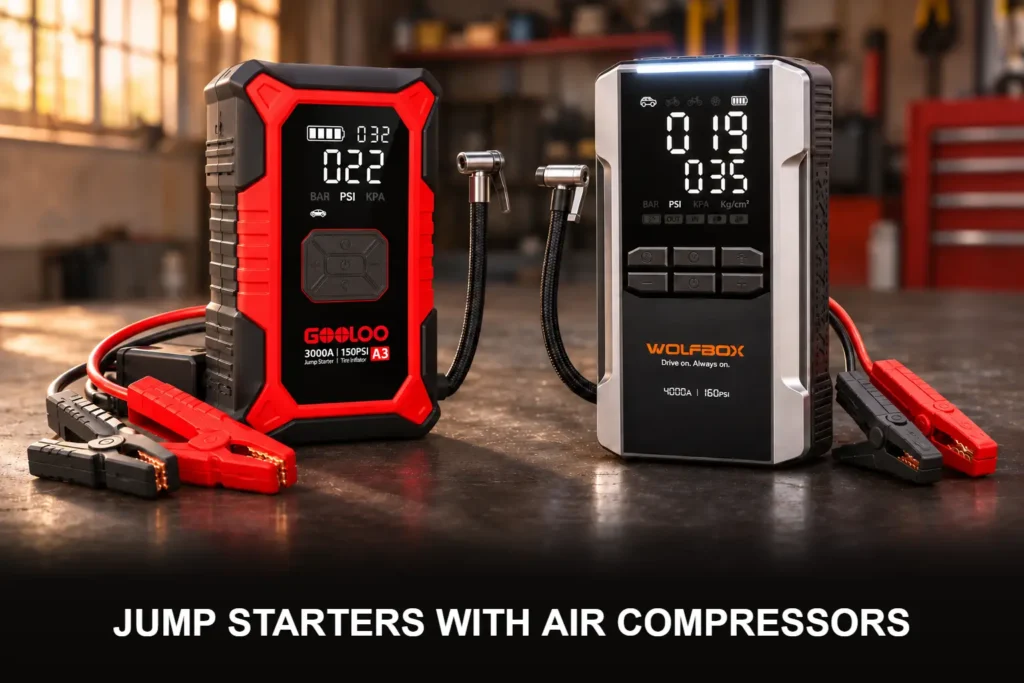
Quick answer: A jump starter with a built-in air compressor is worth it if you want one box in the trunk for two common problems, a dead battery and a soft tire, and you drive a gasoline car or SUV. It is a poorer fit if you want the lightest possible unit, drive a large diesel or need to inflate many large tires on one charge. Between the two combos we cover, the WOLFBOX MegaVolt 24Air has the larger battery and more outside coverage, and the GOOLOO A3 is the smaller box with thinner evidence.
Pick your situation
- I am not sure a combo is better than two tools: read “Combo or Separate Tools?”.
- I want to understand PSI, flow and battery limits: read “What the Compressor Numbers Mean” through “Cold, Heat, Noise and Run Time”.
- I want the detail on one unit: go to chapter 1 (A3) or chapter 2 (24Air).
- I want a pick for my car, my climate or my engine: go to “Head to Head: A3 or 24Air?” and “Winners by Situation”.
- I want to avoid mistakes before I buy: go to “Common Mistakes” through “Your Pre-Purchase Checklist”.
Our Top Picks for Jump Starters with Air Compressors
| For | Pick | Why |
|---|---|---|
| The larger combo | WOLFBOX MegaVolt 24Air | 88.8 Wh, 160 PSI, 45 L/min, a 65 W USB-C port, two hands-on reports and a timed compressor test at Car and Driver |
| The smaller combo | GOOLOO A3 | 150 PSI, 35 L/min on Amazon, a manual that lists 400 A starting current. No controlled independent test found |
| An engine near or above a combo’s diesel rating | NOCO Boost X GBX155 plus a separate inflator | 8.0 L diesel on Amazon, with the best documentation of the units without a compressor |
| The lightest unit | NOCO Boost GB40 plus a separate inflator | NOCO lists the unit alone at 1.65 lb |
These are matches between a need and a unit, not rankings.
Who Wins at a Glance
| Question | Winner | Why |
|---|---|---|
| Larger battery | 24Air | 88.8 Wh against 44.4 Wh |
| Smaller and simpler box | A3 | Compact, with a smaller battery |
| Faster compressor on paper | 24Air | 160 PSI and 45 L/min against 150 PSI and 35 L/min |
| Independent compressor timing | 24Air | Car and Driver timed it. No comparable timing exists for the A3 |
| Starting current published in the manual | A3 | 400 A. The 24Air manual lists none |
| USB-C power bank | 24Air | 65 W in and out. The A3’s ports are phone speed |
| Warranty | 24Air | 24 months against 18 |
What a Combo Is, and Who It Is For
A combo is a jump starter with an air compressor built into the same case. One lithium battery powers both jobs. You connect clamps to a dead car battery and the unit starts the engine, or you screw a hose to a tire valve and the unit inflates the tire to a pressure you set. Two units on this site do both: the GOOLOO A3 and the WOLFBOX MegaVolt 24Air. The other four jump starters we cover have no compressor.
The idea is simple, and so is the buyer. A combo suits the driver who wants one box in the trunk instead of a jumper kit and a plug-in inflator, and who would rather deal with a soft tire in the driveway than at a gas station. It suits a household with one gasoline car or SUV, a commuter who parks in a tight garage and a driver who takes road trips and wants fewer things to pack.
It is not the right tool for everyone. Anyone who needs the largest possible jump starter should start from the engine rating and add a separate inflator if needed. Anyone who wants the lightest unit should choose a small jump starter without a pump. Anyone who expects to fill several large truck tires from a single charge should read “What the Inflation Reports Say, and What They Cannot Say” first, because no source we found gives a number for that.
This guide is about the category and the choice between the two units. It does not repeat the full specifications. Those are in the GOOLOO A3 review and the WOLFBOX 24Air review, and the head-to-head is in the A3 vs 24Air comparison.
Combo or Separate Tools?
The first decision is not which combo to buy. It is whether to buy a combo at all.
| Question | A combo | Separate jump starter and inflator |
|---|---|---|
| Trunk space | One box | Two items |
| Weight | Heavier than a compact unit | You choose each |
| Battery | Shared between two jobs | Each has its own |
| Best at | Convenience | Each job on its own terms |
| Diesel engines | Set by the combo’s own documented diesel rating (6.5 L for the A3, 6 L or 10 L for the 24Air) | Set by the jump starter you pick. Ratings run higher on some units, such as 8.0 L on the GBX155 |
| Failure | One fault can take out both functions | One tool fails, the other still works |
| Evidence on this site | Two units, with a timed test for the 24Air and thin evidence for the A3 | Four reviewed units without a compressor |
The failure row is our reasoning, not a finding. We have no reliability data for either combo.
When a combo wins. You drive a gasoline car or SUV, your engine is well inside the combo’s documented rating, and you value having both tools in one place. Having a compressor does not make a unit better or worse at starting an engine. The documented rating does that work.
When separate tools win. Your engine is near or above a combo’s documented diesel rating, you drive a large diesel or live in a hard freeze, you have more than one vehicle, or you already own a good inflator. A unit built only for jump starting, such as the GBX155, gives more engine margin, and a small inflator is easy to carry in the same bag. A compact driver who wants the lightest option should look at the GB40 and a separate inflator.
The middle case. If you want a combo and your engine sits near the limit, the 24Air’s 6 liter Amazon diesel figure and the A3’s 6.5 liters are not much separated, and neither has a controlled diesel test. Choose margin first. For the no-compressor options, see Portable Jump Starters.
What the Compressor Numbers Mean
Every compressor listing shows two numbers: PSI and liters per minute.
PSI is the highest pressure the pump can reach. The A3 lists 150 PSI and the 24Air lists 160. A passenger-car tire needs a fraction of that, and the correct pressure is on the label in the driver’s door jamb and in the owner’s manual. A high rating means the pump has headroom. It does not mean you should inflate to it.
Flow is the volume of air the pump moves in a minute. The A3 lists 35 liters per minute on Amazon, and the 24Air lists 45. A higher flow should fill a tire faster, but real fill time also depends on tire size, starting pressure and the charge left in the battery. Makers rarely publish how they measured flow.
Neither number says how many tires one charge will fill. That depends on the battery, and the next section explains why. If you want the definitions in detail, with the measuring caveats and the troubleshooting steps, read Jump Starter Air Compressors: PSI, Flow and Limits. This guide uses those ideas to answer a different question: should you buy a combo, and which one?
The Battery Is the Real Limit
Both compressors share one battery with the jump starter. A jump start uses little energy. TechGearLab reported that its WOLFBOX MegaVolt24, the unit without a compressor and a different product, used about 3 percent of its battery on each of three jump starts of a drained 2010 Ford Explorer. That is one lab, one unit and one vehicle, so it is an illustration. Inflating tires is a longer job and draws energy for longer.
The A3’s battery is 44.4 watt hours, and the 24Air’s is 88.8. That means the 24Air holds twice the energy. It does not prove that it fills twice as many tires, because we do not know the compressor draw of either. No source we read gives tires per charge, and we will not guess.
Two practical consequences follow. First, a low battery limits the compressor and also leaves less for a jump start, so the order of use matters: if you inflate tires every month and rarely jump anything, you can drain the unit without noticing. Second, recharging on schedule is part of owning a combo. The manuals ask for a recharge at least every three months in storage for the A3 and every six months for the 24Air.
Practical rule: after you inflate a tire, recharge the unit, so that it is ready to start a car.
What the Inflation Reports Say, and What They Cannot Say
We found no controlled compressor test of the A3. For the 24Air there is one timed test. Here is what exists:
| Unit | Source | What it reports | Strength |
|---|---|---|---|
| 24Air | Car and Driver, updated 2026-02-17 | A 245/50R20 tire on a Hyundai Santa Cruz from 10 PSI: 30 PSI in 3 minutes 12 seconds and 45 PSI in 6 minutes 10 seconds. It also measured 84.0 dBA of noise | Independent timed test, model named |
| 24Air | Popular Science, 2026-02-11 | An SUV tire from 25 to 35 PSI in about a minute. A flat tire is the author’s estimate of three to five minutes | Hands-on |
| 24Air | DashcamTalk, thread from 2025-11-09 | The compressor ran to 3.3 bar without struggling. No times given | Owner report |
| A3 | Air Tool Lab, 2026-09-25 | A Tesla Model 3 tire from 30 to 36 PSI in about a minute | Anecdotal, no method documented |
| A3 | Men’s Journal, 2026-01-25 | Four car tires in about 15 minutes, including learning the unit, with the battery indicator down one bar of four and the built-in light also used | Practical report |
What does this mean for a buyer? Four things.
A top-up is quick. Two reports, Popular Science and Air Tool Lab, put a 6 to 10 PSI top-up of a car tire at about a minute, under different conditions. A slow-leaking tire is the use these units are best suited for.
A full fill takes minutes, not seconds. The Car and Driver timing shows that going from 10 PSI to 45 PSI on a large passenger-car tire took a little over six minutes on the 24Air, and the pump took about three minutes to reach 30. Your tire may be smaller or start higher, which shortens the job.
Four tires fit in one session. Men’s Journal reports inflating four car tires with the A3 in about 15 minutes of use, with the indicator down one bar of four. The minutes include learning the unit, the bars are not watt hours, and the review gives no pressures. We do not claim the tires started flat.
Nothing here is a race. The reports used different tires, different starting pressures and different methods. There is no matching timing for the A3, and the Car and Driver numbers belong to one tire and one starting pressure. For the full reading of the Car and Driver figures, see the PSI, Flow and Limits guide.
What no source gives for either unit: a time from flat, a number of tires per charge and a compressor duty cycle. We say so rather than guess.
Cold, Heat, Noise and Run Time
Both units list operation down to minus 4 degrees Fahrenheit. The 24Air manual describes cold protection below 0 degrees Celsius that is lifted above 5, and heat protection above 55 that is lifted below 45. In a cold garage, the unit may refuse to work until it warms. The A3 manual lists an operating range of minus 20 to plus 60 degrees Celsius and warns that above 60 the cells may be damaged. Its tutorial page gives a narrower storage range of minus 10 to plus 45.
Small compressors heat up when they run. We found no stated compressor run time limit or duty cycle for either unit. If the pump gets hot, stop and let it cool.
Noise is worth knowing about. Car and Driver measured 84.0 dBA on the 24Air. That is loud for a closed garage. We have no noise measurement for the A3.
Practical habits that follow: keep the unit indoors in winter, bring it to the car when you need it, do not leave it in a hot car and do not run the pump on a hot unit.
The Two Units at a Glance
Values are from the Amazon listing unless a cell names another source.
| Topic | GOOLOO A3 | WOLFBOX MegaVolt 24Air |
|---|---|---|
| Compressor | 150 PSI, 35 L/min | 160 PSI, 45 L/min |
| Modes and nozzles | Five modes, five nozzles | Car, motorcycle, bicycle and ball modes (manual), three nozzles, 20 inch hose (manual) |
| Battery | 44.4 Wh (manual) | 88.8 Wh |
| Jump starter peak | 3000 A | 4000 A |
| Starting current | 400 A (manual) | Not stated in the manual we read |
| Gasoline / diesel | 9 L / 6.5 L | 10 L / 6 L (the manual copy says 10 L) |
| USB | USB-C input 5 V / 2 A, USB-A output 5 V / 2.4 A (manual) | USB-C 65 W in and out |
| Operating temperature | Minus 4 to 140 F | Minus 4 to 140 F (manual) |
| Warranty | 18 months | 24 months |
| Maker’s manual copy | JS-506 on ManualsLib | MegaVolt 24 Air on manuals.plus |
Weights are the open question. The A3’s weight is not stated in the sources we read, and the 24Air is 3.42 pounds on Amazon, 5.3 in its manual copy and 5.0 in Car and Driver’s measurement.
1. GOOLOO A3: The Smaller Combo
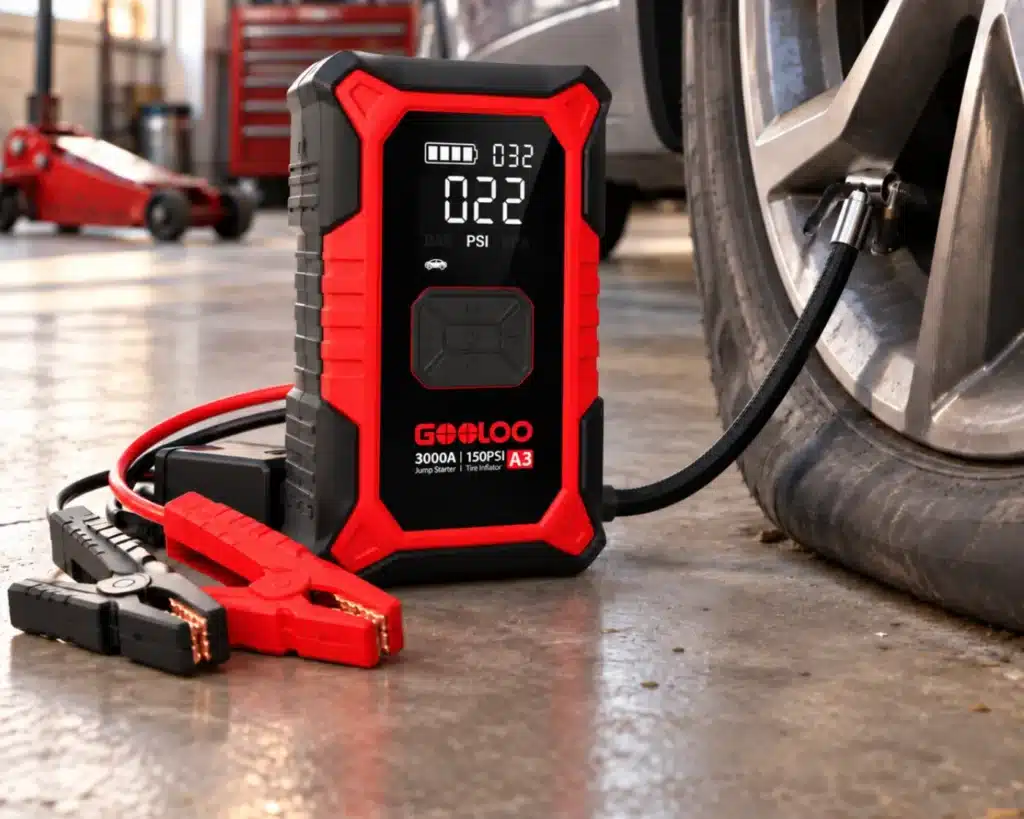
Who it is for. The A3 is for the driver who wants a compact box for a soft tire first and a dead battery second, drives a car or a small SUV and does not need a large power bank. It suits someone who values a manual that is open about starting current. It does not suit someone who wants independent proof, because we found no controlled test of this unit.
The compressor, first. The Amazon listing gives a pump that reaches 150 PSI at 35 liters per minute, with five inflation modes and five nozzles in the box, together with a pump tube. The listing also names a smart LED screen, tire pressure detection and auto shut-off.
In use, you attach the tube and the right nozzle, select the mode for what you are inflating (car, motorcycle, bicycle or ball), set the target pressure and start the pump, and it stops by itself at the target. Set the target from the label in your driver’s door jamb, and check with a separate gauge now and then, since we have no accuracy data for the built-in one.
What reports exist for the pump. Men’s Journal, in a review dated January 25, 2026, inflated four car tires in about 15 minutes, including getting to know the unit, with the built-in light also in use. The battery indicator fell by one of its four bars. The review does not give pressures, does not measure watt hours and does not test jump starting, and it does not say the tires started flat.
Air Tool Lab, on September 25, 2026, reports a Tesla Model 3 tire rising from 30 to 36 PSI in about a minute and a bicycle tire inflated, with no documented method. Together they say the A3 is a practical pump for topping up. They do not give a time from flat, a number of tires per charge or a duty cycle.
The battery behind the pump. The manual lists 44.4 watt hours, which is half of the 24Air’s 88.8. That battery covers inflation, jump starting and the light. We found no source that says how many tires one charge fills. The one data point is Men’s Journal’s four tires with one bar of four used, but a bar is not a watt hour, so treat it as a hint and not as a measurement.
As a jump starter. The title lists 3,000 peak amps, gasoline engines to 9 liters and diesel to 6.5. The manual calls the 3,000 the peak and lists a starting current of 400 amps, which is the honest number, and the WOLFBOX 4000A and 88.8Wh manual lists 1,000 for comparison.
GOOLOO’s tutorial page sets the limits: start within 30 seconds of the solid green LED, no more than three consecutive jump starts with two minutes between them and 30 minutes of cooling before you recharge. BOOST overrides some checks, so press it only after the cable is correctly connected.
Air Tool Lab reports a BOOST start of a car with an almost-dead battery on a chilly morning, without naming the vehicle or the temperature.
Where it fits. A compact or midsize car is the main use, with engines up to a few liters well inside the rating. A family car with a slow leak can be topped up in the driveway. A motorcycle or ATV is possible, and the listing names a motorcycle mode. Bicycles and balls work with the right nozzle. On a road trip, it replaces a jumper kit and a plug-in inflator.
The USB ports are slow: the manual lists a 5 volt, 2 amp USB-C input and a 5 volt, 2.4 amp USB-A output, which is ordinary phone-charging speed, so do not count on it as a laptop power bank.
What to watch. There is no controlled independent test. The sources do not state a weight or a dust and water rating, so check the listing. The manual asks for a recharge at least every three months in storage, and it warns that above 60 degrees Celsius the cells may be damaged, so do not leave it in a hot car. The Amazon dimensions are 4.96 by 5.87 by 2.3 inches. The warranty is 18 months, and the listing names Carku as the maker, with model number JS-506 in the manual.
Compared with the 24Air. The A3 is smaller, with half the battery, a slightly lower pump rating (150 PSI against 160), a lower flow (35 liters per minute against 45), phone-speed USB and a shorter warranty (18 months against 24). In its favor, its manual publishes a starting current, and it is the smaller box. It has no independent compressor timing at all.
A first session with it. Charge it fully before first use, as the manual says, and check that its own battery shows at least two bars before you ever jump a car. Inflate one tire to the door-label pressure and watch the target stop the pump, so you know how it behaves. Try the smart jumper cable and learn the solid green LED once in daylight. Then set a reminder for the three-month recharge, and if the unit has sat for months, check the battery bars before you rely on it for either job.
Why it stays in the guide. It is one of only two units on this site with a compressor, and its manual is the more candid of the two about starting current. Where the evidence is thin, as it is for the pump, we say so and label every report instead of filling the gap.
Choose it if you want a compact two-in-one for a car, mostly for topping up tires, and you accept that its numbers come from the maker.
Skip it if you want a larger battery and more independent coverage, in which case the 24Air is the other combo, or if you drive a large diesel or live in a hard freeze.
Read the full GOOLOO A3 review.
2. WOLFBOX MegaVolt 24Air: The Larger Combo

Who it is for. The 24Air is for the driver who wants a jump starter, a stronger pump and a power bank in one box, drives a gasoline car or SUV and has room for a bulkier unit. It is the combo with the most outside coverage, and it is the only compressor in this guide with an independent timing. It is not the lightest option, and its listing contradicts its own manual on two points.
The compressor, first. Amazon sells it as model MV24A, with a pump rated at 160 PSI and 45 liters per minute. The manual copy lists car, motorcycle, bicycle and ball modes, three nozzles and a 20 inch hose. The listing says it can inflate a pickup truck tire in 2.5 minutes, which is a claim we found no independent timing for.
You choose a mode, set the target pressure and the unit stops by itself. If the pressure does not reach 20 kPa in 50 seconds, the manual says to check for leaks, which in practice means the hose, the nozzle seal and the valve.
What reports exist for the pump. This is where the 24Air stands apart. Car and Driver, in Tested: The Best Portable Tire Inflators, updated February 17, 2026, timed it by name on a 245/50R20 tire on a Hyundai Santa Cruz, starting from 10 PSI: 3 minutes 12 seconds to 30 PSI and 6 minutes 10 seconds to 45 PSI.
It also measured 84.0 dBA of noise, a weight of 5.0 pounds and a 20 inch hose. The article names the model, not the ASIN or the revision, so we cannot say the tested unit is identical to the one on the Amazon listing. It is a compressor test only.
Popular Science, on February 11, 2026, topped off an SUV tire from 25 to 35 PSI in about a minute, and estimated three to five minutes for a flat tire, which is the author’s estimate. Its cons for the unit are that it is slightly heavy, that the hose can be short for some valves and that the light drains the battery in long use.
A DashcamTalk owner reports that the compressor ran to 3.3 bar without struggling and that it is not the quietest.
The battery behind the pump. At 88.8 watt hours (24,000 mAh), the 24Air holds twice the energy of the A3. That is the main reason it is the better match for several tires or a larger tire. We found no source that says how many tires one charge fills, and the Car and Driver numbers cover single inflations only.
As a jump starter. The listing gives 4,000 peak amps, gasoline to 10 liters and diesel to 6, and the manual copy says 10 for both. The manual lists no starting current. Popular Science reports starting a mid-size SUV in about 0 degrees Fahrenheit weather, a crossover, a six-cylinder pickup and a diesel Ford F-350 shop truck, without engine details for the F-350. MacSources used it on a 2013 Ford Escape and a 2019 Dodge Charger SRT Hellcat. The starting limit is eight starts in 10 minutes, then a 10 minute rest.
The two disagreements. Amazon’s title says diesel up to 6 liters and the manual copy says 10. Amazon says about 3.42 pounds, the manual copy 5.3 and Car and Driver 5.0. Plan around the lower diesel figure and check the weight yourself. The Amazon page also offers variants, titled “3000A + 65W Fast Charging,” “4000A + 65W Charger” and “4000A + 65W Fast Charging,” which we did not open, so match the variant to the specifications you read.
What to watch. The manual describes cold protection below 0 degrees Celsius that can stop the unit until it warms above 5, and heat protection above 55 that lifts below 45. The compressor is loud. MacSources lists no wall charger and no car charging adapter, and calls long-term durability unknown. The manual asks for a full charge every six months. The 65 watt USB-C port works in both directions, and MacSources reports about an hour to recharge at 65 watts.
The other ports. Amazon lists USB-C at 65 watts, USB-A at 12 or 18 watts and a 160 watt DC output, and the manual copy gives the DC output as 14 to 16 volts. The DashcamTalk owner reports a 15 volt DC output, which he would rather see at 12 to 13.5 volts, and an 8 hour timer on the USB ports that shuts the output off. Both are owner observations, not tests.
Compared with the A3. The 24Air has twice the battery, a faster pump on paper, a 65 watt USB-C port and a 24 month warranty, and it has the only independent compressor timing. It is bulkier, its listing disagrees with its manual and its manual does not state a starting current.
A first session with it. Charge it fully, and have a PD charger ready, because MacSources found no wall charger in the box. Check the exact variant you received against the listing you read. Inflate one tire to the door-label pressure with a separate gauge beside it, and learn BOOST and the cold lockout before you need them. If you keep it in a car in winter, bring it indoors between uses.
Where the evidence stops. Car and Driver’s times cover one tire and one starting pressure, and Popular Science’s estimate for a flat tire is the author’s own. No source gives a number of tires per charge, a duty cycle or a measured battery for this model. The 88.8 watt hours is the listing and the manual, not a lab figure, unlike the TechGearLab measurement on the no-compressor MegaVolt24, which we never apply here.
Choose it if you want one box for starting, inflating and charging, you drive a gasoline engine and you value independent coverage.
Skip it if you want the lightest unit, or if your engine is near the top of a combo’s diesel rating.
Read the full WOLFBOX 24Air review.
Head to Head: A3 or 24Air?
If you have already decided on a combo, the choice comes down to four questions.
How many tires, and how big? The 24Air has the larger battery and a faster pump on paper, and it has an independent timing on a large tire. For frequent inflation, for SUV or crossover tires and for a driver who wants margin, it is the safer pick. For occasional top-ups on a compact car, the A3’s battery is enough on the evidence we have, and the single report of four tires with one bar used is encouraging.
How much space and weight? The A3 is the smaller box. The 24Air is bulkier, and its weight is unresolved between 3.42, 5.0 and 5.3 pounds. If the unit lives in a small glove box or a motorcycle bag, size decides.
Which evidence do you trust? The 24Air has a timed compressor test, two hands-on reports and an owner thread. The A3 has two practical reports and a maker’s tutorial page. The A3’s manual states a starting current, and the 24Air’s does not.
Do you want the power bank? Only the 24Air has a 65 watt USB-C port. If you charge a laptop on the road, that settles it.
In short: the 24Air for the larger battery, the pump with independent coverage and the power bank, and the A3 for the smaller box and a stated starting current. The full comparison, with the Amazon and manual columns side by side, is in GOOLOO A3 vs WOLFBOX MegaVolt 24Air.
Winners by Situation
A compact car, mostly commuting. The A3 is enough: the engine is far inside its rating, the box is small, and a slow leak is the main tire job. If weight matters above all and you never inflate away from home, a GB40 and no compressor is lighter still.
A midsize SUV or crossover. The 24Air. The larger battery matters more with a bigger tire, and the 10 liter gasoline figure sits well above the engine. The A3 is possible for occasional top-ups.
A pickup or a large tire. The 24Air, with caution. The listing claims a pickup tire in about 2.5 minutes, but we found no independent timing, and Car and Driver’s number is for a passenger-car tire. A larger tire from a lower pressure takes longer. If your pickup has a large diesel, start from the jump starter, not the compressor, and add a separate inflator.
A diesel engine. Use the diesel column and add margin. The A3 lists 6.5 liters and has no controlled test. The 24Air lists 6 liters on Amazon and 10 in its manual, with an F-350 start reported by Popular Science and no engine details. A GBX155 and a separate inflator gives the most margin among our units.
A cold climate. We found no cold-weather evidence for either pump. The A3 lists operation to minus 20 degrees Celsius in its manual. The 24Air can stop below 0 until it warms. Keep either unit indoors in winter.
A road trip or remote work. The 24Air, for the 65 watt USB-C port, the larger battery and the power bank role.
A motorcycle, a bicycle or balls. Both list the modes. The A3 lists five nozzles and the 24Air three. Use the nozzle that fits.
A household with two cars. One combo can serve both, but a larger jump starter and a small inflator may be more flexible if the engines differ a lot.
A car that sits for months. Either unit, recharged on schedule: at least every three months for the A3 and every six for the 24Air.
Four Typical Buyers
These are typical situations, not real people.
The commuter with a compact car. Parks in a tight garage, drives a four-cylinder gasoline car, gets a soft tire in winter. The A3 covers both problems in one small box, and the engine is far inside the rating.
The family with an SUV. Two children, a midsize SUV, a weekend trip every month. The 24Air gives a larger battery for four tires and a 65 watt USB-C port for a tablet or laptop. The extra bulk fits a trunk.
The owner of a pickup or a diesel. The engine sits near the combo ratings. A combo is the wrong first step. Choose a jump starter with margin, such as the GBX155, and carry a small separate inflator.
The driver who already has a good inflator. Wants only a jump starter. A compact NOCO such as the GB40, or the GB70 for a larger engine, is lighter and simpler.
What a Combo Does Not Do
- It does not start a bigger engine because it has a pump. The documented engine rating does that, and no source we found tested the top of either rating.
- It does not tell you how many tires one charge fills. No source gives that number for either unit.
- It does not replace checking your pressure. We have no accuracy data for either built-in gauge, so check with a separate one now and then.
- It does not remove the need to charge. Both manuals ask for regular recharging, and a low battery limits the compressor and a jump start.
- It does not have a published duty cycle. If the pump gets hot, stop and let it cool.
- It does not prove reliability. We have no reliability data for either unit.
- It does not work the same way in the cold. The 24Air’s protection can stop it below 0 degrees Celsius until it warms above 5.
Common Mistakes
- Buying a combo for a large diesel. The documented diesel ratings are 6.5 liters for the A3 and 6 on the 24Air’s listing, and neither has a controlled diesel test.
- Reading PSI as speed. The 150 and 160 PSI figures are ceilings. Flow and the battery decide how a job goes.
- Expecting several large tires per charge. No source supports a number.
- Treating the reports as a race. The Car and Driver timing is for one tire, from one starting pressure, on one unit.
- Skipping the recharge schedule. A unit that has sat for months may be flat when you need it for either job.
- Believing the first number you see. The 24Air’s listing and manual disagree on diesel size and weight.
- Ignoring the cold. Cold protection can stop the 24Air until it warms, and cold also limits the battery.
- Leaving the unit in a hot car. The A3 manual warns that above 60 degrees Celsius the cells may be damaged.
- Pressing BOOST before the cable is connected. On the A3, press it only after the cable is correct.
A Simple Way to Choose
- Start with your engine. If it is near or above 6 liters of diesel, or you live in a hard freeze, choose a jump starter with margin and add a separate inflator.
- Decide how much you will inflate. For occasional top-ups on a compact car, the A3 is enough on the evidence we have. For frequent inflation or a larger tire, the 24Air has the larger battery and the only timing.
- Check the extras. If you charge a laptop on the road, you want the 24Air’s 65 watt USB-C port. If you want the smallest box, you want the A3.
Your Pre-Purchase Checklist
- What is my engine size, and is it gasoline or diesel?
- Do I need a compressor often, or only for a slow leak?
- Do I live where it gets very cold?
- Do I charge a laptop away from home?
- How much trunk space and weight can I accept?
- Which exact listing and variant am I on?
- Have I set a reminder to recharge the unit every three to six months?
- Do I know the connection light and the BOOST rule of my unit?
- Have I read the manual for the compressor modes and the leak check?
After the unit arrives, charge it fully, inflate one tire to the pressure on your door label and check it with a separate gauge. Practice the jump start connection once in daylight. Learning on a quiet afternoon is easier than on a dark roadside.
Where the Sources Disagree and What Is Still Unknown
| Unit | Disagreement or gap | What we do |
|---|---|---|
| 24Air | Diesel 6 L (Amazon title) against 10 L (manual) | Show 6 L first. Plan around it |
| 24Air | Weight 3.42 lb (Amazon) against 5.3 lb (manual and Popular Science’s spec list). Car and Driver weighed 5.0 lb | Show each figure with its source |
| A3 | No weight or dust and water rating in the sources we read | Check the listing |
| Both | No tires-per-charge figure and no compressor duty cycle | Say so instead of guessing |
| A3 | No controlled independent test of the unit | Rely on practical reports and label them |
Independent Evidence We Used
| Unit | Source and date | Type |
|---|---|---|
| 24Air | Car and Driver, updated 2026-02-17 (compressor timing, 245/50R20, from 10 PSI) | Independent timed test, model named |
| 24Air | Popular Science, 2026-02-11 | Hands-on |
| 24Air | MacSources, 2026-07-17 | Hands-on |
| 24Air | DashcamTalk, thread from 2025-11-09 | Owner report |
| A3 | Air Tool Lab, 2026-09-25 (one BOOST start, one tire top-up, no method) | Anecdotal |
| A3 | Men’s Journal, 2026-01-25 (four tires in about 15 minutes, indicator down one bar of four) | Practical report |
| A3 | GOOLOO tutorial page (start limits, charging, storage) | Maker |
| MegaVolt24 (no compressor) | TechGearLab, about 3 percent of the battery per jump start | Used for the 3 percent figure only, a different product |
Frequently Asked Questions
Is a combo better than separate tools?
It is more convenient. Separate tools are each lighter on their own, and each can be better at one job.
Which combo is better?
The 24Air has the larger battery and the only independent compressor timing. The A3 is the smaller box and publishes a starting current. See “Head to Head: A3 or 24Air?”.
How high does the pressure go?
150 PSI for the A3 and 160 PSI for the 24Air. Your tire needs the pressure on the door label, much lower.
How many tires can one charge fill?
We found no source that says. It depends on the battery, the tires and the starting pressure.
How long does it take to fill a tire?
Car and Driver timed the 24Air on a 245/50R20 tire from 10 PSI: 3 minutes 12 seconds to 30 PSI and 6 minutes 10 seconds to 45 PSI. A top-up of 6 to 10 PSI took about a minute in two reports. Your time depends on the tire and the starting pressure.
Does inflating drain the jump starter?
Yes. Recharge afterward so the unit can still start a car.
Can I use the compressor for bikes and balls?
Both list modes for them, with the right nozzle.
Is the built-in gauge accurate?
We have no accuracy data. Check with a separate gauge now and then.
Is the compressor loud?
Car and Driver measured 84.0 dBA on the 24Air. We have no measurement for the A3.
Does it work in the cold?
The 24Air’s protection can stop it below 0 degrees Celsius until it warms above 5. The A3 manual lists operation down to minus 20 degrees Celsius. Keep either unit indoors in winter.
Can I leave it in my car?
Do not leave it in a hot car. The A3 manual warns of cell damage above 60 degrees Celsius.
What if the compressor does not reach pressure?
The 24Air manual says to check for leaks if pressure does not reach 20 kPa in 50 seconds. Check the hose, the nozzle and the valve, and make sure the unit is charged.
Where to Go Next
- GOOLOO A3 review
- WOLFBOX MegaVolt 24Air review
- GOOLOO A3 vs WOLFBOX MegaVolt 24Air
- Jump Starter Air Compressors: PSI, Flow and Limits
- Portable Jump Starters
The Bottom Line
A combo is convenient for a gasoline car or SUV. The 24Air has the larger battery and more outside coverage, and the A3 is the smaller box with thinner evidence. PSI is a ceiling and flow is speed, but the battery is the real limit, and no source we read puts a number on it. If your engine is near or above a combo’s documented diesel rating, pick a jump starter with more margin and add a separate inflator. Where the numbers are missing, such as tires per charge, we say so instead of guessing.
Sources and How We Checked
For each compressor we read the Amazon listing, the maker’s manual and the independent reports that name the exact model. We label each number: Amazon listing, maker, hands-on report or owner report. Where a report is anecdotal, we say so. We do not claim to have run our own measurements on either unit.
- Amazon: GOOLOO A3 listing and WOLFBOX MegaVolt 24Air listing, titles and bullets read on 2026-10-29.
- GOOLOO A3 (JS-506) manual copy on ManualsLib. WOLFBOX MegaVolt 24Air manual copy: manuals.plus (third party hosts). GOOLOO A3 tutorial page (maker, read 2026-10-30): https://us.gooloo.com/blogs/tutorials/a3-jump-starter
- Popular Science, Wolfbox 4-in-1 Jump Starter with Air Compressor review, 2026-02-11: https://www.popsci.com/gear/wolfbox-4-in-1-jump-starter-with-air-compressor-review/
- Car and Driver, Tested: The Best Portable Tire Inflators (updated 2026-02-17): https://www.caranddriver.com/car-accessories/g42589683/best-portable-tire-inflators-tested/
- MacSources hands-on review of the WOLFBOX MegaVolt 24Air (2026-07-17), a LinkedIn repost with a link on record: https://www.linkedin.com/pulse/wolfbox-megavolt-24-air-4-in-1-jump-starter-compressor-review-8zetf/
- DashcamTalk thread (owner report): https://dashcamtalk.com/forum/threads/wolfbox-megavolt-24air-jump-starter-with-air-compressor.57990/
- Air Tool Lab, GOOLOO A3 review, 2026-09-25: https://airtoollab.com/gooloo-a3-12v-3000a-jump-starter-review-reliable-portable/
- NikkTech, GOOLOO A3 and GT4000S review, 2026-01-22: https://www.nikktech.com/main/articles/gadgets/car-motorcycle/16136-gooloo-a3-gt4000s-jump-starters-review
- Men’s Journal, GOOLOO A3 review by John Alexander (2026-01-25), practical report: https://www.mensjournal.com/shopping/gooloo-a3-jump-starter-tire-inflator-review
- TechGearLab, WOLFBOX MegaVolt24 (no compressor), used for the 3 percent figure only: https://www.techgearlab.com/reviews/tools/jump-starter/wolfbox-megavolt24