Car Emergency Kit Checklist: Where a Jump Starter Fits
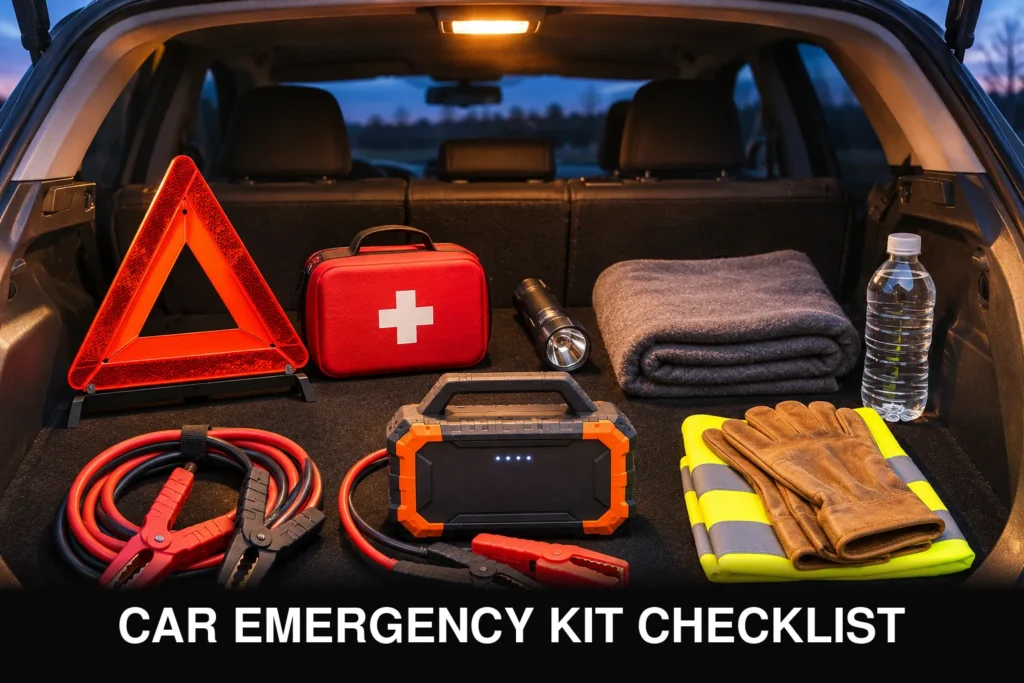
Quick answer: Public preparedness sources list a short set of items for a car: a way to restart a dead battery (jumper cables), a way to be seen (reflective triangle or flares), light, a phone charger, warmth (blankets and clothing), an ice scraper, water and food, a map and sand or cat litter for traction. A portable jump starter can fill the place of the cables, and the units we cover also charge a phone. The kit is only as good as its upkeep: a jump starter that is flat and a flashlight with dead batteries are the usual failures. Check the kit twice a year, and add what your climate and your trips need.
Pick your situation
- I want the list: read “The Basic List”.
- I want to know where the jump starter goes: read “Where the Jump Starter Fits”.
- I drive in winter: read “Cold-Weather Additions”.
- I want to keep it ready: read “Keeping the Kit Ready”.
The Basic List
Two public sources we read agree on a core set.
Ready.gov, the US government’s preparedness site, lists for a car: jumper cables, flares or a reflective triangle, an ice scraper, a car cell phone charger, a blanket, a map, and cat litter or sand for traction. It also advises keeping the gas tank full and having a mechanic check the car’s battery, brakes, lights and oil before an emergency.
The Pennsylvania Emergency Management Agency lists supplies for a car as: blankets and clothing, an ice scraper, food and water, jumper cables, a flashlight with extra batteries, local maps, a phone charger, and cat litter or sand. It advises keeping a gas-powered vehicle’s tank at least half full, because gas pumps may not work in an emergency.
Combined, the list is:
| Item | Why |
|---|---|
| Jumper cables, or a jump starter | Restarts a dead battery. See below |
| Reflective triangle or flares | To be seen by other drivers |
| Flashlight and extra batteries | Light for the car and for work at night |
| Phone charger | To keep a phone alive |
| Blanket and warm clothing | A stalled car loses heat |
| Water and food | For a long wait |
| Ice scraper | For visibility in winter |
| Map | Phones and signals fail |
| Sand or cat litter | Traction on ice or snow |
The two lists are public safety guidance, not tests. Neither says how often a given item is needed.
Where the Jump Starter Fits
Both public lists name jumper cables. A portable jump starter does the same job without a second vehicle, and the comparison is in Jump Starter or Jumper Cables. What matters for a kit:
- Cables are a “never-flat” item, but they need another running vehicle. A jump starter works alone, but it must be charged.
- A jump starter covers a second item on the list. The units we cover have USB ports, listed at about 2 amps, so they can charge a phone. Phone charging draws on the battery you need for starting, so use it sparingly.
- Some units add a light and a compressor. The units we cover include a built-in light, and two include an air compressor. They are conveniences, and the compressor is covered in Jump Starters with Air Compressors.
- Carry the manual or a photo of its key pages. The start limits and the connection order are the details people forget under stress. See How to Read a Jump Starter Manual.
- Know the steps before you need them. How to Jump Start a Car explains the order.
If you are choosing a unit, What Size Jump Starter Do I Need? explains how.
Where to Keep It
- Not in a hot trunk in summer and not in a freezing car in winter. The A3 manual warns that cells may be damaged above 60 degrees Celsius, and NOCO says to keep its unit indoors when it is not in use. The ranges are in How to Store and Recharge a Jump Starter.
- Within reach. A kit under a pile of luggage is a kit you will not use.
- Contained. A box or a bag keeps items from sliding. One of the summaries we read suggests a plastic container in the trunk or back seat.
Cold-Weather Additions
Winter lists in the summaries we read add an ice scraper and snow brush, warm clothes and blankets, hand warmers and a small folding shovel. Ready.gov and the Pennsylvania agency both list the scraper, and the Pennsylvania list adds blankets, clothing and food. A winter kit also benefits from a jump starter that is stored indoors until the trip, as in Jump Starters for Cold Climates.
Other Items Worth Considering
These appear in summaries of other lists we read, and we did not verify them in a primary source. They are options, not a requirement.
- A first aid kit and any medication you need, with expiry dates checked.
- Basic tools, a jack and a lug wrench for the spare tire, with the spare’s pressure checked now and then.
- A tire gauge and an air pump, covered in the compressor guide.
- A fire extinguisher.
- A power bank for the phone, kept separate from the jump starter. See Jump Starter vs Power Bank vs Portable Power Station.
- Some cash in small bills, in case a card reader fails.
Keeping the Kit Ready
A kit goes stale. Three habits keep it useful.
- Review it twice a year. One summary we read suggests a reminder every six months. Pair it with the clock change.
- Charge the jump starter on a schedule. The manuals we read ask for a recharge every three to six months, and the A3 manual wants at least two bars before a jump.
- Replace what ages. Flashlight batteries, water and food, and medicines have dates.
Test the battery itself before the seasons that stress it, as in Signs Your Car Battery Is Failing. A kit helps after a failure, and a test can prevent it.
What a Kit Does Not Do
- It does not replace roadside assistance. If the vehicle will not start after a jump, or you are not comfortable, call for help.
- It does not make an unsafe place safe. On a busy road, being seen and being out of the traffic come first.
- It does not cover hybrids and EVs specially. Their low-voltage battery and jump-start rules depend on the vehicle. See Jump Starting a Hybrid or Electric Vehicle.
What We Cannot Tell You
- The AAA kit list. The page could not be opened, and we do not rely on it.
- Which items are most often needed. Neither public source gives data.
- Legal requirements. Some places require a warning triangle or a first aid kit. Check your local rules.
- We do not claim to have run our own measurements on any unit.
Frequently Asked Questions
What should be in a car emergency kit?
Ready.gov lists jumper cables, flares or a reflective triangle, an ice scraper, a phone charger, a blanket, a map and sand or cat litter. The Pennsylvania agency adds food, water and a flashlight.
Do I need a jump starter if I have jumper cables?
Cables need a second vehicle. A jump starter works alone but must be charged. Many drivers who worry about being stranded carry both.
How often should I check my kit?
Twice a year is a common suggestion in the summaries we read, and the jump starter’s charge every three to six months.
Where should I keep it?
Within reach, in a container, away from extreme heat or cold.
Can I charge my phone from a jump starter?
Many units can. It draws on the battery used for starting.
Is a first aid kit necessary?
It appears on many lists. We did not verify it in a primary source.
The Bottom Line
A short kit covers most breakdowns: a way to restart the battery, to be seen, to see, to stay warm and to stay connected. A jump starter can serve as the restart tool and the phone charger, if it is charged. Check the kit twice a year, store it where heat and cold will not harm it, and add what your climate and trips need.
Sources and How We Checked
We read the public lists below and the maker documents for the units we cover. We do not claim to have run our own measurements.
- Ready.gov, Car emergency preparedness (kit items, tank, mechanic check): https://www.ready.gov/car
- Commonwealth of Pennsylvania, Ready PA, Gather Supplies (vehicle supplies, half-full tank): https://www.pa.gov/en/agencies/ready/get-prepared/gather-supplies.html
- Search summary on 2026-11-02 of checklists from insurers and auto sites (Lemonade, Dubizzle, Carproof, Caterpillar, CLEARRoads and others) for the optional items and winter additions. The AAA page returned only a partial result and 403 when opened, and is not relied on.
- NOCO Boost X GBX155 User Guide, June 26, 2024 (keep indoors): https://no.co/media/wysiwyg/downloads/User_Guides/Boost_X/GBX155_User_Guide_06.26.2024.pdf
- Manual copies for the GOOLOO A3 (JS-506) and WOLFBOX units (MegaVolt 24Air and MegaVolt24 V1.0) on third-party hosts.