Jump Starters for Motorcycles, Boats, ATVs and Tractors: What to Check Before You Use One
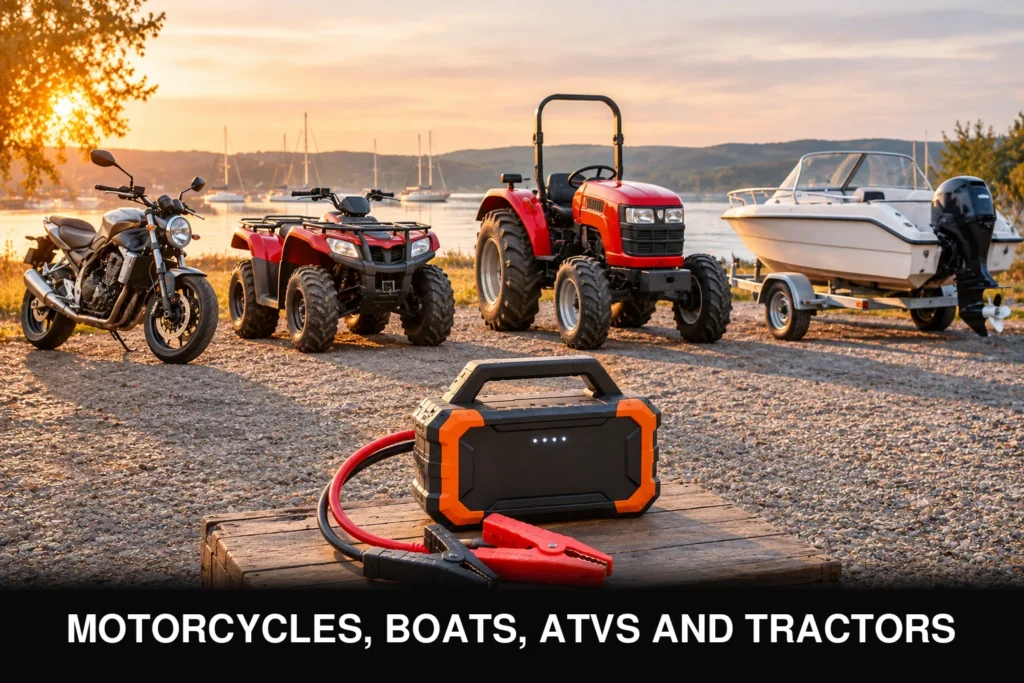
Quick answer: A jump starter made for cars may or may not be suitable for a motorcycle, a boat, an ATV or a tractor, and the answer is in two documents: the jump starter’s manual and the vehicle’s manual. Check four things. First, the battery voltage must be the voltage the unit is made for, which for the jump starters we cover is 12 volts. Second, the battery type and size, because a small motorcycle battery and a large marine battery are different jobs. Third, whether the vehicle’s maker allows jump starting at all, since some do not recommend it. Fourth, the setting: a boat has fuel vapors, and the engine compartment needs ventilation before anything is connected. We found no maker document for the units we cover that addresses these vehicles, so this guide is a set of checks, not an approval.
Pick your situation
- A motorcycle or scooter: read “Motorcycles”.
- A boat or a personal watercraft: read “Boats”.
- An ATV, a side-by-side or a lawn tractor: read “ATVs, Tractors and Mowers”.
- I want the checklist: read “Five Checks”.
What Is Different From a Car
Three things change when the engine is not in a car.
The battery is a different size. A motorcycle battery is much smaller than a car battery. A large marine or tractor battery can be bigger. A unit made to start a large engine is not necessarily gentler on a small battery, and we found no maker document that says how its unit behaves on one.
The battery type may differ. Boats may carry starting batteries, deep-cycle batteries or both. Some motorcycles use lithium batteries. The type changes what is safe to connect. We read this only from search summaries of vendor and enthusiast pages, and those sources disagree in detail.
The vehicle’s maker may have a position. A search summary of Harley-Davidson service material says that the company does not recommend jump starting a motorcycle but gives a procedure for cases where it is necessary, and that both vehicles must have the same battery voltage. We could not open the service pages (access denied), so we cannot quote the wording. Check your own manual.
Motorcycles
What the sources we found agree on, from search summaries of retailer and blog pages, is limited:
- Match the voltage. The jump starters we cover are specified for 12 volt batteries, and the NOCO GBX155 guide says its unit is for 12 volt lead-acid batteries only. Most modern motorcycles use 12 volts. Some older ones do not, and if yours is 6 volt, see the voltage and polarity checks in Jump Starters for Classic and Rarely Driven Cars.
- Lithium motorcycle batteries need care. Several sources our search returned warn that a jump starter not suited to a lithium battery can damage it, and one forum thread discusses a jump starter that cannot be used on lithium batteries. We did not read a maker document stating whether the units we cover accept a lithium motorcycle battery.
- Use a connection the manual allows. Do not improvise. One source suggests using a car with its engine off as a source, and another says the donor engine should be off. We did not verify either.
If your motorcycle is hard to start because the battery is weak, a charger or maintainer is often the better tool. The distinction is in Jump Starter vs Battery Charger vs Maintainer.
Boats
A boat adds a hazard that a car does not have to the same degree: fuel and battery vapors in an enclosed space. We could not open the Yamaha or other engine manuals the search summary points to, and the summary reports:
- Ventilation first. Yamaha manuals advise opening the engine compartment hatch for several minutes before a jump start if the blower will not run, and warn that sparks could ignite battery or fuel vapors. Battery Tender is reported to suggest running the blower for at least four minutes before any electrical work near the engine. These come from summaries and we did not read the manuals.
- Starting versus deep-cycle batteries. A retailer page is reported to say that starting batteries are generally safe to jump and that deep-cycle batteries should not be jump started. Treat that as unverified.
- Cable order differs by manual. A Yamaha manual is reported to warn against connecting the last clamp to the dead battery’s negative terminal, which matches the car guidance we read at AAA, and a forum thread describes attaching it to a metal part of the boat. The sources differ, so follow the engine manual.
- Chemistry settings. One retailer page is reported to say that the battery chemistry setting on the jump starter should match the battery. The units we cover do not list such a setting in the documents we read.
The practical point for a buyer: a jump starter sold for cars should be checked against the engine maker’s manual before it goes near a boat, and a marine battery charger or a maker-approved marine jump starter may be the better answer. We do not recommend a marine unit.
ATVs, Tractors and Mowers
Our search found no usable source on ATVs, side-by-sides or tractors. What we can say:
- The same checks apply: voltage, battery type and the maker’s instructions.
- A garden tractor’s battery is small, and a farm tractor’s can be large and may be 12 volt or something else. Look at the label.
- The owner’s manual decides. If it describes jump starting, use its connection points.
- Do not assume a diesel rating transfers. The diesel guide covers road vehicles: Jump Starters for Diesel Engines, Pickups and Vans.
Five Checks
- Voltage. The battery and the system are the voltage the jump starter is made for.
- Battery type. Starting, deep-cycle, lead-acid or lithium, and whether the maker of the jump starter and of the vehicle allow it.
- The vehicle manual’s position. Some makers do not recommend jump starting. If so, do not.
- The setting. Fuel vapors on a boat, dust and fuel on farm equipment. Ventilate and follow the manual.
- The unit’s limits. Start limits, temperature range and recharge interval, as in How to Store and Recharge a Jump Starter.
Does Carrying One Unit for Everything Work?
A single 12 volt unit is attractive if you own a car, a motorcycle and a boat, and it may work for some of them. For each vehicle, the question is not the rating but the checks above. A unit that is safe on a car battery is not automatically safe on a small lithium battery, and a unit used on a boat needs the ventilation habit. If you cannot confirm a use in a manual, treat the use as unconfirmed.
What We Cannot Tell You
- Whether the units we cover are approved for motorcycles, boats, ATVs or tractors. We found no maker statement.
- Whether they are safe on lithium vehicle batteries. No maker document we read says.
- The exact wording of the Yamaha, Harley-Davidson and other manuals cited by search summaries. We could not open them.
- Anything about 6 volt or 24 volt equipment. See Jump Starters for Classic and Rarely Driven Cars and Jump Starters for Diesel Engines, Pickups and Vans.
- We do not claim to have run our own measurements on any unit.
Frequently Asked Questions
Can I use a car jump starter on a motorcycle?
Possibly, if the battery is 12 volt and the motorcycle’s maker allows it. Some makers do not recommend jump starting. We found no maker statement for the units we cover.
Can I jump start a boat with a portable jump starter?
Many people do. The engine maker’s manual decides the connection, and ventilation of the engine compartment comes first. Deep-cycle batteries are reported to need special care.
Is it safe to jump a lithium motorcycle battery?
Several sources warn that a jump starter not suited to lithium can damage the battery. Check both manuals.
Do I need a different jump starter for a tractor?
Check the battery voltage and size, and the tractor’s manual. We found no usable source for tractors.
Is a charger better for a motorcycle?
For a weak battery on a bike that is stored, often yes. See Jump Starter vs Battery Charger vs Maintainer.
Can I use my car to jump a motorcycle?
Some sources say yes with the car’s engine off, and some manufacturers do not recommend jump starting. Check the motorcycle manual.
The Bottom Line
A jump starter for cars is a 12 volt device, and the vehicle’s maker decides whether it may be used on a motorcycle, a boat, an ATV or a tractor. Check voltage, battery type, the vehicle manual and the setting, and treat any use you cannot confirm in a manual as unconfirmed. Our sources for these vehicles are thin, and we would rather say so than guess.
Sources and How We Checked
We cover jump starters and do not rate marine, motorcycle or farm equipment. We do not claim to have run our own measurements.
- Search summaries on 2026-11-02 of Harley-Davidson service procedures (access denied), Yamaha engine manuals on ManualsLib, Battery Tender, Batteries Plus, Cobra, Redway, WIS-TEK, Motobatt and enthusiast forums. None of these pages could be opened directly, and every statement taken from them is marked as reported.
- NOCO Boost X GBX155 User Guide, June 26, 2024 (12 volt lead-acid batteries only): https://no.co/media/wysiwyg/downloads/User_Guides/Boost_X/GBX155_User_Guide_06.26.2024.pdf
- AAA Oregon/Idaho, Jump Starting Your Car Battery (last clamp on bare metal, not the dead battery’s negative terminal): https://info.oregon.aaa.com/jump-starting-your-car-battery-a-safe-and-easy-guide/