Workshop Booster or Portable Jump Starter: Which One Fits a Garage?
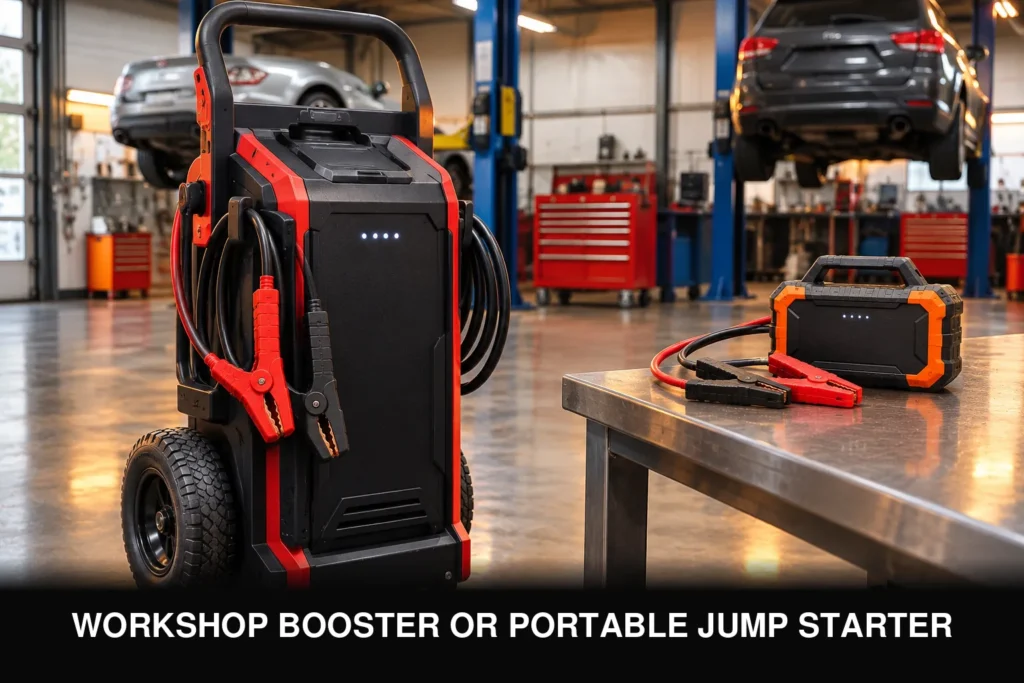
Quick answer: A portable lithium jump starter fits an owner, a mobile mechanic or a garage that starts the occasional vehicle. A larger workshop booster, usually a wheeled unit fed from a mains outlet or a large battery, is the tool a busy garage looks at when vehicles need starting many times a day, when heavy vehicles or 24 volt systems are involved, or when the unit is used all day in one place. The deciding questions are how many starts you need per day, what vehicles you start, whether the unit has to leave the building, and who keeps it charged. We cover portable jump starters on this site and do not rate workshop boosters, so this guide gives the questions, not a product.
Pick your situation
- I run a small garage and start the occasional customer car: read “The Occasional Start”.
- A vehicle needs starting several times a day: read “The Daily Load”.
- I work on trucks, vans or 24 volt vehicles: read “Vehicle Types”.
- I want the questions to ask any supplier: read “Questions to Ask Before You Buy”.
What We Mean by the Two Tools
A portable jump starter is a lithium battery in a case with its own cables, as in the rest of this site. It is carried by hand, and the units we cover list a weight from 1.65 pounds for the unit alone to about 5 pounds or more.
A workshop booster is the name we use here for a larger starting unit meant for a workshop, often on wheels. The sources we found describe such units as fed by a mains charger or as lead-acid based, rated for 12 and sometimes 24 volts, with larger clamps and cables, and marketed for heavy daily use. A search summary reports one trolley unit combining a 40 amp mains charger with a jump starter for 12 and 24 volt lead-acid vehicles, and another heavy-duty booster that lists about 4,000 amps of starting current, weighs close to 20 kilograms and recharges from a running engine. Those figures come from vendor listings that we could not open directly, and we do not endorse any product.
What is not a workshop booster: a battery charger or a maintainer. They restore or hold a battery over hours, and the difference is in Jump Starter vs Battery Charger vs Maintainer.
What Limits a Portable Unit in a Workshop
The limits that matter for a garage are the ones that the manuals print.
- Start limits. The NOCO GBX155 guide allows five starts in 15 minutes, the GOOLOO A3 tutorial three in a row two minutes apart, and the WOLFBOX 24Air eight in 10 minutes. The units cool down between attempts, and their makers say so. These limits are written for a driver on the road, not for all-day use.
- Charge between uses. A lithium unit is used until it runs low and then charged. TechGearLab measured about 3 percent of a unit’s battery per start in one test, and its guide notes that higher usable capacity means more jump starts between charges. The usable capacity is lower than the label claims.
- Heat. The units list temperature protection, and a unit used repeatedly in a warm workshop is in the range where those protections work. The manuals ask for a cool-down. The A3 tutorial says to let the unit cool for 30 minutes after jump starting before charging it.
- Voltage. The units we cover are for 12 volt batteries.
- A rated continuous output. We found no maker document for the units we cover that states a continuous or daily rating, only peak amps and start limits. TechGearLab, in the guide we used, notes that jump starters are utility tools better suited to being kicked around in the back of a work truck, and says of one model that it is not meant for repeated consecutive boosts.
None of this means a portable unit cannot work in a garage. It means the limits above were not written for a shop that starts vehicles all day, and the buyer has to count.
The Occasional Start
If a garage starts a customer vehicle now and then, a portable unit is the practical answer. It reaches the vehicle wherever it is parked, needs no cable run, and can be moved between bays. The habits matter more than the hardware: charge it on a schedule, keep it out of heat, and put it away in the same place. See How to Store and Recharge a Jump Starter.
The Daily Load
If vehicles need starting many times a day, count the starts and compare them with the start limits and the recharge time of the unit. A wheeled unit fed from the mains, or a pair of portable units rotated while one charges, are the two solutions that the workshop world uses according to the summaries we read. A fixed or wheeled unit does not run out in the middle of the day, which is the main appeal. It also needs a place, an outlet and upkeep. We cannot rank the two from independent data.
A related point is the cause. A shop that needs to start many vehicles a day may have a different problem: customer cars that arrive with flat batteries. The causes are in Why Does a Car Battery Die?, and a test is better than repeated jumps, as in Signs Your Car Battery Is Failing.
Vehicle Types
- Cars and light vans. Portable units are rated far above these engines. See What Size Jump Starter Do I Need?.
- Diesel pickups and larger vans. The ratings thin out and the evidence is limited. See Jump Starters for Diesel Engines, Pickups and Vans.
- 24 volt trucks and buses. The portable units we cover are 12 volt devices. A workshop that handles 24 volt vehicles needs equipment whose maker names 24 volts. The search summaries describe workshop boosters with 12 and 24 volt modes, and we have not verified any.
- Hybrids and electric vehicles. The low-voltage battery and its jump-start rules depend on the vehicle. See Jump Starting a Hybrid or Electric Vehicle.
Questions to Ask Before You Buy
- How many starts per day, on average and on the worst day?
- What is the largest engine, and is any vehicle 24 volt?
- Does the maker state a continuous or repeated-use rating, or only peak amps?
- How long does it take to recharge, and is there a spare?
- Does the unit have to leave the building, or does it stay at one bay?
- Who is responsible for charging and checking it? A unit with no owner goes flat.
- What do the clamps, cables and protections look like, and who replaces them if they wear?
- Does the maker’s document cover workshop use, or only consumer use? A consumer manual does not promise daily duty.
If a supplier cannot answer 3 and 8 in writing, treat the unit as a consumer tool.
What We Cannot Tell You
- Which workshop booster to buy. We do not rate them.
- How many starts a day a portable unit can take. No maker document we read gives a daily rating.
- Anything from our own workshop experience. This guide uses maker documents and published sources only. We do not claim to have run our own measurements on any unit.
- Specifics of the workshop boosters mentioned. They come from search summaries of vendor pages that we could not open.
Frequently Asked Questions
Can a portable jump starter be used in a garage every day?
The documents we read give start limits and cool-down times for each unit, and none gives a daily rating. For occasional use it is fine. For many starts a day, count them against the limits.
What is the difference between a workshop booster and a portable jump starter?
A workshop booster is usually larger, often mains-fed or on wheels, and made for heavier or more frequent use. A portable unit is a hand-carried lithium pack.
Do I need a 24 volt unit?
Only if you handle 24 volt vehicles. The portable units we cover are 12 volt.
Is a bigger unit always better for a garage?
Not necessarily. Rating matters for large engines, but a garage’s real limit is usually the number of starts and the charging routine.
Should a garage start a car with a jump starter or fix the battery?
Both. A jump gets the car moving, and a test finds the problem.
Are there rules for using a jump starter around customers’ vehicles?
Follow the vehicle maker’s manual and the jump starter’s manual. Hybrids and EVs often have specific instructions.
The Bottom Line
For an owner or a mobile mechanic, a portable lithium unit is enough. A garage that starts many vehicles a day should count the starts, check the maker’s duty statements and consider a larger unit built for it. We cover the portable class and cannot rank workshop boosters, so use the questions above and ask for written answers.
Sources and How We Checked
We cover portable jump starters and do not rate workshop boosters. We do not claim to have run our own measurements.
- TechGearLab, Best Jump Starters (utility tools, lithium packs hold charge, a model not meant for repeated consecutive boosts, usable capacity; updated 2026-04-29): https://www.techgearlab.com/topics/tools/best-jump-starter
- NOCO Boost X GBX155 User Guide, June 26, 2024 (start limits; 12 volt): https://no.co/media/wysiwyg/downloads/User_Guides/Boost_X/GBX155_User_Guide_06.26.2024.pdf
- GOOLOO A3 tutorial page (maker, read 2026-10-30; start limit, cool-down): https://us.gooloo.com/blogs/tutorials/a3-jump-starter
- Manual copies for the WOLFBOX units (MegaVolt 24Air and MegaVolt24 V1.0) on third-party hosts.
- Search summary on 2026-11-02 of vendor listings for workshop trolley boosters and professional lithium boosters. None of the pages could be opened, no product is named in the text and no specific figure is relied on beyond what is attributed.